
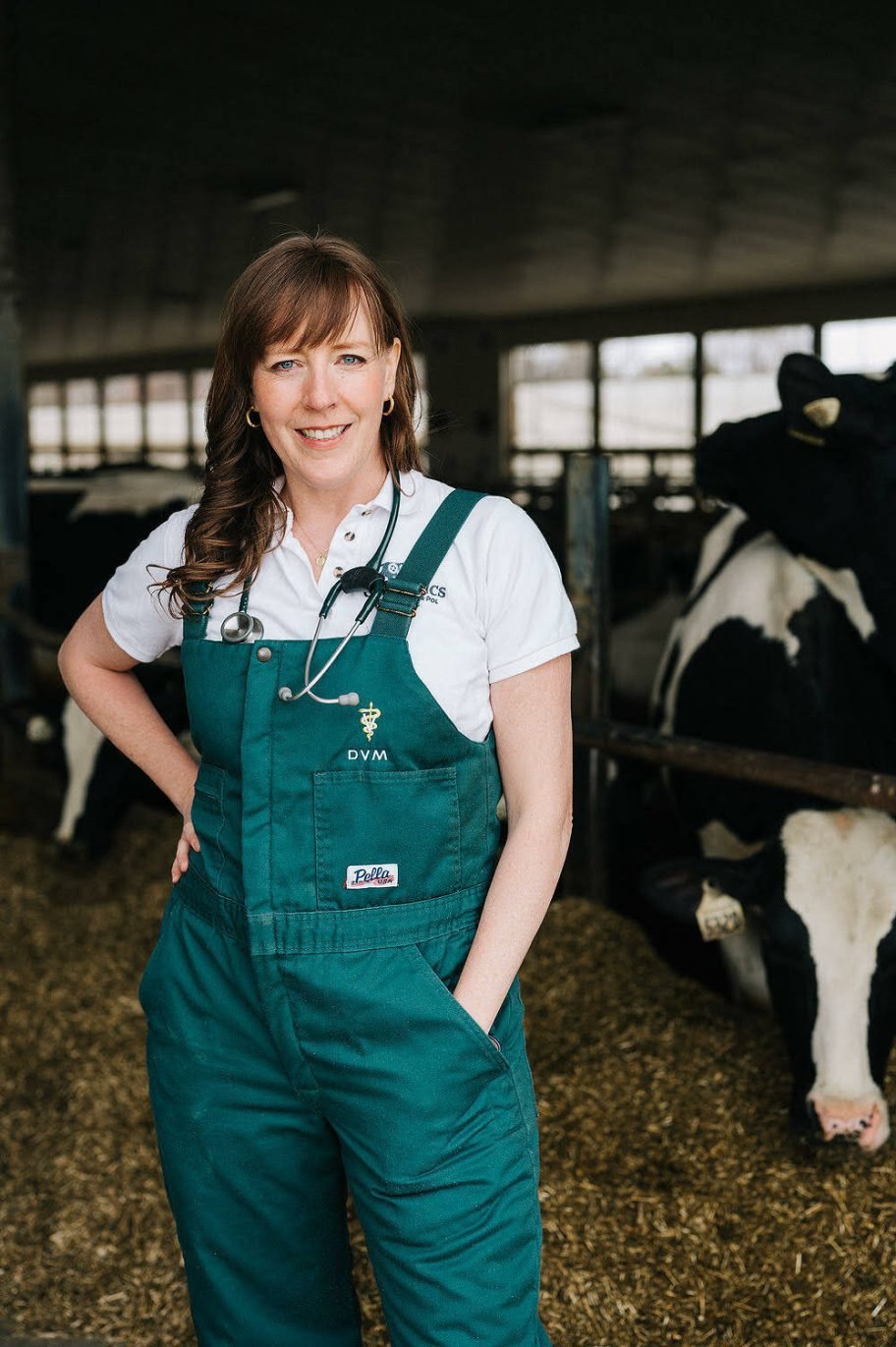
As part of our year-long series highlighting the women who have shaped and continue to shape Canada’s agriculture sector, Glacier FarmMedia sat down with Dr. Shari van de Pol, a computer engineer turned large-animal veterinarian, who brings a rare combination of technical expertise and hands-on agricultural knowledge to solve on-farm challenges with her tech platform, CATTLEytics.
In 2014, van de Pol incorporated CATTLEytics with a clear mission: to build software that actually works in the barn, not just the boardroom.
| Founder | Dr. Shari Van de Pol — a computer engineer turned large-animal veterinarian |
| Started | 2014 as a consulting practice; its own dairy platform launched around 2021. Bootstrapped, no outside investors |
| The product | Dairy management software that integrates with tools farms already use, such as Afimilk and Lely |
| Customers | From family farms to some of the largest dairies in North America, and increasingly Europe |
| What’s next | International expansion, a “Dairy Digital Twin” simulation model and CowPilot, a plain-English AI assistant |
What prompted you to launch CATTLEytics? Was that always the plan?
The truth is, CATTLEytics wasn’t always the plan. When I went into engineering, I saw it as a good career, good job, good salary. I started in computer engineering at McMaster, did data mining work in Northern Ireland, then spent years at IBM followed by writing software for critical infrastructure (atomic reactors at Chalk River, Ontario Power Generation). But I knew I wanted to make a change. I was spending time with veterinarians. I fell in love with the whole concept of biology and business. I returned to school for veterinary medicine but, for a long time, they felt like two separate lives.
What changed (for me) was seeing the world as a vet and seeing how much information farmers had that they couldn’t actually use. Every farmer has rich data — milking systems, parlour records, breeding software, lab results — but it’s scattered across half a dozen tools that don’t talk to each other. Farmers were making seven-figure decisions on gut (feeling) and spreadsheets. I kept thinking, I know exactly how to fix this.
We started in 2014 as a consulting practice. Feedlot Health (now part of TELUS Agriculture) was our first big client, and that work really helped us gain our footing and grow our team. The dairy platform – which was our own product – started around 2021 and seriously in 2023. So, no, the plan wasn’t to build an ag-tech company from day one. It was to solve a problem I kept running into and the company built itself around the solution.
What has been the response from farms? Are they mostly young farmers more likely to incorporate technology in their operations or are senior farmers just as enthusiastic?
It’s been wonderful, and it surprises me almost every week. We work with everyone from family operations to some of the largest dairies in North America, and increasingly in Europe. The assumption people make is that it’s the younger generation pulling technology onto the farm, and there’s some truth to that.
But it’s relative whether it is a young new farmer or a seasoned older one. They are using technology whether they think they are or not. Some farmers are using WhatsApp messenger. If there are things to be done by employees relating to cows’ needs, at the end of the day did that issue get done? We saw some farms using this, but it can be time-consuming and things can get lost or missed. We decided to make it simpler so farmers can have all the information right away, so they know things are done.
We made a schedule specifically for the dairy farmer. We document all the data. Some of our most enthusiastic users are senior farmers who’ve been at it for 40 years. Once they see how much time the platform gives them back — one of our farmers told us we’d given him “two hours each day back” — they don’t need convincing. What they care about isn’t whether something is new or Al powered. They care about whether it is straight forward and helps them do their job. When it does, they’re all in.
There’s an idea that farming is a conservative, traditional occupation and that some farmers are unwilling to change how they do things. What do you see in terms of how willing farmers are to incorporate more technology into their operations? Has it been a welcome, easy transition or a struggle?
I love this question because the stereotype really doesn’t match what I see in barns.
Farmers are conservative about change for change’s sake — and they should be. A bad decision on a dairy farm can cost real money. But they’re not technology averse. Most modern dairy farms are already running robotic milking, automated feed pushers, activity monitors and sort gates. The barn is one of the most sensored environments most people will ever stand in.
What farmers resist is technology that doesn’t respect their time, their judgment or their existing systems. That’s why we built CATTLEytics to integrate with what farms already use, for example, Afimilk, Lely, genetics data, herd management data, rather than ask anyone to rip and replace.
Sometimes, when I go to a dairy farm, I’ll see a whiteboard with to-do things listed. But do they get done? To make things easier, we created a digital whiteboard. It has all the posted information with a history of what you did. Some people put weather on the board and other information to track and watch. There may be specific information on each cow and their pregnancies. Everyone is on the same page.
One of our software areas has to do with calves. In dairy farms with calves, they often have a whiteboard and an Excel spread sheet. But these systems can sometimes inadvertently lose information. With the price of calves today, any calf lost is a loss of money, something farmers can’t afford.
Farmers have protocols but are they being followed all the time? By everyone? If a cow requires medication, is it being given on time? With our system, if you see a calf that looks poorly, you can add an alert for it to be watched more carefully. With the software managing the workflow, it is a more secure way to ensure the animal needing attention is not ignored.
When a cow gives birth … we make a custom lactation model … with a lot more detail. It adjusts for feed changes. Does this affect milk output? There’s the cost of the changes. It answers a farmer’s question: Am I making money? Maybe halfway through lactation a farmer is moving to a cheaper feed but losing money. We simplify this. We put the information out there in a simple way.
Artificial intelligence is icing on the cake. The cake is your people, your farm, your data, organized so they all make sense in one place, in your hand. (With that) the transition isn’t a struggle. It’s a relief.
Your company is highly solution oriented. Can you share thoughts on the value of data-driven solutions helping farmers deal with issues efficiently?
The clearest way to explain it is the math problem nobody talks about. One farmer is often responsible for hundreds or thousands of cows. There is no human eye that can watch that closely. The technology is there to be a second set of eyes, to make sure the cow that needs help gets noticed.
Here are a few examples:
- A cow’s milk production drops two pounds three days in a row. That’s not something a person scanning the barn would catch, but our system flags it and the farmer can intervene before she’s clinically sick.
- A new employee starts on the farm and has the core knowledge generated automatically into a welcome platform. It has details on their specific tasks in their own language with audio files to accompany the text, multiple choice quizzes and ties to real on-farm data.
- Breeding success drops. The platform knows and all the follow-up questions as to why are already pursued with answers given.
- Somatic cell count starts trending the wrong way. The herd manager sees it on Monday instead of finding out three weeks later when the milk cheque drops.
One of our clients saved roughly $6,000 a month just from cleaner communication and 15 minutes saved here and there. As mentioned earlier, another farm manager got back one to two hours every day. The value is catching the small things early and giving people their time back.
Is there a balance between a farmer’s instinct/wisdom and state-of-the-art technology that can tweak the farmer’s knowledge without threatening their core beliefs or values?
This is the heart of it, and it’s something I feel strongly about. The intelligence is in the farmer. That’s a design principle. Farmers know things about their cows that no algorithm will capture — the way she stands at the bunk, her gait and mentation, the sense if something is wrong with the herd. Years spent every day with these cows in the barn builds a judgment that’s irreplaceable.
What technology does is augment that judgment — surface the data point the farmer didn’t have time to look up, flag the cow they haven’t walked past yet today, do the math on which group to treat, or if feed changes aren’t working.
CATTLEytics is built to make the farmer’s life easier, not be in charge. They are the ones in charge. We’re the tool in the hand. The farms that get the most out of the platform are the ones whose owners and managers stay deeply engaged with their cows and use our system to extend their reach. The technology isn’t a replacement for their wisdom. It’s a force multiplier for it.
Is CATTLEytics only for dairy farms or could it be applied to other farms?
Right now, dairy is our centre of gravity. We built the platform specifically for the complexity of modern dairy operations. Dairy is uniquely data-rich and demanding. You’ve got individual cow records, daily milking events, reproduction cycles, lactation curves, milk component data, regulatory traceability. By building software that handles dairy well, you’ve solved a very hard problem.
That said, the underlying architecture wasn’t built in a way that locks us into dairy forever. The data model handles individual animals and group events so that gives us possibilities of future extension.
We are a relatively recent Canadian company and we keep focused. Being a vet, going to farms and watching how people do things but from a technical point of view, many things can come up. I knew, if we did this better, it would really help the farmer.
(For example), when registering calves, farmers must go online to access the software. Ours does this automatically. It’s much easier. When I talk to farmers about it, they say “sign me up right away!”
What’s next?
There are some (upcoming opportunities) I’m genuinely excited about. International expansion is real and happening. We already have farms in Europe where they are showing strong product-market fit. There’s a global appetite for software that respects how farmers actually work. We’re going to keep meeting it.
On the product side, we’re investing heavily in our Dairy Digital Twin, a complete digital model of a farm that lets producers simulate decisions as they make them. Imagine being able to test a feed change or a breeding strategy on a virtual version of your herd before committing to it. That’s the future of dairy management, and we’re building it now.
And, of course, AI. We have a conversational layer, ‘CowPilot’, that lets farmers and their teams query their own data in plain English. No custom database connections, no reports menu. Just ask.
Beyond that, we want to keep being a Canadian company that builds for the world. We’ve been bootstrapped from day one, no outside investors, and that has let us build deliberately, for farmers, with farmers. We’re going to keep doing exactly that. For now, our focus is being one of the top three dairy platforms in the world.
The post From atomic reactors to dairy barns: the vet behind CATTLEytics appeared first on Farmtario.


