
Google is stepping up its water stewardship as AI drives data center growth. The company has pledged $60 million to new water projects in the U.S. Its goal is to achieve water positivity across data center operations by 2030. This means Google aims to replenish more freshwater than it uses while also supporting water quality and ecosystem health.
This effort builds on a water strategy launched in 2021. At that time, Google aimed to use water wisely, replenish what it uses, and enhance watershed health in its operational areas.
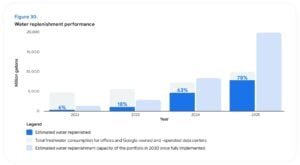
The challenge is growing as Google’s data center footprint expands. The company consumed 10.9 billion gallons of water in 2025. This is a 34% increase from the previous year and over twice its 2021 usage.
Google Replenished 78% of Its Water Use in 2025
Despite rising use, Google has grown its water replenishment efforts.
- In 2025, its projects replenished about 7.7 billion gallons of water, or roughly 78% of its consumption. This is up from 63% in 2024.
During the year, Google added 54 projects, boosting its total to 165 across 97 watersheds. The company estimates these projects could replenish over 19.7 billion gallons annually by 2030 when fully operational.
Google measures replenishment benefits using the Volumetric Water Benefit Accounting 2.0 method through a third-party partner. It counts projects in watersheds linked to its operations with confirmed benefits.
The new funding will help expand Google’s projects to 12 states, including five new initiatives in:
- Ohio
- Indiana
- Arizona
- Oklahoma
- Virginia
These projects address local water challenges rather than just offsetting consumption.
In Arizona, Google supports removing culverts to restore natural streamflow for Apache trout. In Indiana, it collaborates with Fort Wayne City Utilities to improve water reuse and cut withdrawals from the St. Joseph River.
An Ohio project will enhance agricultural drainage through H2Ohio. In Oklahoma, Google is removing invasive Eastern Red Cedar trees and restoring native wetlands. In Virginia, stormwater filtration systems will improve water quality in the Chesapeake Bay and Roanoke River watersheds.
AI Is Increasing the Water Challenge
Google’s progress comes as AI drives rapid growth in computing.
AI servers use a lot of electricity and generate heat. Many data centers rely on evaporative cooling systems, which need water to remove heat.
- In 2025, Google’s freshwater consumption rose by 37% due to expanding data centers for AI and other services. The company expects its water use to keep increasing.
This presents a tough sustainability challenge. Google must speed up its replenishment projects to match rising demand while ensuring meaningful benefits in the watersheds where it operates.
- This issue goes beyond Google’s operations. Estimates suggest that the water footprint from data center electricity could reach 9.3 trillion liters by 2030.
Data centers often locate in areas with attractive land, electricity, and tax incentives. Unfortunately, these spots can overlap with water-stressed regions, leading to competition for water among data centers, households, agriculture, and industry.
Consequently, water availability is becoming a pressing concern for investors, regulators, and local communities. Companies may face more scrutiny when seeking approval for large data center projects, especially in water-scarce areas.
Water Positive Does Not Mean Water Use Is Low
The term “water positive” is increasingly common among tech companies.
Google, Microsoft, Meta, and Amazon have all set water stewardship or replenishment targets tied to their data centers. These commitments help address concerns about the environmental impact of infrastructure supporting cloud computing and AI.
However, replenishing water doesn’t mean a data center has low consumption.
A better approach starts with reducing freshwater needs. Companies can use air cooling, closed-loop systems, and reclaimed water to limit withdrawals. Then, they can enhance water efficiency per computing unit before investing in replenishment.
The location of these projects matters too. Replenishing water far from stressed watersheds may show measurable benefits but doesn’t tackle local water challenges caused by a data center.
This is why Google’s focus on projects within connected watersheds is crucial. Its projects aim to combine water replenishment with improvements to water quality, biodiversity, and community water security.
Google’s Climate Impact Is Also Growing
Water is just one part of the environmental challenge from AI infrastructure growth.
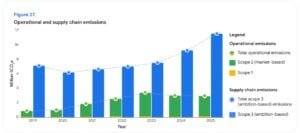
Google reported about 14.5 million metric tons of carbon emissions in 2025, an 18% rise from 2024. Much of this increase came from supply chain activities supporting rapid business growth.
- However, it also estimates its decarbonization efforts avoided over 58 million metric tons of CO2e in 2025.
Clean energy purchases played a big role in these avoided emissions. Google estimates that its clean energy buys prevented about 57 million metric tons of CO2e from 2012 to 2025, including around 12 million metric tons in 2025.
These figures highlight the broader sustainability challenge for AI companies. Efficiency improvements and clean energy can lessen the environmental impact of computing capacity, but rapid growth can still push overall resource use higher.
Water Stewardship Could Become a Competitive Advantage
Google’s expansion of its water investments shows how strategically important water is becoming for tech companies.
As AI infrastructure grows, companies will need more electricity, cooling, land, and water. Responsible management of these resources could be key for securing permits, gaining community support, and meeting investor demands.
For Google, the aim is more than just replenishing water used by its facilities. The company is linking its investments to watershed restoration, water quality, and ecosystem health.
The next challenge will be whether these efforts can keep up with AI’s rapid expansion.
Google’s 2030 target is to replenish 120% of the freshwater it uses in its offices and data centers. Achieving this will require ongoing investment, better water efficiency, and projects that deliver measurable benefits to local communities.
As AI changes the tech industry, competition may shift from just computing power to also include who can build infrastructure while minimizing pressure on natural resources.
- FURTHER READING: Microsoft Becomes Water Positive Ahead of 2030 Goal With AI-Powered Data Center Innovation
The post Google Commits $60 Million to Water Projects as AI Data Center Demand Grows appeared first on Carbon Credits.


