

Google and ReNew Energy Global have signed a long-term agreement to develop a 150 megawatt (MW) solar power project in Rajasthan, India. This is another step for major tech companies to get clean energy and cut emissions. The project will start operations in 2026. It will boost renewable capacity in one of India’s fastest-growing clean energy markets.
Google will buy environmental attributes from the solar plant. This will help the company tackle emissions in its value chain, also called Scope 3 emissions. The project will generate clean electricity that adds to India’s broader goal of building a cleaner, more reliable energy system.
Vrushali Gaud, Global Director of Climate Operations at Google, remarked:
“Clean, affordable electricity is central to our growth ambitions, both for our own infrastructure and for our value chain this novel agreement with ReNew is a critical strategic step; it brings new solar capacity onto the grid in a key region, and helps address challenging portions of our value chain emissions. We are committed to supporting India’s clean energy journey through this collaboration and contributing and contributing positively to the national grid.”
How Environmental Attributes Power Corporate Climate Goals
The solar scheme will have a capacity of 150 MW. It is expected to generate around 425,000 megawatt-hours (MWh) of electricity each year after it starts in 2026. This amount of power is enough to meet the annual electricity needs of more than 360,000 households in India.
Even though the project is medium-sized compared to India’s largest solar parks, it is important. This is because it connects to a long-term commercial agreement. The sale of environmental attributes helps make the project financially viable. Long-term procurement deals provide revenue certainty. This certainty is key to financing and building renewable projects.
The agreement also expands ReNew’s portfolio of corporate clean energy contracts. By late 2025, its commercial and industrial renewable capacity will be around 2.7 GW. This shows strong interest from corporate buyers in India’s clean energy market.
India’s Solar Market: Rapid Growth and Scale
India’s solar energy sector has grown significantly over the past decade and continues to expand rapidly. As of early 2025, total installed renewable capacity in India exceeded 180 GW, with almost half coming from solar and wind power. Solar alone accounted for 119 GW of that renewable base—about 63% of the country’s total renewable capacity.
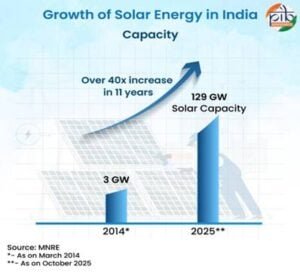
The Government of India wants to achieve 500 GW of non-fossil fuel capacity by 2030. This goal has boosted investment and encouraged private sector involvement in solar projects nationwide. The country added a record 22 GW of renewable capacity in the first half of 2025, further showing strong growth momentum.
Industry forecasts project continued expansion. India’s solar energy market is expected to grow from about 122.5 GW in 2025 to nearly 295.8 GW by 2030. This shows an annual growth rate of around 19%. This growth is driven by policy support, falling technology costs, and increasing demand for clean power from industry and households.
Why Google Is Betting on Clean Energy in India
Google’s deal with ReNew highlights a trend. Big companies are increasingly securing renewable energy directly. Tech firms like Amazon and Microsoft have made big clean energy deals worldwide. They aim to meet climate goals and power energy-heavy operations, such as cloud data centers.
Google buys environmental attribute certificates to help reach its goal of using 100% carbon-free energy by 2030. The solar project helps Google show that it generates clean energy in India. It may also offset emissions beyond what it directly uses.
The project also contributes to reducing Scope 3 emissions, which include indirect emissions in a company’s value chain. Many corporations find that direct renewable energy procurement helps address emissions they cannot eliminate through internal operations alone.
Google’s Clean Energy Procurement
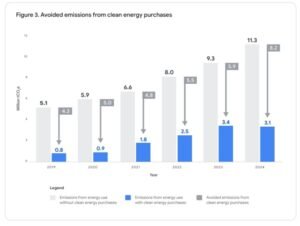
Google is one of the world’s largest corporate buyers of clean energy. From 2010 to 2024, the company signed more than 170 clean energy contracts, totaling over 22 gigawatts (GW) of capacity. These deals include solar, wind, and other clean power sources across many regions.
In 2025, Google continued expanding its clean energy supply. Other clean energy deals in 2025 include:
-
A 15-year renewable supply contract in the United States for about 1.5 terawatt-hours (TWh) of clean electricity from a large solar plant in Ohio.
-
A corporate wind power purchase agreement in Belgium to reduce roughly 27,000 tons of CO₂ emissions per year.
-
Renewable energy progress in Ireland that will help data centers reach 60% carbon-free energy on an hourly basis in 2025.
Google’s long-term goal is to use 100% carbon-free energy every hour of the day by 2030. Clean energy procurement remains a central part of this strategy as electricity demand continues to grow.
India’s Broader Renewable Energy Landscape
India stands as one of the world’s fastest-growing renewable energy markets. The country is currently ranked among the top global producers of renewable power. It ranks third globally in solar power generation and fourth in total renewable energy installed capacity. This reflects the rapid expansion of solar and wind capacity in recent years.
Solar power has experienced particularly strong growth. India surpassed the 120 GW solar capacity milestone in 2025, a notable benchmark toward the 2030 renewable goals. Annual additions continue to track high, with utility-scale deployments making up the majority of solar capacity.
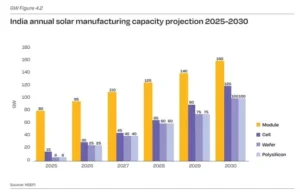
India is boosting its solar manufacturing capacity. This move is key to cutting costs and ensuring supply chain security in the long run. Solar module capacity is expected to hit 160 GW by 2030, while cell manufacturing capacity might grow to 120 GW. This would greatly strengthen the local industry and cut down on imports.
In addition to large utility projects, states such as Rajasthan and Gujarat lead in installation and policy support. Rajasthan alone holds over 37 GW of installed renewable capacity, making it one of the country’s key hubs for solar energy.
Looking Ahead: India’s Renewable Energy Trajectory
Despite strong growth, India’s solar market faces challenges. A lot of renewable energy capacity is still in development and not yet running.
The country also needs to expand its transmission infrastructure. This will help ensure reliable power delivery across regions. Some projects face delays due to regulatory and land acquisition issues. This can push commissioning past the planned timelines.
Financing and grid integration also remain areas of focus. India is moving toward higher renewable energy targets. Energy storage and hybrid solutions, which mix solar with wind or storage systems, are becoming popular.
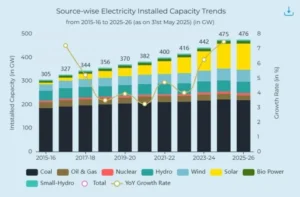
Moreover, investing in battery energy storage systems helps balance the energy supply. This improves grid stability, especially during peak demand times.
Even with these hurdles, India’s solar sector outlook remains strong. Analysts expect steady growth for the rest of the decade. And solar energy will keep driving clean energy capacity expansion. Policy support and corporate off-take agreements like Google’s will play an important role in shaping this trajectory.
The post Google Joins ReNew Energy for 150 MW Solar Project in India to Cut Scope 3 Emissions appeared first on Carbon Credits.


