

Google is expanding its renewable energy portfolio in Oklahoma through a new 15-year power purchase agreement (PPA) with German energy company RWE. Under the agreement, Google will purchase all of the electricity generated by RWE’s 155-megawatt (MWac) Crooked Creek Solar project in McCurtain County, Oklahoma.
RWE Expands Solar Presence in Oklahoma
Ingmar Ritzenhofen, Chief Commercial Officer, RWE Americas:
“This agreement with Google marks an important milestone for RWE Americas and reflects the growing demand for affordable, reliable, domestically produced energy. Crooked Creek Solar demonstrates how strategic partnerships can accelerate new energy development while creating jobs, generating local tax revenue and strengthening communities. We’re proud to work with Google to help power its operations, while supporting Oklahoma’s continued economic growth with affordable, American-made energy.”
Crooked Creek Solar will be RWE’s first solar project in Oklahoma. The company already operates the 148 MW Boiling Springs wind project in Woodward County.
The company plans to begin construction on the project later this year. Crooked Creek Solar is expected to start commercial operations in 2028.
Once online, the solar project will supply electricity to support Google’s operations in the Southwest Power Pool (SPP) market. At the same time, it will create jobs, generate tax revenue, and provide long-term economic benefits for communities in southeastern Oklahoma.
RWE also has six additional power projects totaling about 1.6 gigawatts (GW) in development across the state.
The company expects Crooked Creek Solar to create up to 250 jobs during peak construction. Construction activity is estimated to generate around $24.3 million in local economic activity.
The project is also expected to provide about $1.4 million in state and local tax revenue during construction.
Once the solar facility begins operating, its economic impact will continue. RWE estimates that Crooked Creek Solar could generate approximately $25 million in revenue over its operating life for local programs, emergency medical services, the Broken Bow School District, and regional technology education centers.
These benefits are becoming increasingly important as communities seek to attract new investment while expanding local power infrastructure. It has also contributed more than $100,000 through donations, sponsorships, and community partnerships in Oklahoma.
Google Continues to Secure Clean Power
For Google, the new PPA is part of a broader strategy to secure more electricity from clean energy sources.
The company has been increasing its renewable energy purchases as its electricity needs rise. Data centers supporting cloud computing and AI require large, reliable power supplies.
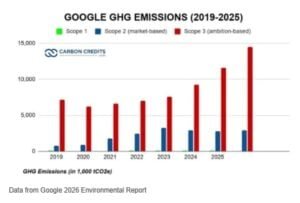
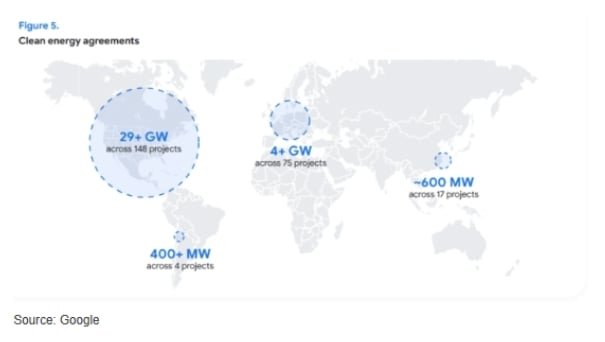
In 2025, Google signed agreements for more than 12 GW of new clean energy capacity. The company also launched more than 25 energy projects that added nearly 2 GW of new carbon-free electricity to the grids serving its operations.
At the same time, Google reported progress in reducing emissions from its own operations.
- Its combined Scope 1 and market-based Scope 2 emissions declined by about 2% in 2025 to roughly 2.9 million metric tons of carbon dioxide equivalent (CO2e). That marked the second consecutive year of lower operational emissions.
Google is also working toward matching 100% of its annual electricity consumption with renewable energy purchases.
The company’s approach is increasingly focused not only on buying renewable energy but also on bringing new clean power projects onto electricity grids.
Oklahoma Becomes a Major Google Investment Hub
The Crooked Creek agreement comes as Google increases its investment in Oklahoma.
The company has announced plans to invest $9 billion in the state to expand its cloud and AI infrastructure. The investment includes the development and expansion of data center infrastructure needed to support growing digital services.
Google has also secured another major solar PPA in Oklahoma this year. In May, the company signed a 15-year agreement with Enlight to purchase electricity from a 200 MW solar project.
Together, these agreements show how Google is using long-term power contracts to support the electricity needs of its growing operations.
For renewable energy developers, deals with major technology companies can also provide long-term revenue certainty. PPAs typically allow developers to secure a buyer for their electricity over many years, helping support financing and construction of large-scale projects.
Data Centers Are Driving Electricity Demand
The timing of these agreements is significant because electricity demand from data centers is rising rapidly.
AI applications require powerful computing systems, and those systems consume large amounts of electricity. As companies expand AI infrastructure, they are looking for additional power supplies that can operate reliably while also helping them meet emissions targets.
A new BloombergNEF (BNEF) analysis shows just how fast that demand is growing. It projects that data centers could consume about 20% of all U.S. electricity by 2035, up from 5.9% today.
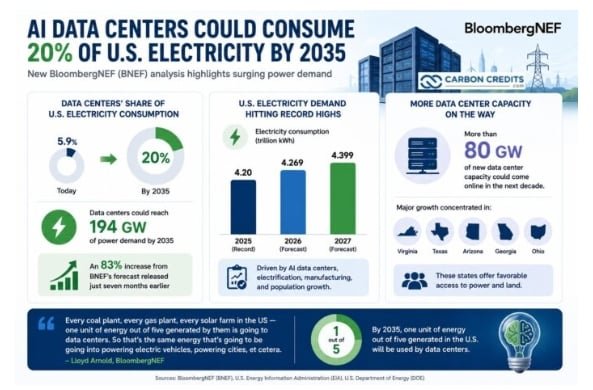
Over the coming years, the country will therefore need substantial new generation capacity to meet this growing demand.
This is pushing companies such as Google, Microsoft, and Meta to secure electricity through long-term agreements with renewable energy developers. These contracts can help companies manage power needs while adding more clean generation to the grid.
However, renewable energy is only one part of the solution. Data centers require electricity around the clock, while solar and wind generation changes with weather and time of day.
As a result, companies and utilities are increasingly looking at a combination of solar, wind, battery storage, nuclear power, and other flexible generation resources.
Solar Takes Center Stage in U.S. Power Growth
Solar power is expected to play a major role in meeting the country’s growing electricity needs.
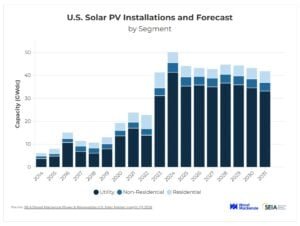
The U.S. solar industry installed about 7.8 GWdc of solar capacity during the first quarter of 2026. Solar also accounted for around 60% of new U.S. electricity-generating capacity additions during the quarter, according to Energy Information Administration (EIA) data.
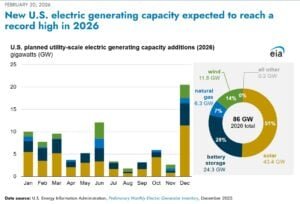
- According to SEIA, the country’s total solar capacity is now around 210 GW, while solar generates roughly 8% of U.S. electricity.
More importantly, developers are adding tens of gigawatts of new solar capacity each year. This makes solar one of the fastest ways to bring additional electricity generation onto the grid.
For technology companies, solar PPAs can therefore provide access to large amounts of new electricity while supporting the expansion of renewable generation.
RWE Plans Major U.S. Energy Investment
RWE is also making the United States a major part of its global growth strategy. The company currently has approximately 13 GW of installed generation capacity across 27 U.S. states. Its portfolio includes solar, onshore wind, and battery storage projects.
- By 2031, RWE plans to invest a net €17 billion in the U.S. This represents nearly half of its planned global investment of €35 billion.
The company expects these investments to add around 9 GW of new generation capacity, taking its total U.S. installed capacity to approximately 22 GW.
Alongside renewable energy, RWE plans to develop flexible generation capacity, including gas-fired peaking plants. These facilities can provide additional power when electricity demand is high and help support grid reliability.
The company’s U.S. strategy comes after RWE agreed to a $1.22 billion settlement with the U.S. Department of the Interior involving the relinquishment of several offshore wind leases.
Despite this change in its offshore strategy, RWE continues to invest in U.S. energy infrastructure, particularly projects that can respond to rising electricity demand.
Google’s Clean Energy Push Reflects a Bigger Shift
The Crooked Creek Solar PPA shows how renewable energy is becoming increasingly important to the technology sector.
Google needs more electricity to support its cloud and AI expansion. At the same time, the company is under pressure to control emissions from its growing operations. And long-term renewable energy agreements offer one way to address both challenges.
As U.S. electricity demand continues to rise, projects like Crooked Creek Solar could become increasingly important.
The broader trend is clear: major technology companies are becoming some of the largest buyers of new clean power, while energy developers are responding with bigger solar, wind, storage, and other generation projects.
Google’s latest agreement with RWE is another example of that shift, linking the rapid growth of AI and data centers with the expansion of America’s renewable energy infrastructure.
The post Google Signs 15-Year Solar PPA With RWE for 155 MW Oklahoma Project appeared first on Carbon Credits.


