
A four-year study of the Greater Golden Horseshoe region is helping grain and oilseed farmers maximize soil health, crop returns and water management.
Why it matters
Row-cropping fields using at least one soil health management practice made gains toward matching untouched reference areas, according to the study.
The study sampled crop and vegetation types two to six weeks after planting, in corn, soybeans and other crops, to be measured against “references,” such as fencerows, wooded areas, hayfields, meadows and orchards.
“The goal of this was to sample at a time when there weren’t many field operations, but also to capture soil health at the time when it’s really vital to that growing plant,” explained Jenny Bower, a Soil Health Institute research soil scientist, during the Greenbelt Foundation’s regional soil health event in Wellington County, July 14.

Baseline measurements
The non-cultivated references were selected because they “max out those soil health principles,” said Bower, who led the study, providing a “ceiling” of how far soil can improve under soil health management protocols.
Ryan Carlow, Greenbelt Foundation program lead, said providing scientific soil health data to support farmers in implementing best management practices was a key goal of the study.
“You can’t manage what you can’t measure,” said Carlow. “We also understand the importance of the ground that we live and farm on, and we want to keep the land prosperous. To do that, our soils must be healthy.”
The study logged 117 samples from 40 farms in the Niagara and Hamilton region, 97 samples from 48 farms in the York, Durham and Kawartha Lakes region and 71 samples from 25 farms in the Halton, Peel and Wellington region.
When it comes to common management practices, Bower said, there is variability throughout the regions.
Management practices
“In terms of management practices within this (Halton, Peel, Wellington) region, we found that 86 per cent of growers of the fields we sampled included winter wheat in the rotation, and 51 per cent use one or more cover crops, 22 per cent use organic amendments and 23 per cent are strict no-till,” she said.
In the Niagara and Hamilton region, 68 per cent of producers use winter wheat in their rotation, 58 per cent use one or more cover crops, 43 per cent use organic amendments and 32 per cent are strict no-till.
In York, Durham and Kawartha Lakes, 54 per cent of producers use winter wheat in the rotation, 43 per cent use one or more cover crops, 49 per cent use organic amendments and 32 per cent are strict no-till.
Out of the diverse management practices, Bower highlighted four to show a range and how soil health management isn’t based on any one single practice.
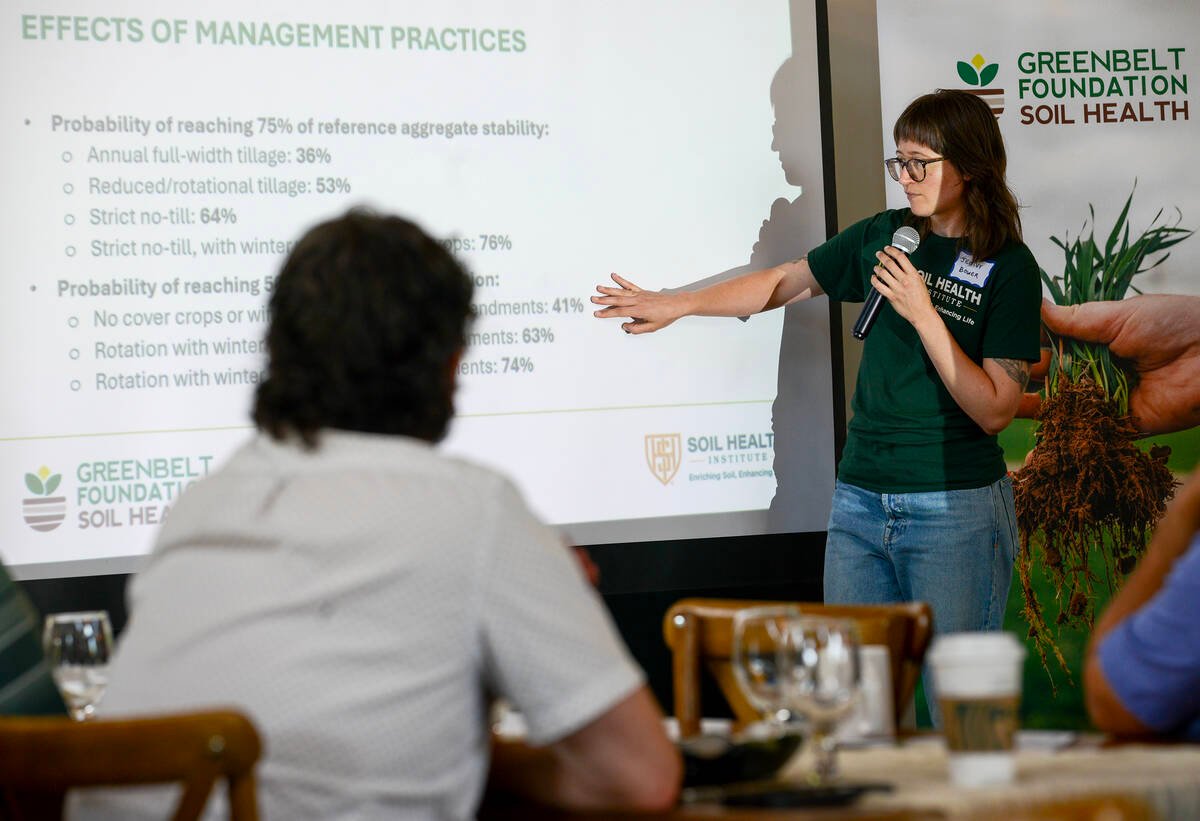
Additionally, Ontario’s glacial landforms and diverse soil types contribute to soil property variation, which influences soil health indicators and expression, she said.
For example, a five-metre-deep sandy soil is going to perform differently than a soil that is 15 centimetres deep on top of bedrock.
“The water movement is going to be very different, the organic matter build-up,” Bower explained. “We’re farming water, in a way, by improving our soil health … and improving a whole lot of other soil functions.”
Soil type variability
Each region’s diverse common row-cropped soil types and drainage efficiency impacts soil health management efficacy and the speed at which improvements are achieved, or not.
In the Halton, Peel, Wellington and the Niagara-Hamilton regions, the study sampled 31 common soil samples; in York, Durham and Kawartha Lakes, it was 24.
All soils were grouped based on similar texture and drainage and analyzed based on measured texture for soil health indicators — soil organic carbon, active carbon, aggregate stability, respiration and potentially mineralized nitrogen.
“The reason for measuring all of these indicators is that they capture different soil functions,” she said, including efficient nutrient cycling, water retention and drainage, support plant production and livestock, stability against erosion, pest, pathogen and disease resistance, helping plants grow despite stress events.
After analyzing indicator-related data across a range of soil types, the researchers chose a sandy loam and a clay loam to measure a range of row crop practices against the soil references over the four years.
Soil health gains
“We were able to see improvements from our conventional to reference, which is, of course, expected because those are maxing out our soil health principles,” she said. “But we also found differences in all five of our indicators from implementing soil health practices.”
When comparing the conventional to the reference on aggregate stability index for maximum soil health, Bower said one could “expect 74 per cent higher organic matter, 44 per cent higher active carbon, 51 per cent aggregate stability, a lot of increase in respiration (28 per cent) and potentially mineralizable nitrogen (39 per cent), 30 per cent higher available water holding capacity and 37 percent higher organic carbon stocks.”
- Organic matter: 74% higher
- Active carbon: 44% higher
- Aggregate stability: 51% higher
- Respiration: 28% higher
- Potentially mineralizable nitrogen: 39% higher
- Available water holding capacity: 30% higher
- Organic carbon stocks: 37% higher
Source: Soil Health Institute, comparing conventional row-crop fields to non-cultivated reference areas
While soil health practice numbers weren’t as dramatic, there was improvement, with six per cent higher organic matter, seven per cent active carbon, 16 per cent aggregate stability, 28 per cent high respiration, 39 per cent potentially mineralizable nitrogen, 12 per cent high water holding capacity and two per cent organic carbon stocks.
Improvement milestones
Bower said these soil health practices could only have been implemented within the last five years and increases realized on a long-term agricultural research site take longer to build.
“What I found really powerful is some of our row crop farmers are reaching those reference aggregate stability values, and that is really powerful, right?” Bower said. “Because going into this, I didn’t think that row crop farmers could get to a soil structure capacity of a fence row or a pasture, but that is what our data seems to indicate.”
In aggregate stability data, corrected for soil type, the study found three-quarters of the continuously no-tilled fields achieved the 75 per cent of the reference goal, compared to rotationally tilled fields at 50 per cent of and tilled fields at 40 per cent annually.
Bower advised farmers to test in the spring, two to six weeks after planting, every three to five years after implementing new soil health BMPs, comparing high and low yielding field areas, to see if there is improvement.
“We are shifting the needle,” Bower said. “These increases might look small, but I would say, talk to some of the farmers and they’re noticing real differences in their soils.”
The post Greater Golden Horseshoe region study shows soil health practices are paying off appeared first on Farmtario.


