
 See more visuals like this on the Voronoi app.
Greenland vs. Iceland: What’s the Difference?
See visuals like this from many other data creators on our Voronoi app. Download it for free on iOS or Android and discover incredible data-driven charts from a variety of trusted sources.
Key Takeaways
- Greenland is more than 20 times larger than Iceland by land area, yet has a population one-seventh the size.
- Iceland outperforms Greenland economically, with a much higher GDP, longer life expectancy, and a more diversified economy.
Iceland and Greenland are often confused due to their similar names, but they differ dramatically in geography, climate, population, and political status.
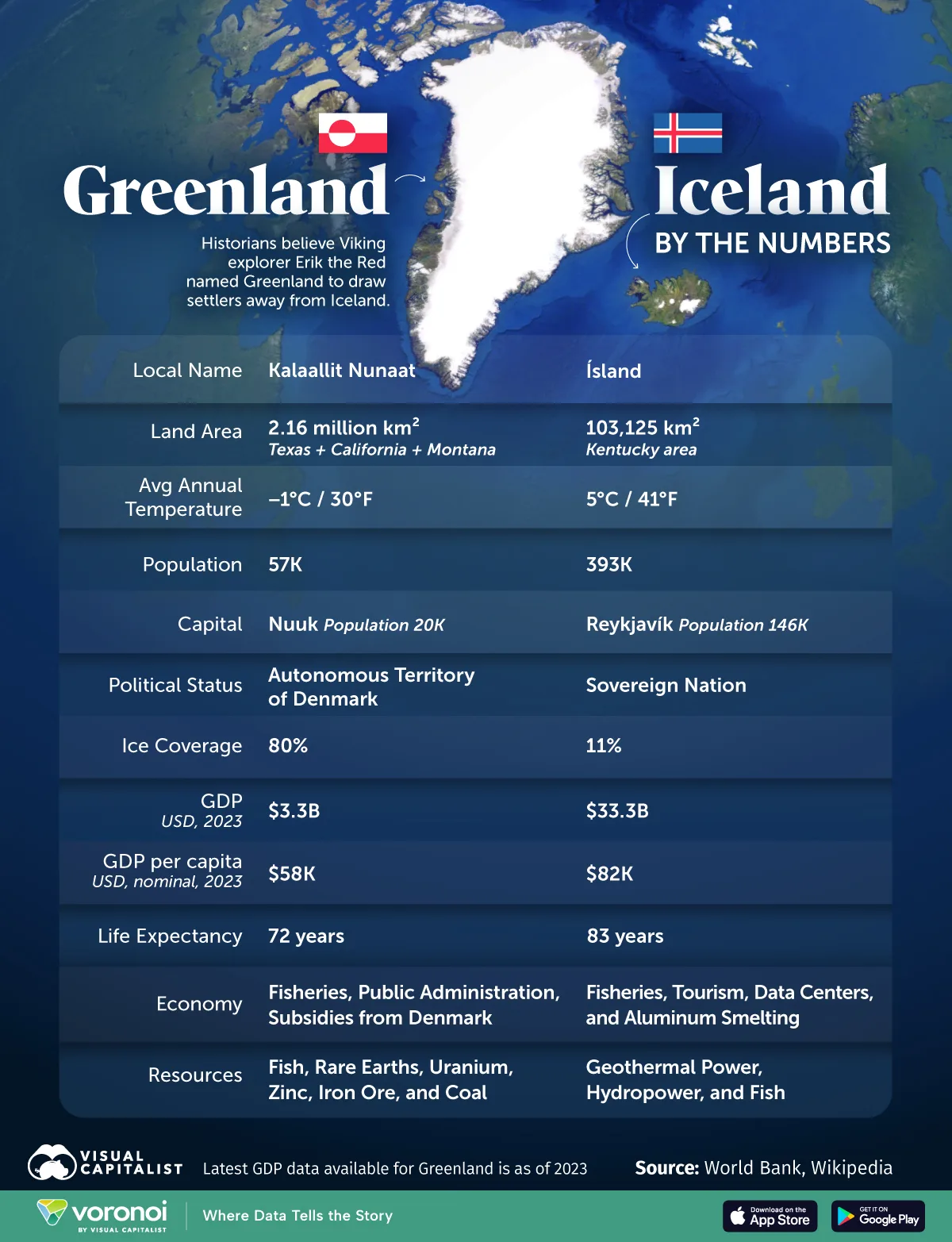
This map compares the two islands across a variety of fundamental metrics. Despite being located just a few hundred miles apart in the North Atlantic, the two places differ dramatically in scale and development.
The data for this visualization comes from Wikipedia, and the World Bank.
A Vast Size Gap, With Very Different Populations
Greenland is enormous, covering 2.16 million square kilometers—roughly the combined area of Texas, California, and Montana.
Iceland, by comparison, spans just over 103,000 square kilometers, similar in size of Kentucky. Yet Greenland is home to only 57,000 people, while Iceland’s population is nearly 393,000.
| Category |  Greenland Greenland |
 Iceland Iceland |
|---|---|---|
| Local name | Kalaallit Nunaat | Ísland |
| Land area | 2.16 million km² | 103,125 km² |
| Avg Annual Temp | −1°C / 30°F | 5° / 41°F |
| Population | 57K | 393K |
| Capital | Nuuk | Reykjavík |
| Political status | Territory of Denmark | Sovereign nation |
| Ice coverage (land area) | 80% | 11% |
| GDP (USD, 2023) | $3.3B | $33.3B |
| GDP per capita (USD, nominal, 2023) | $58K | $82K |
| Life expectancy | 72 years | 83 years |
| Economy | Fisheries, public administration, subsidies from Denmark | Fisheries, tourism, aluminum smelting, data centers |
| Resources | Minerals, fish | Geothermal power, hydropower, fish |
Iceland is “Greener” than Greenland
Contrary to what their names suggest, Iceland has a much milder climate and far less ice coverage.
About 11% of Iceland’s land area is covered by ice, compared with roughly 80% of Greenland.
According to medieval sagas, Viking explorer Erik the Red named the icy island “Greenland” around 985 AD to make it sound more appealing to settlers from overcrowded Iceland. Today, Iceland’s average annual temperature sits around 5°C, while Greenland averages closer to −1°C.
Economic Output and Living Standards
Iceland’s economy is significantly larger and more diversified. In 2023, its GDP reached $33.3 billion, compared with Greenland’s $3.3 billion. On a per-capita basis, Iceland also comes out ahead, with nominal GDP per person around $82,000 versus $58,000 in Greenland.
Life expectancy reflects this gap as well, at 83 years in Iceland—among the highest globally—compared with 72 years in Greenland.
Iceland’s economy benefits from geothermal power, tourism, aluminum smelting, and data centers, while Greenland relies more heavily on fisheries and subsidies from Denmark, despite vast mineral resources.
Learn More on the Voronoi App
If you enjoyed today’s post, check out How Venezuela’s Oil Reserves Compare to the Rest of the World on Voronoi, the new app from Visual Capitalist.


