
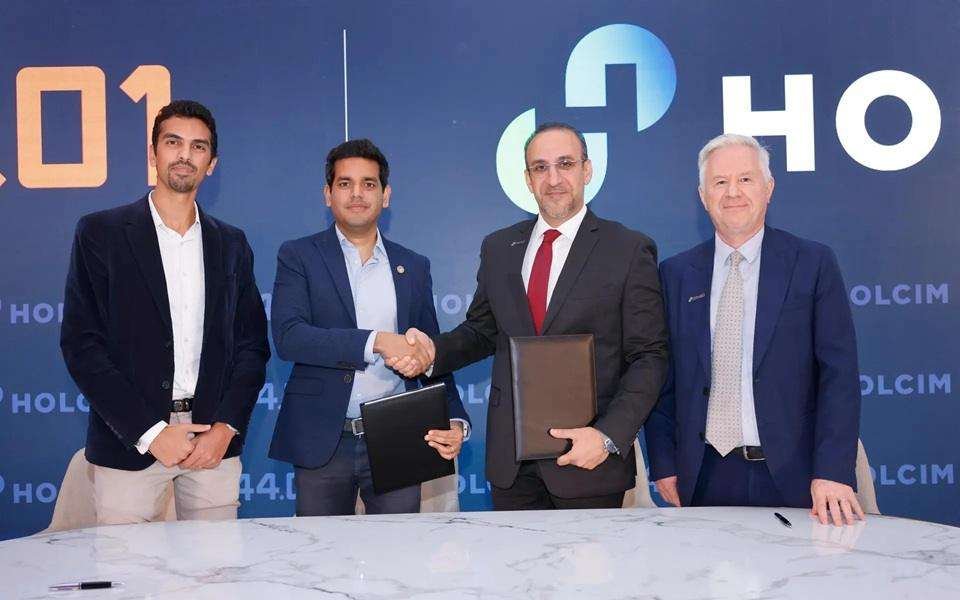
Building materials company Holcim and carbon sequestration technology company 44.01 announced the launch of a new pilot project in the UAE, aimed at capturing, permanently storing, and mineralizing CO2 from cement production.
Cement production is a significant contributor to global greenhouse gas emissions, and one of the more difficult sectors to decarbonize. Cement currently accounts for approximately 8% of global carbon dioxide emissions, with over 900 kg of CO2 emissions generated for every 1,000 kg of material produced.
Founded in Oman in 2020, 44.01 provides solutions to eliminate CO2 captured from the air or from hard-to-abate industrial processes by turning it into rock, through its technology to accelerate the natural process of CO2 mineralization. The company’s solution takes captured CO2 and dissolves it in water, creating an acidic solution that mobilizes cations within rock that reacts with the CO2 and mineralizes it, and injects the fluid deep underground, where high pressure, temperature and high CO2 concentration causes a rapid mineralization process.
The new pilot project seeks to demonstrate this process using CO2 taken directly from a cement plant.
The Fujairah-based project plans to capture five tons of CO2 per day from cement production before storing it in local rock formations, where it is expected to mineralize underground. According to the companies, it will be the first effort globally to combine cement-derived CO2 with in-situ mineralization at an industrial site.
Ali Said, CEO of Holcim in the UAE and Oman, said:
“This project demonstrates how innovation and collaboration can accelerate progress toward net zero. This pilot to decarbonize our cement plant is another example of how we are building progress for people and the planet. Our partnership with 44.01 reinforces our shared commitment to pioneering sustainable solutions and showcases what is possible when industry leaders work together to drive meaningful, scalable impact.”
The project is supported by the Fujairah Natural Resources Corporation and carried out with NT Energies, which will deploy Shell’s CANSOLV carbon capture technology.
For Holcim, the pilot is part of its broader push to scale low-carbon technologies across the construction sector under its NextGen Growth 2030 strategy, in addition to supporting the UAE’s Net Zero 2050 pathway. For 44.01, it marks its first collaboration with an industrial customer and a European multinational, expanding its pipeline as it works to scale mineralization projects in key markets.
The companies said that the project highlights how cooperation between technology developers, local authorities and industry could unlock new permanent carbon-reduction pathways in the region.
Talal Hasan, CEO of 44.01, said:
“This partnership shows that industrial companies can play a leading role in permanent carbon removal. We are demonstrating a practical and scalable path to decarbonization that can be replicated worldwide.”


