
Lessons come to you when you’re ready. This summer, when the opportunity came to visit Omega, I was ready to receive the peace and enlightenment that it had to offer. 🌱
I often seek time away from the city, but usually in the form of an expensive stay that involves strenuous travel and either costly hotels or the sometimes complicated machinations of home swapping. It can be a big production to get away — and while I’m there, I wonder if I’m simply avoiding the contemplation and work that occupy me daily, instead of reconsidering or releasing myself from them.
Omega was an opportunity to do something different — it’s moderately priced with an outsize impact, thanks to the mind-opening workshops and the truly relaxing experience on campus. That’s especially true for those on the East Coast who can drive to their Rhinebeck campus. But even for those who fly into Albany or NYC airports, it can still be easy to enter the world unto itself that is the Omega Institute.
“Omega was an opportunity to do something different — it’s moderately priced with an outsize impact, thanks to the mind-opening workshops and the truly relaxing experience on campus.”
On a sunny summer Friday, I drove up to Omega for a two-night stay to attend a workshop, explore their campus, and take advantage of some wellness treatments (!) — not to get away, but to find myself. It worked. When I left the campus, I felt like a ray of light. So, I’ve written up my notes for you on everything I experienced and my suggestions for making the most of your Omega visit, if you’re interested in attending.
What is the Omega Institute for Holistic Studies?
Omega is a nonprofit, educational organization situated in Rhinebeck, New York, offering workshops, retreats, conferences, and professional training on 250 acres of beautiful upstate woods. It was founded in 1977 by Eastern scholar Pir Vilayat Inayat Khan, holistic medical doctor Stephan Rechtschaffen, and educator Elizabeth Lesser. This mix of Eastern and Western knowledge defines the Omega experience to this day. And if you’re wondering: Why “Omega”? The name comes from the writings of Pierre Teilhard de Chardin, a 20th-century Jesuit priest and evolutionary biologist who spoke of the “Omega Point,” or the point of unity toward which all of life is evolving.
If you’re familiar with the world of wellness retreats and spiritual healing, you’ll know what I mean when I say that Omega strikes me as the East Coast Esalen. The upstate location makes it feel like an adult summer camp for spiritual seekers, with so many years of experience behind it that it runs like a well-oiled machine.
“Like an adult summer camp for spiritual seekers.”
My review of Omega: A weekend of transformation
I started writing my review before I left Omega. Nestled in an Adirondack chair, I scribbled in my notebook while looking at the grape vines and frosty lamb’s ear in the garden bed across from me. There are spots like this all over the campus — a chair or bench perfectly placed so that you feel peace and focus, while someone very nearby is experiencing the very same. I’m inspired as I look at the lamb’s ear. Their frozen-over look seems to be the result of some curse. A fairy tale starts to unravel in my mind. Everything reminded me of something else while at Omega, so I was constantly linking and thinking.
Just like a fairy tale, I went in unsuspecting, and I left transformed.
Getting there
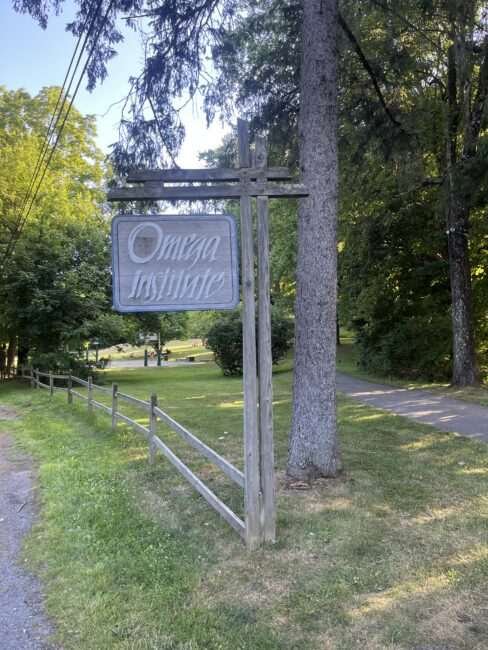
I arrived Friday evening for my three-day workshop after a two-and-a-half-hour drive from Brooklyn. The last hour of the drive up was exquisite as the landscape revealed itself and city traffic subsided. I saw a family of deer running across someone’s front lawn and looked back at my GPS. I was close. As I pulled onto campus, I was directed by strategically placed staff members to pull into the parking lot, drop my luggage at the tent (they would deliver it to my cabin for me), and sent to Guest Services to check in.
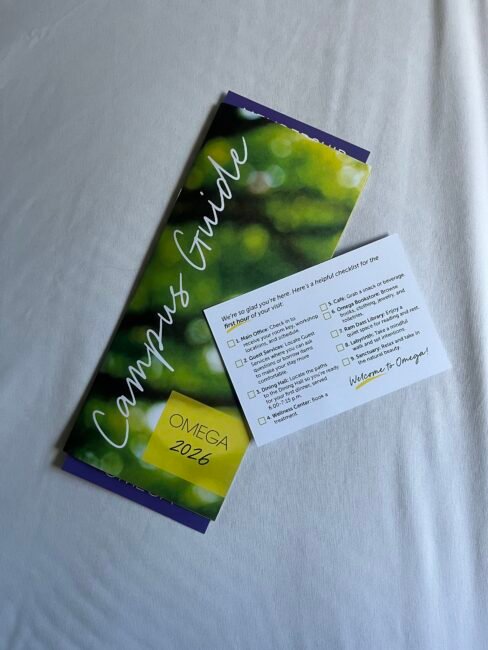
I soaked in the atmosphere, did a scan of who would be accompanying me over the weekend — one young couple, but mostly women solo travelers in the second half of life. Equipped with a map of campus, my workshop schedule, and the dining hall hours, I was ready to set off on my quest. I was encouraged to explore and engage. Omega’s staff is expert at encouraging, and the rules, like the no-phone policy, are more like a tacit agreement that arises naturally from the ethos of the place.
Housing
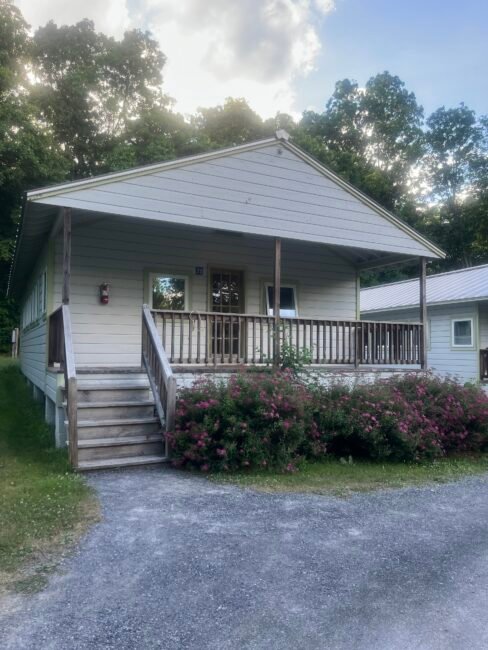
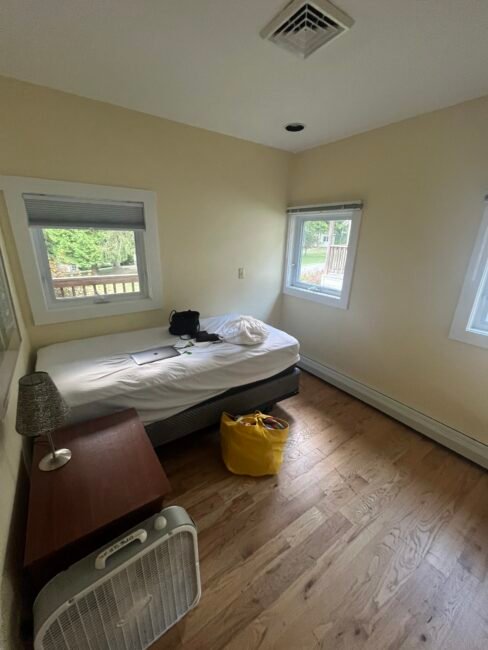
I decided to get my bearings and head first to my single room in the dormitory-style housing. As I walked back to my cabin, I passed gardens, sculptures, and the wellness center (more on that later!). I got to my room (72-01) and unlocked the door.
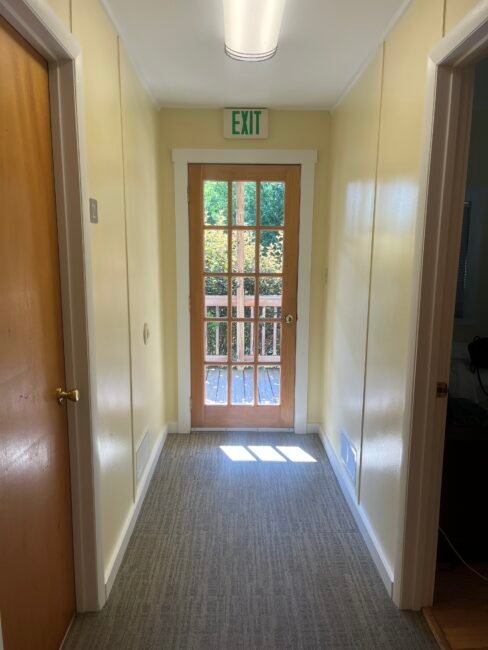
My sparse room was furnished with a twin bed, a nightstand, a fan, a folding chair, and a clothing rack. A hallway down the center of the eight rooms led back to two toilets and two showers that would be shared amongst us. I only saw one of my cabinmates throughout the stay, though I heard a couple more. I never ran into any of them when using the restroom or showers, either. Staying in private housing might have been more comfortable, but not by much! You can also camp, if that’s your style.
Dining Hall
Next, it was time for the dining hall before the first session of my workshop. In my current phase of life, I’m a person who prefers to pick up fancy grocery store sushi over meal prepping — so this was a wonderland for me.
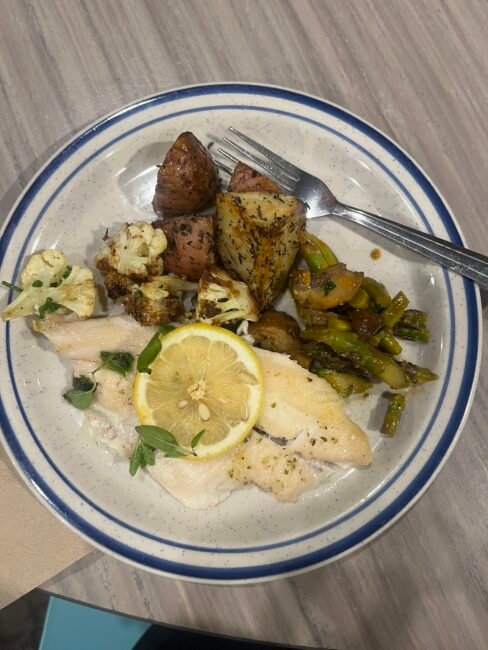
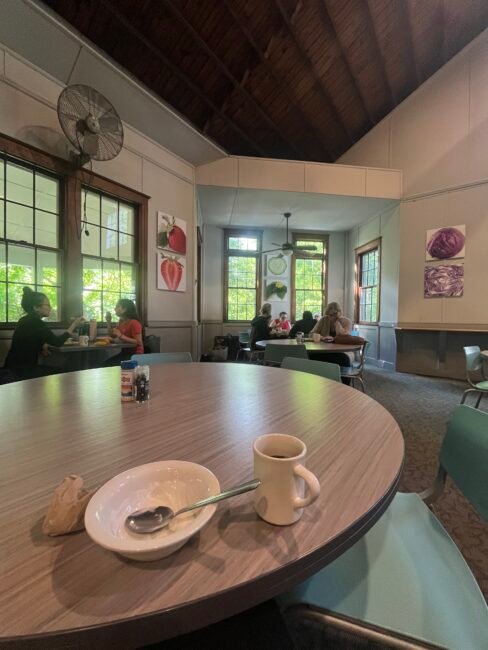
The dining hall is a beautiful building with a huge flowering southern catalpa tree out front. I flashed my badge and went inside to find that local and organic foods, prepped with minimal additives, were abundant. A salad bar presents itself first before the prepared foods of the day, always with a warm vegan option, too. For my first dinner, I had catfish and sauteed organic vegetables. And later in the weekend, a particularly memorable piece of chicken — bone-in, of course, with crispy skin.
“I flashed my badge and went inside to find that local and organic foods, prepped with minimal additives, were abundant.”
As I would come to see, for breakfast, the salad bar was swapped out for a local yogurt and toppings (SO good!), and there were warm foods too, like potatoes and mini frittatas. I felt satisfied and fueled by the offerings. One day, I even managed to snag a gluten-free matcha, black sesame cookie. The coffee served up with breakfast was a particularly strong blend called “Ahab’s Revenge,” and a small cup kept me going all day long. If the dining hall doesn’t align with your needs at any point, there is a café on campus that’s open late. They serve meals, coffee, and snacks — so you’re never without.
My one tip for you? Bring a water bottle! I might be the last person in the world waking up to this, but it is necessary for refilling at the dining hall and carrying with you to workshops throughout the day.
Workshop
For my workshop, I chose to follow Mark Nepo‘s “The Fifth Season: Creativity in the Second Half of Life.” Sure, it might sound like a strange choice for a 35-year-old like myself, but I’ve always been concerned with aging. My fate was sealed when my mother exclaimed, “This is an old soul,” at my birth. I’ve even written about it for The Good Trade. So, I was optimistic I’d fit in. Plus, Mark Nepo’s work also crosses into two of my core interests: Poetry and philosophy.
I took a beat to mentally prepare for our workshop schedule, which would be Friday 7–9 p.m., Saturday 9 a.m.– 12 p.m. and 2 p.m.–5 p.m., and Sunday 9 a.m.– 12 p.m. For my first session at 7 p.m, I walked down to Stillwater, a building near the 80-acre Long Pond Lake that sits on campus. It resembled a long house, with vaulted ceilings.
“For my first session at 7 p.m, I walked down to Stillwater, a building near the 80-acre Long Pond Lake that sits on campus.”
I noticed that most participants had taken off their shoes at the door. The space was dotted with rows of standard event chairs, but also, in front of that, many meditation chairs and pillows. I opted in, settling at the end of a row on the floor. We participants faced Mark as he spoke, behind him, a full wall of windows looking out onto an unobstructed lawn and grove of trees, often slightly blowing in the wind.
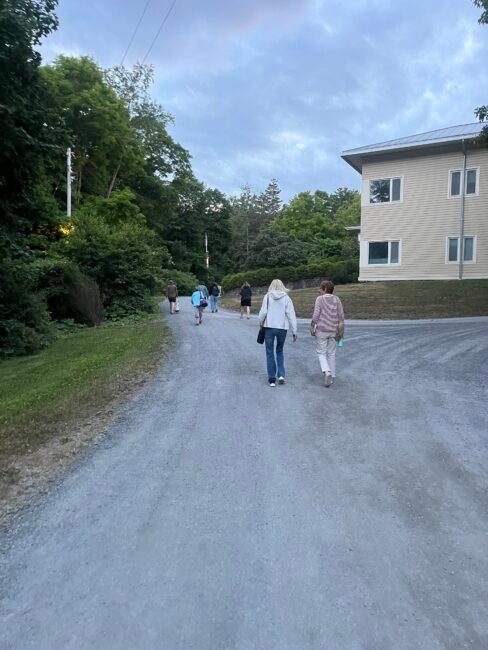
I noted that there were about 40 people in my workshop. Most of the time was spent moving between Mark’s remarks, carried over from his headset through the speaker system, and open discussion in the group, where our facilitator, Jess, moved around the room with a mic so we could all hear. What ensued were hours of teaching and connection. If I had to estimate, I’d guess there was an aphorism that opened my third eye about every 15 minutes over the course of the days we spent together.
While the workshop centered on staying creative and connected to life in the latter half of it, every morsel felt relevant and rang true for me. It turns out that when something is true, it lands, no matter how old you are. While I can’t recreate the moving stories from Mark’s childhood that he would use to introduce more autobiographical poems, or the feeling of clarity after a day of sharing insights that cut across a melange of cultural traditions, I can share choice snippets from my notebook:
“Being hardened helps us get through life; being softened will help us experience it.”
“Any goal is a guess enshrined.”
“Poetry is the utterance of the soul.”
“Every true question doesn’t have an answer; it invites a practice.”
“The mind is a net, the heart is a sponge.”
“Being hardened helps us get through life; being softened will help us experience it.” – Mark Nepo
Twice over the three days, we split into pairs for discussions centered on questions provided by Mark. I paired up with Robin, who was seated next to me, and it opened up a portal into another world. Robin, in her mid-60s, and I shared our questions, hesitations, misgivings, inspirations, life stories, and hard-earned lessons. Robin was there with three of her childhood friends, and meeting them was an honor and a delight.
I left with memories, prompts, new books from the bookstore, a new interlocutor in Robin, and a clarity that is hard to achieve but worth seeking every day. A few days after the workshop, I received an email with the poems Mark had read attached, and the option to purchase a recording of the course to experience it all over again.
Treatments at the wellness center
“The body work was gentle yet effective, and a beautiful complement to the spiritual and intellectual work of the workshop.”
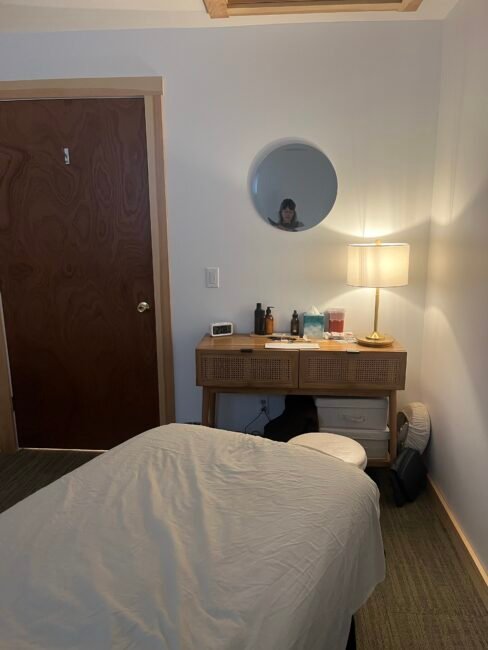
In advance of my stay, I had a phone call with the Wellness Center (845.266.4444, ext. 575) to book two treatments, scheduled around my workshop. Both came in at $145 before tip, a reasonable cost at least for this city dweller. Because of a recent dalliance with a pinched nerve, I decided to try acupuncture for the first time and, the next day, a massage. I showed up five or so minutes before each treatment, leaving my shoes at the door as was indicated by the cubbies provided, and chatted with the delightful staff to check in. I was brought back quickly, shared all the relevant information with Phil for my acupuncture treatment and later, Elise, for my massage, and then enjoyed the next hour of healing. The effects have lasted all week following. The body work was gentle yet effective, and a beautiful complement to the spiritual and intellectual work of the workshop. And the staff helped me schedule everything according to my workshop times to make it easy, so I didn’t ever have to skip a meal or miss out on time exploring.
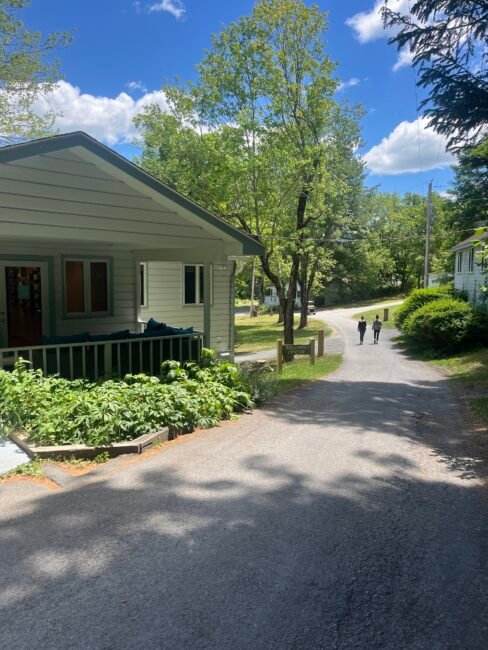
Exploring campus
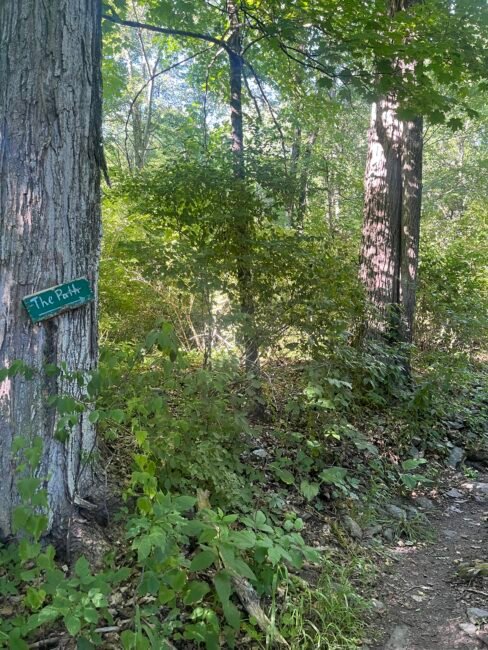
Omega’s campus is well-resourced without being overly fussy or busy. The hiking trail that winds around the outside of the back half of campus is a full two miles, with options to peel off back to campus throughout. I did the full thing (there are inclines!) and I was sweating before dinner. There’s Tai Chi in the evenings, yoga in the mornings, tennis courts, and pickleball, too.
“Omega’s campus is well-resourced without being overly fussy or busy.”
Outside of the Main Hall between workshop sessions, I gathered with 5 or so other visitors to admire a groundhog. Daily, I went and visited the Sanctuary without ever feeling rushed, pressured, or uncomfortable. (These feelings are everyday occurrences for me in NYC — but I imagine they might be for you, too, no matter where you are.) The Sanctuary is set up on a hill above the housing and Dining Hall, and offers a place for quiet reflection. It’s perched above the Yearning Pond, where I admittedly recorded a heartfelt voice note one evening just before quiet hours set in at 10 p.m., against the gently recommended no-phone policy.
On my final morning, I walked out to the lake and took in the expansive view. The beach was undergoing construction, but it didn’t inhibit my capacity to enjoy the serene view and marvel at yet another beautifully kept aspect of the campus.
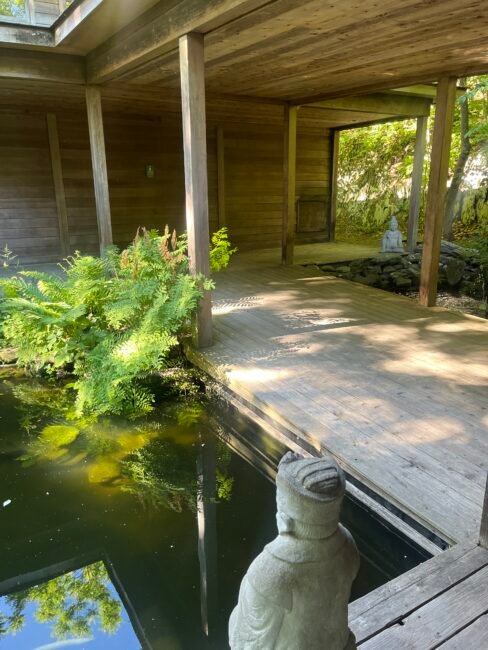
For your next trip, instead of renting a lake house, consider visiting Omega to reconnect with yourself or others. Bring an older family member, your adult child or children, an old friend, or even a new one from book club who has similar interests. Or come alone, as I did, and find yourself restored and relaxed in a way that you realize is in fact attainable — especially since everyone else on campus is after the same thing as you, to slow down and open up, listening to life’s great teachings. Empowerment, humility, peace, joy.
If you have questions about which workshop to choose, booking your stay, or any other aspect of Omega, leave them in the comments, and I’d be happy to weigh in. 🫶
This story is in partnership with our friends at Omega Institute for Holistic Studies
Ashley D’Arcy is the Senior Editor at The Good Trade. She holds an MA in Philosophy from The New School for Social Research and has contributed to esteemed outlets such as The Nation, 032c, and Yale School of Management’s Insights where she’s leveraged her expertise in making complex ideas accessible to a broad audience. In addition to her editorial work, she is training as a psychoanalytic mental health professional and provides care to patients in New York City. Ashley also explores sustainable fashion, clean beauty, and wellness trends, combining thoughtful cultural critiques with a commitment to mindful living.
The post How A Weekend At Omega Institute Restored Me (2026 Review) appeared first on The Good Trade.


