How Global Central Bank Reserves Have Shifted Since 2000
See visuals like this from many other data creators on our Voronoi app. Download it for free on iOS or Android and discover incredible data-driven charts from a variety of trusted sources.
Key Takeaways
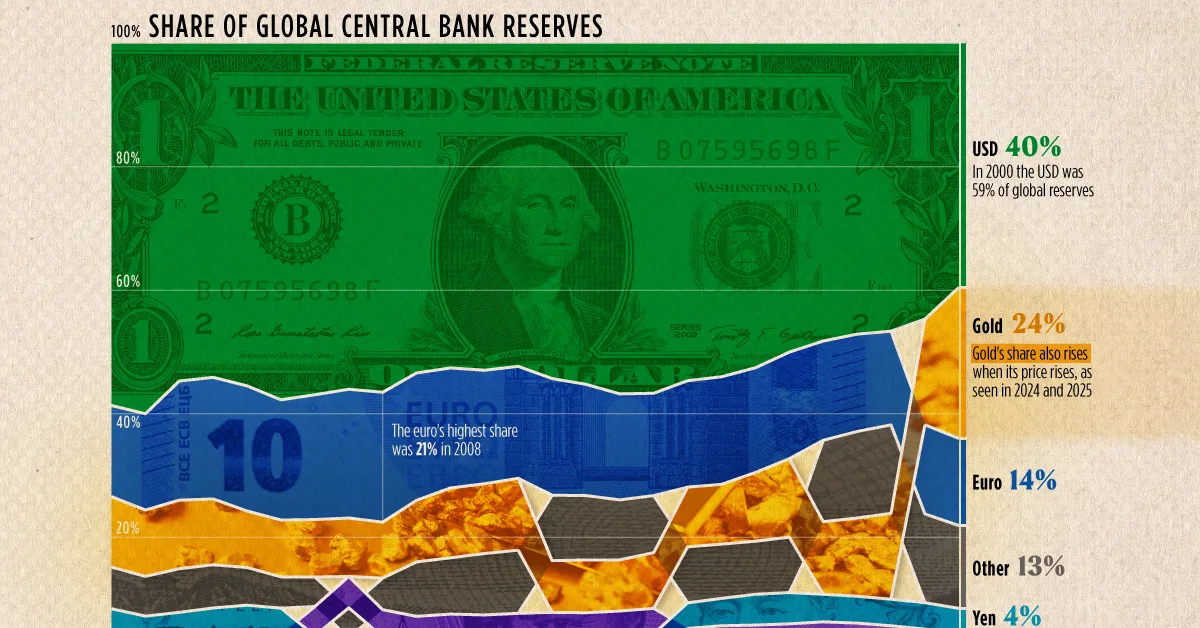
- The U.S. dollar’s share of global central bank reserves has fallen from nearly 59% in 2000 to just under 40% in 2025.
- Gold has become the biggest beneficiary of reserve diversification, rising from 11% to nearly one-quarter of global reserves.
- The recent jump in gold’s share reflects both record central bank buying and rising gold prices, which increased the value of existing holdings.
For more than two decades, central banks have gradually diversified their reserve portfolios. While the U.S. dollar remains the world’s dominant reserve asset, its share has steadily declined as countries have added gold and a broader mix of currencies.
This visualization tracks how global official reserves have changed between 2000 and 2025. It shows that gold has been the biggest winner of this shift, climbing to nearly one-quarter of total reserves even as no single currency has come close to replacing the dollar.
The data comes from the IMF’s Currency Composition of Official Foreign Exchange Reserves (COFER) database and International Liquidity (IL) dataset.
The Dollar Remains Dominant—but Its Share Is Shrinking
The U.S. dollar accounted for nearly 59% of global reserves in 2000, compared with just under 40% by the end of 2025.
| Central Bank Reserve Assets | 2000 | 2025 | Change |
|---|---|---|---|
| Gold | 11.4% | 24.5% | +13.0 pts |
| U.S. dollar | 58.7% | 39.6% | -19.1 pts |
| Euro | 14.8% | 14.1% | -0.7 pts |
| Yen | 5.5% | 4.0% | -1.5 pts |
| Pound | 2.9% | 3.1% | +0.2 pts |
| Renminbi | — | 1.4% | +1.4 pts |
| Other | 6.8% | 13.4% | +6.7 pts |
Although no other currency has come close to replacing it individually, central banks have steadily diversified their reserve portfolios over time.
The euro remains the second-largest reserve currency, while the Japanese yen, British pound, and Chinese renminbi together account for a relatively modest share.
Gold Has Become the Biggest Winner
Gold’s share of global reserves has more than doubled since the early 2000s, reaching 24.5% in 2025.
Unlike reserve currencies, gold carries no sovereign issuer and cannot be frozen or sanctioned by another government, making it increasingly attractive in an era of geopolitical uncertainty.
The sharp rise during 2024 and 2025 reflects both strong central bank purchases and higher gold prices, which increased the value of existing holdings.
As geopolitical fragmentation continues, reserve diversification is likely to remain a defining theme for central banks worldwide.
Learn More on the Voronoi App 
If you enjoyed today’s post, check out Mapped: How Major Currency Performance Shifted in 2025 on Voronoi.