How Insulation Boosts Energy Efficiency and Lowers Costs in 3 Charts
High-performance insulation is a cost-effective and reliable way to permanently reduce a building’s energy demand and carbon emissions over its entire service life.
However, despite its ability to deliver significant economic benefits to homeowners and businesses, insulation is often undervalued or overlooked.
For this graphic, Visual Capitalist partnered with the American Chemistry Council. In it, we explore three reasons insulation can lower costs and reduce a home or business’s carbon footprint.
1: Improves Energy Efficiency
Improving a building’s energy efficiency by insulating its envelope is one of the most effective ways to lessen the strain on the energy grid and enhance energy reliability.
An airtight envelope ensures the building is properly insulated and minimizes heat or energy loss.
If the U.S. built all new buildings with a tight envelope, this could negate over 111 Mt of greenhouse gases (GHGs) annually—more than the combined GHGs produced by Israel and Norway in 2022.
| Forecast Year | GHG Emissions (Mt) |
|---|---|
| 2022 | 0.00 Mt |
| 2023 | 2.26 Mt |
| 2024 | 4.84 Mt |
| 2025 | 7.82 Mt |
| 2026 | 11.22 Mt |
| 2027 | 14.95 Mt |
| 2028 | 19.04 Mt |
| 2029 | 23.49 Mt |
| 2030 | 25.81 Mt |
| 2031 | 28.46 Mt |
| 2032 | 31.39 Mt |
| 2033 | 34.71 Mt |
| 2034 | 38.34 Mt |
| 2035 | 42.27 Mt |
| 2036 | 45.35 Mt |
| 2037 | 48.47 Mt |
| 2038 | 51.43 Mt |
| 2039 | 54.30 Mt |
| 2040 | 58.20 Mt |
| 2041 | 61.90 Mt |
| 2042 | 65.80 Mt |
| 2043 | 69.81 Mt |
| 2044 | 74.38 Mt |
| 2045 | 79.19 Mt |
| 2046 | 84.82 Mt |
| 2047 | 90.51 Mt |
| 2048 | 97.20 Mt |
| 2049 | 104.38 Mt |
| 2050 | 111.74 Mt |
2: Reduces Power Consumption
High-performance insulation not only provides multifunctional building envelope benefits but can also help reduce a building’s power consumption.
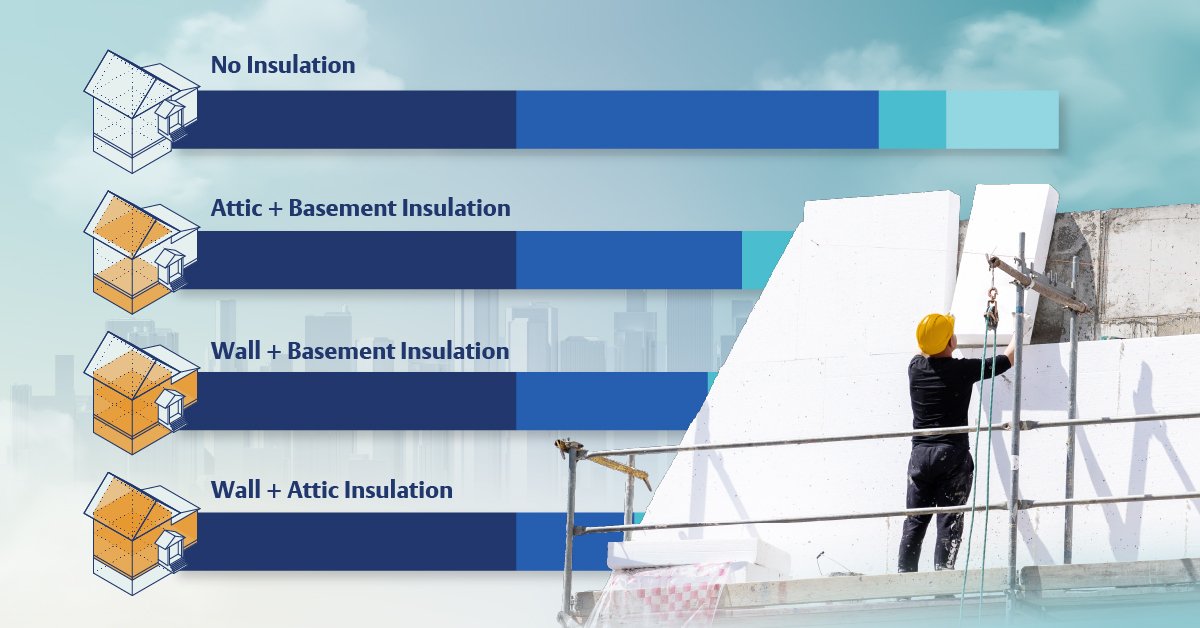
Many older homes in the U.S. lack insulation, while many newer homes are not sufficiently insulated. Raising a building’s insulation levels to current energy codes will significantly reduce energy consumption, as shown below for a typical home*.
| Insulation Type | Energy Consumption |
|---|---|
| No Insulation | 100,725 kBtu |
| Basement + Attic Insulation | 80,655 kBtu |
| Wall + Basement Insulation | 73,037 kBtu |
| Wall + Attic Insulation | 60,067 kBtu |
| Whole Home Insulation | 55,478 kBtu |
*Typical home in Climate Zone 5 covers North American locations with cold winters and temperate summers, such as Massachusetts, New York, and Ohio.
Insulating a home to meet modern U.S. energy code standards can reduce energy consumption by up to 45%. This decreases the building’s carbon footprint and enhances insulation’s carbon-saving benefits.
3: Lowers Overall Emissions
Insulating a home with high-performance foam plastic insulation can reduce a building’s carbon emissions by over 1,200 tons over its lifespan. Equipping the construction industry with tools to lower greenhouse gas emissions.
| Insulation | Lifetime Carbon Savings |
|---|---|
| Whole Home Insulation | 1,185 t |
| Wall Insulation | 635 t |
| Attic Insulation | 462 t |
| Basement Insulation | 137 t |
A High-Performance Solution
Through foam-plastic, high-performance insulation, the construction industry can simultaneously reduce its emissions, minimize power consumption, and improve energy efficiency.

-

 Green7 days ago
Charted: Renewable Energy Capacity in the U.S. (2014-2024)
Discover how renewable energy capacity in the U.S. has grown over the past decade, with solar PV leading the charge.
-

 Energy4 weeks ago
Visualizing Chinese EV Market Share Overseas
Chinese brands accounted for 62% of global EV sales in 2024.
-

 Economy1 month ago
Mapped: How Much Each Country Pays for Gas in 2025
Production and refining costs, transportation and distribution fares, and taxes and subsidies all affect how much everyone pays for gas.
-

 Mining2 months ago
How Many New Mines Are Needed for the Energy Transition?
Copper and lithium will require the highest number of new mines.
-

 Energy3 months ago
Where the U.S. Gets Its Enriched Uranium
Russia controls nearly half of global uranium enrichment capacity.
-

 Energy3 months ago
Oil & Gas Leases on Public Lands Under Obama, Trump, and Biden
President-elect Donald Trump wants a massive boost in U.S. oil production to reduce energy costs.

The post How Insulation Boosts Energy Efficiency and Lowers Costs in 3 Charts appeared first on Visual Capitalist.