How Nvidia’s Market Cap Stacks Up Against Entire Countries
See visuals like this from many other data creators on our Voronoi app. Download it for free on iOS or Android and discover incredible data-driven charts from a variety of trusted sources.
Key Takeaways
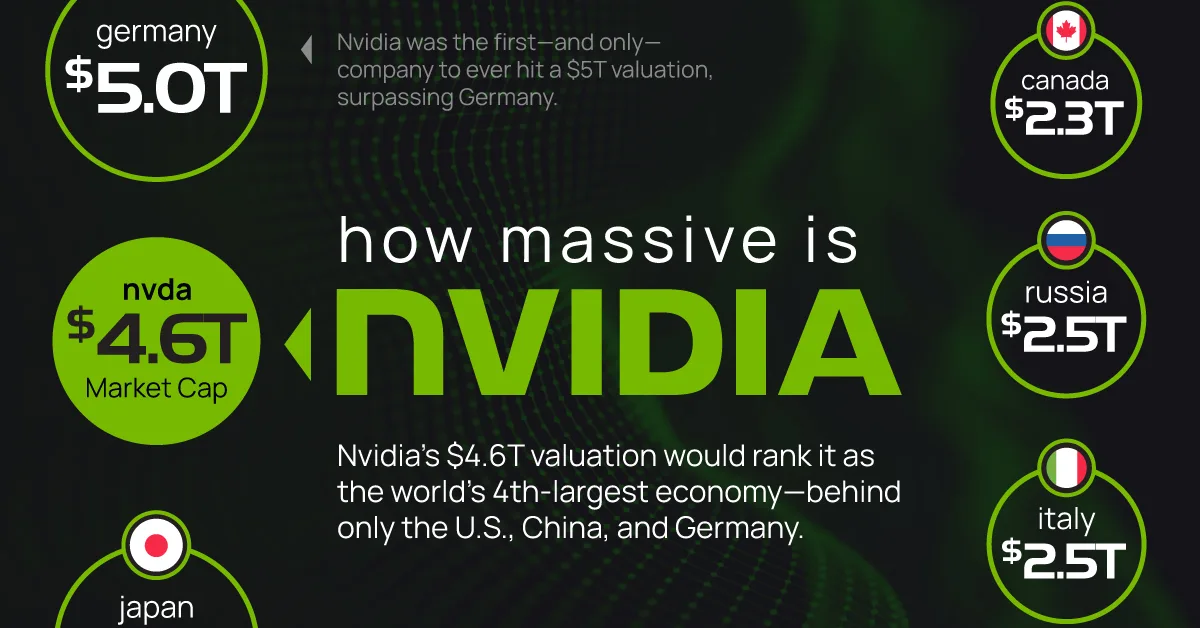
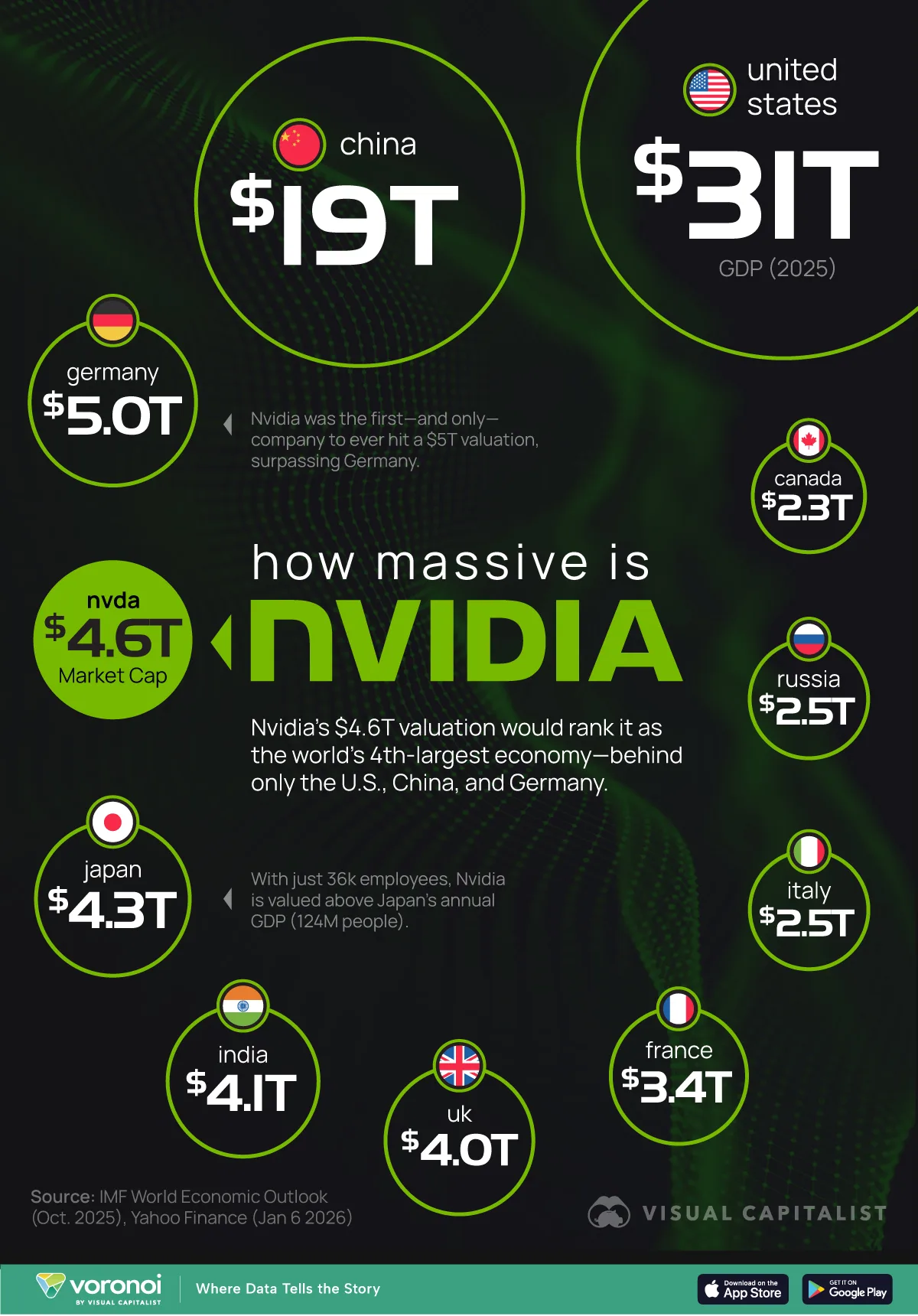
- Nvidia was the first—and only—company to ever hit a $5T valuation, briefly surpassing Germany’s GDP at one point.
- With just 36K employees, Nvidia is valued above Japan’s annual GDP, which is powered by 124 million people.
A single chipmaker has grown so large that its market capitalization now rivals the economies of entire G7 nations.
Using Nvidia’s valuation from Yahoo Finance and nominal GDP data from the IMF World Economic Outlook, Nvidia’s roughly $4.6T market cap would “rank” as the world’s fourth-largest economy—behind only the U.S., China, and Germany.
How Nvidia’s Market Cap Compares to Countries’ GDPs
Nvidia’s rise in valuation over the past few years has been nothing short of historic. In 2025, it surpassed the GDP figures of heavyweights such as Japan, India, and the United Kingdom.
The data below showcases where Nvidia stands if compared to country economies, underscoring how central its chips have become to the AI revolution:
| Rank | Country / Company | GDP / Market Cap ($B) |
|---|---|---|
| 1 |  U.S. U.S. |
30,616 |
| 2 |  China China |
19,399 |
| 3 |  Germany Germany |
5,014 |
| 4 | Nvidia | 4,572 |
| 5 |  Japan Japan |
4,280 |
| 6 |  India India |
4,125 |
| 7 |  UK UK |
3,959 |
| 8 |  France France |
3,362 |
| 9 |  Italy Italy |
2,544 |
| 10 |  Russia Russia |
2,541 |
| 11 |  Canada Canada |
2,284 |
While comparing market capitalization (the total value of a company’s shares) to GDP (the annual economic output of a nation) is not an apples-to-apples metric, it illustrates the sheer magnitude of Nvidia’s scale relative to the global economy.
What makes this valuation even more impressive is the efficiency behind it: it takes only 36,000 Nvidia employees to generate a market cap that exceeds the GDP of Japan—an economy powered by nearly 124 million people.
What Powered Nvidia’s Surge in 2025?
Behind Nvidia’s jump in valuation is a mix of AI infrastructure spending, expanding AI use cases, and a sticky software ecosystem.
A huge wave of AI infrastructure spending flowed into accelerated computing, and Nvidia sat at the center of it.
Demand has repeatedly outpaced supply, and in their latest fiscal quarter earnings announcement, Nvidia CEO Jensen Huang confirmed “Blackwell sales are off the charts, and cloud GPUs are sold out,” highlighting how quickly customers are buying up AI chips and cloud access to them.
At the same time, the AI story broadened beyond chatbots. Nvidia increasingly framed the next leg of the tech boom as “physical AI”—robots, autonomy, and industrial systems—widening the perceived long-term market for its compute platform.
Finally, Nvidia’s advantage wasn’t only hardware. CUDA and the surrounding software ecosystem helped lock in developers and customers, raising switching costs and making Nvidia harder to displace even as competitors raced to catch up, effectively acting as a competitive advantage or what Warren Buffett would call a moat.
Learn More on the Voronoi App 
If you found this infographic interesting, explore more investing and market insights on Voronoi, including this graphic on Nvidia’s market performance since 2019.