
As textile fiber production volumes increase annually, and new and upcoming regulations in the EU and US reshape approaches to waste management, Reju is helping to accelerate the transition to textile-to-textile recycling through its innovative regeneration hubs, where textile waste is given a new life.
Reju CEO Patrik Frisk shares his perspective on regionalization, investment in infrastructure, policy, and how collaboration and coordination are the key to building a more circular textile system.
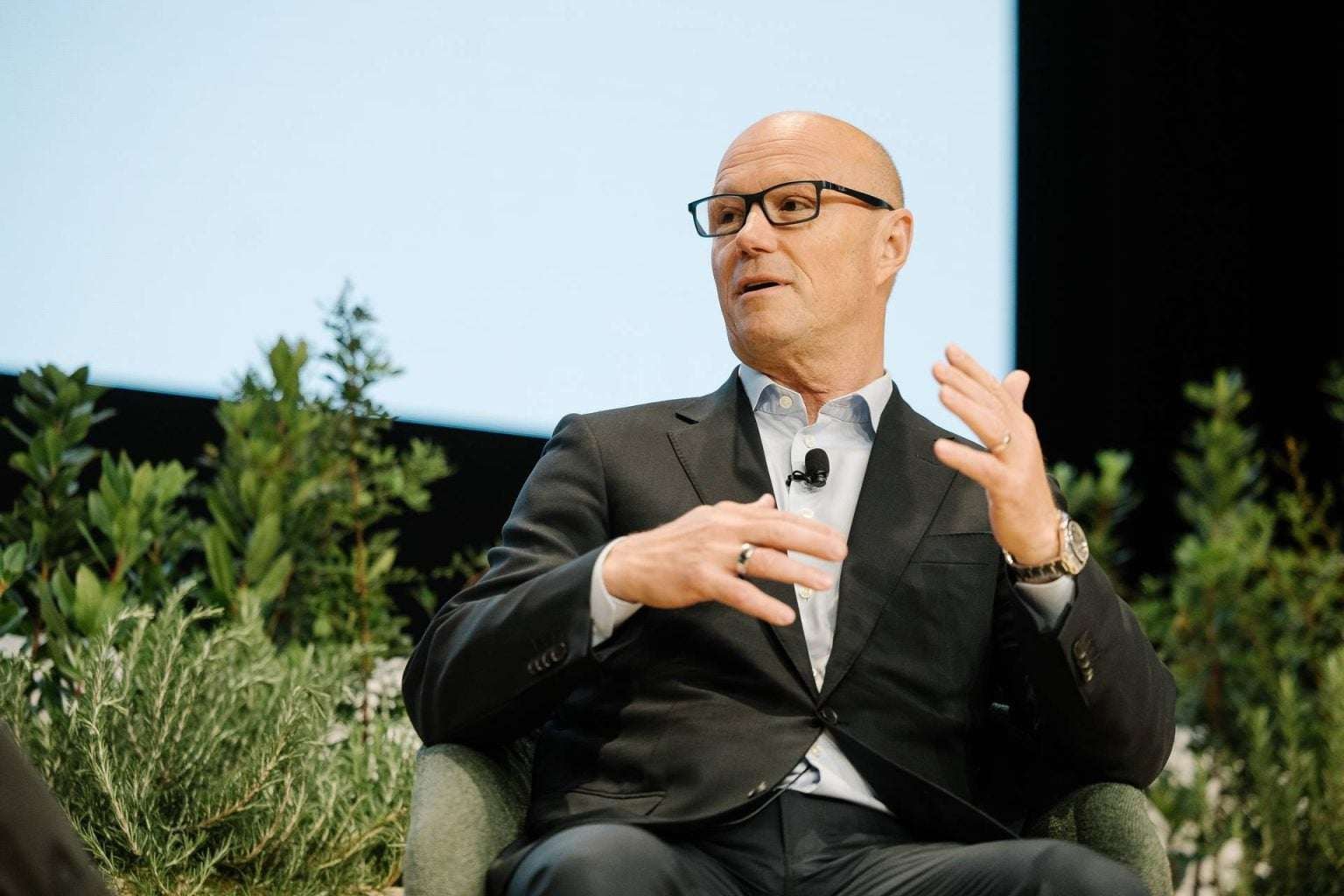
The theme of the 2026 Textile Exchange Conference is The Implementation Era—do you believe that our industry is at the point now where we are ready to begin implementing change at scale?
Not yet actually. When it comes to dealing with all the regulation that’s on the horizon, transitioning from where we have been, and specifically, moving recycled polyester from using bottles to post-consumer textiles, we’re not there yet.
The reason why Reju is here and has always been here is to deal with the problem of the creation of post-consumer textile waste. We’ve been doing that for a very long time, and now we are making sure that we’re compliant, and we’re helping the industry become compliant, with all the regulation that’s coming down the pipeline.
It’s going to take time to prepare, not just for Reju, but also upstream, as there is a lot of work to do, such as organizing feedstock, aggregation, sorting, and the preparation of feedstock, to create the pipeline of the future.
So, if you were to ask me: is it today? No. Is it tomorrow? Yes.
The EU is placing increasing emphasis on textile circularity, including with the Ecodesign for Sustainable Products Regulation (ESPR) as well as with Extended Producer Responsibility (EPR). From your perspective, how are these measures driving circularity in the textile industry, and where do you see opportunities for them to go far further?
I believe that the textile industry as a whole is yet to embrace what the EU and individual states in the US are actually trying to do.
The problem here is post-consumer textile waste. It isn’t about the transformation of a material. In other words, Reju is not here just to provide Reju polyester. We are making sure that we are helping the industry transition to a future where we can deal with post-consumer textile waste in a circular way.
Right now, with regulations in the EU, in other countries, in individual states of the US, not just California, but also New York, Washington state, Oregon, Minnesota, and Maine, there’s a lot of understanding being embedded into the legislative bodies.
The reality is that the avalanche of textile waste hasn’t really hit the market yet. Let’s think about how long a garment, even if it’s a low-cost garment, is kept by the consumer. BCG’s Textile Waste at a Tipping Point report estimated the average lifespan for textiles to be five years in 2024, which could reduce to three. That means the textile waste put into the market this year was sold about four years ago. If you then look to the future and start to aggregate what that means in terms of how much waste is going to hit the market in any given year going forward, that’s a very steep curve, because you have a compounding annual growth rate of about 4%.
We are going to see very dramatic growth in textile waste from 2025 to 2030. According to BCG, it’s going to go from somewhere around 127 million tonnes last year, to around 148 million tonnes in 2030. We’re not going to have a lot of new solutions by then. We are going to be trying to handle 90% of 150 million tonnes versus 90% of 127–128 million tonnes. The problem just gets bigger and bigger.
So, we need to find complementary solutions here, and we should try to do it in a circular way. That builds, by definition, much more resilience into the industry than the linear system, where we add no value at all after the product’s been made.
The reality is that the avalanche of textile waste hasn’t really hit the market yet.
Reju is participating in a session dedicated to EPR at the Textile Exchange Conference called “Textile EPR: Navigating Regional Approaches.” This breakout session will provide a practical, global overview of the latest EPR developments shaping the textile industry. In the EU and US, EPR schemes are being developed at a state level. How important is harmonization across Europe and around the world?
I think it’s critical. Now you’re seeing some frontrunners, like France and Spain in Europe and California in the US, and a lot of the others are holding back to see where these regions end up. I’m an optimist, so I’m really hoping that people will try to align best practices because if they don’t, there will be less engagement from the industry.
The largest challenge is getting to a more homogeneous framework across all EU member states. Otherwise, you run the risk of having 27 different ways of doing this, and you could have an additional risk of 50 states in the US doing it differently.
This lack of coordination is one of the biggest gaps in my view. On the EU side, everybody’s worried about having 27 different systems in 27 different countries, but the reality is you also already have nine Producer Responsibility Organizations in Italy alone. So there is potential for an even worse situation where there is not only a lack of coordination between countries, but also within countries. It could get out of hand really quickly.
It’s important to understand that this is not done in isolation. There is the packaging EPR, which is coming into play at about the same time, with packaging EPR regulations being driven into six or seven US states. The industry is getting really anxious about how different they are in each state in terms of reporting and the effect that has on compliance. We have a similar situation happening in Europe. So I think if we can get this EPR for materials and for textile waste to be coordinated, it certainly will help the discussion also on the packaging side. The key thing is coordination, to make sure that there is a strong framework across the board, with regulation applied consistently and fees structured in a similar way.
If we don’t act now and get organized, we will be driving toward a very high-risk moment for the industry, not just from an administrative perspective, but also in terms of actual fees, which will then drive impacts on the margins and potentially cost of goods as well.
The key thing is coordination, to make sure that there is a strong framework across the board.
Looking at ESPR and EPR together, what is the missing link between legislation and implementation? What needs to happen to ensure these policies have the intended impact?
The missing link here is that we need to ask ourselves: do we know how much waste we’re intending to manage and treat? Do we truly understand what the cost will be of this waste being transformed from waste into a potential product? Only once we have the answers on the amounts and costs, can we decide how it is financed. That would also determine how the fees are paid into the system, because ultimately that’s what the EU and other governments are asking the industry to do: to not just manage this waste but to also finance it.
That’s where the crux is here. This is not just about taking care of the waste. You have to pay to take care of the waste.
We also need to create the mechanism for the valorization of this waste. If we’re going through all this work to collect, to sort, to prepare and to recycle, then the output needs to then be taken back into a closed circular loop for us to actually have created some value. Because if we go through all of that, and then throw it away at the end, what have we really done?
But when we look at implementation, it’s not really about textile to textile. It’s about post-consumer textile waste to textile. That’s what the regulation is aiming to come to terms with, but that is not where the industry is yet.
But when we look at implementation, it’s not really about textile to textile. It’s about post-consumer textile waste to textile.
At Reju, you have been clear that you view Europe’s post-consumer textile waste not as a problem, but as a technical advantage. What needs to change in the way Europe collects, sorts, and manages waste, in order to ensure we are making the most of that advantage?
You have to look at it as an opportunity, right? The opportunity for the industry is also to think about our business differently. Over time, we have extended our supply chains and made them longer and longer. That leads to forecasting becoming less accurate, which drives a lot of the overproduction that creates waste. And that’s because when it gets here, it’s overproduced—it isn’t what the consumer wants. So, we have to discount it, and we all know that approximately 20–40% of clothing put on sale in Europe is not being sold at full price. And that has to do with the fact that the supply chain is now much longer and it continues getting longer because of what’s happening geopolitically.
In that context, a regional circular model makes more sense. We’re not so naive as to think that we’re suddenly going to go from a linear model to a 100% circular model, or that everybody has to change to a post-consumer textile waste to textile recycling approach tomorrow. It’s going to take decades, perhaps a generation, to aggregate enough capacity to reach the volumes that we need.
I’ll give you an example. The regeneration hub we’re building right now in the Netherlands will create about 37–38,000 tonnes of Reju polyester. If we were to replace the polyester that’s currently being made from recycled bottles, we would need to build 216 of those factories. They cost $400 million each. I don’t think that’s going to happen anytime soon.
This is a long, long journey. But it’s important to understand that this aspect of our business, where we’ve gone from a global approach to a regional approach, gives companies an opportunity to rethink how they work and how they can de-risk themselves by being able to near-shore again, rather than giving away so much of the supply chain downstream. To actually go back into it and do the work to drive more of the supply chain ourselves is something that we might need to relearn.
We’re saying: be smart, start small, relearn, and capture the opportunity, because that’s where the world is going. The world is growing into a more regional place, and you should be de-risking and preparing yourself and building a more resilient model for the future.
The regeneration hub we’re building right now in the Netherlands will create about 37–38,000 tonnes of Reju polyester. If we were to replace the polyester that’s currently being made from recycled bottles, we would need to build 216 of those factories.
A key argument in Reju’s “From European waste to European fiber” position paper is how important it is to create demand for recycled materials, alongside the EPR schemes. What would a framework or policy focusing on this look like in practice?
There should definitely be an incentive. EPR needs to be circular by design. If we’re going to set up sorting, preparation, and recycling regionally, the output of that work should be incentivized and mandated, to some extent, for the brands. Let’s say you’re a brand, you’re going to be asked to pay fees for everything you sell in a particular country to support the EPR scheme. If you’re going to drive value out of that waste, wouldn’t it make sense then to incentivize the brands that are contributing to take that valorized product and get a discount? In other words, this is a way for you to get a rebate on what you’ve already contributed, if you take the output. That’s how you incentivize people to be part of the system.
In polyester’s case, which is also ultimately a finite resource, that’s how you make sure you truly create a circular system. For us to begin to protect our industry by creating circular flows with finite materials is no different than what the electronics, packaging, and steel industries are doing. Why shouldn’t we do it in textiles?
For us to begin to protect our industry by creating circular flows with finite materials is no different than what the electronics, packaging, and steel industries are doing. Why shouldn’t we do it in textiles?
What can policymakers in other regions, especially the US, learn from EPR schemes in Europe?
One of the big learnings is to try to coordinate early. Having very strong industry organizations presents an opportunity: using them to help get some of the foundational agreements in place would be smart.
Make sure you understand the amounts of waste that you’re going to be dealing with. And set realistic targets so you understand what kind of resources will be needed to aggregate, sort, prepare, and recycle.
Make sure that the design is circular by definition, because if you do, you will create a much better flywheel in terms of the ability to valorize the work that happens at the state and regional level, and you’ll be able to capture more of the value.
The US has the benefit of being a little bit behind Europe. That doesn’t mean you should wait, you should get ahead of it, get organized, and make sure that you put a system in place where everyone wins. That’s really critical.
If we don’t create a system where everyone wins, we’re not going to have an investable model. We can make all this EPR regulation happen, but if you don’t create value in the EPR system, it will end up as simply a fee for the industry. If you have no output from the system, then you’re just destroying value.

Coming from your perspective as a recycler, what does a well-designed textile EPR system look like to you?
What we’re trying to do is to help the industry transition from a linear system, where no one had to be responsible for what happens to the product at the end of life. That means that we have always externalized the cost of the effect of the waste we create. Now we’re being asked to internalize some of that cost. We’re being asked to manage the waste at its end of life.
Then, we need to contribute to the financial model. The opportunity here is to not have to pay for the capital expenditure, but just the operating expenditure. The way to get away from having to pay any capital expenditure is to make it an investable model—you need private capital to invest into the capital expenditure that’s going to be needed to build all this infrastructure, while you manage the operating expenditure cost. That way, you’re able to recuperate some of that by taking the output. Make it circular by design, and everybody wins.
Make it circular by design, and everybody wins.
Coming back to the idea of The Implementation Era, what would successful implementation of these policies look like to you in five years’ time? What would be indicators that they are working?
In five years’ time, we will be successful if we’ve been able to build a model, on both sides of the Atlantic, where we can show that everybody wins through aggregation, sorting, preparation, recycling, and giving back to the value chain in terms of product. The only thing that’s missing right now is the full circular chain being fully implemented at scale.
There is a double risk—the risk of the environment that we are going to be doing business in, and the risk of the effect of all the upcoming regulation. If you take both of those things into consideration, you have a choice: to either try to prepare or not.
If I were a CEO of a big brand, I would ask myself the question: What is the cost of doing nothing?
When I hear you saying implementation, that’s what it’s all about: it’s finishing the play. It will take these next three to four years because it takes that time to build, it takes the time to prepare, it takes time for all this regulation to come into force. But if you look forward, all the different regulation coming in Europe, and in California will happen at about the same time—everything is anticipated to be fully enforced by 2029. When we get to that point, we will have capacity coming on stream, which will mean the entire value chain upstream from us, from aggregation to feedstock and sorting, has also been set in motion. Right now, we’re creating a baseline, and five years from now, we’ll be able to accelerate.
The post How Reju Plans to Tackle the Growing Problem of Post-Consumer Textile Waste appeared first on Textile Exchange.


