
Soil testing is becoming more sophisticated, with new tools promising deeper insights into how nutrients, water and biology interact below the surface.
However, as technology advances, one long-standing issue is coming into sharper focus: the data itself isn’t always consistent.
At the World Agri-Tech Global conference in San Francisco, one speaker pointed to a fundamental challenge facing soil innovation.
“We hear from startups that will send a sample to multiple labs and get wildly different results, even though it’s the same unit area,” said Sam Malloy, research and development director with the National Science Foundation Ascend Engine.
“And that’s a real challenge.”
WHY IT MATTERS: Better soil data can improve decisions, but variability in how samples are collected and analyzed can limit how useful that information really is.
That kind of variability makes it difficult to compare results, build large datasets or scale digital tools that depend on consistent inputs.
Yet even within that same event, speakers acknowledged that soil systems are complex and dynamic, and that perfect consistency may be difficult to achieve.
University of Saskatchewan soil fertility professor Jeff Schoenau agrees. While appealing, large-scale standardization simply isn’t practical.
“I can understand why they want to do it because when dealing with really big data sets, it’s easier to roll through all of that if it’s all standardized and consistent,” he said.
“But unfortunately, that may not be particularly biologically meaningful.”
Sampling variability
Part of the challenge is that soil testing isn’t a single, uniform process.
Methods can vary depending on what’s being measured, from nutrient levels to organic matter or biological activity. Even within a single field, factors such as soil type, moisture and landscape position can influence results, making it difficult to apply one standardized approach across the board.
Sampling itself also introduces variability.
Differences in depth, timing and handling can all affect the outcome, and those decisions are often made with a specific purpose in mind, whether that’s fertility recommendations, environmental monitoring or research.
The risk of standardization is that it can strip away information that is important for interpreting how soil functions in real-world conditions.
That doesn’t mean consistency has no role, Schoenau said, but it has to be balanced with an understanding of how soil behaves as living systems.
Trying to force uniformity across all situations can oversimplify that complexity, particularly when biological processes are involved.
“You’d be kind of trying to lump everything into one bucket,” he said.
“That bucket may not be the best fit for everything.”
Digital tools
For companies building digital tools around soil data, that variability presents a different kind of challenge: how to manage it without losing meaning. That’s the approach taken by Saskatchewan-based Croptimistic Technology.
The company’s SWAT Maps system is built around the simple idea that production variability within a field can be explained, mapped and managed.
The process starts by layering soil, water and topography data to divide fields into distinct management zones. Those zones are then checked with soil sampling and agronomic knowledge to understand what’s actually driving differences in yield potential.
Rather than treating a field as a uniform unit, the system breaks it into consistent landscape positions, from dry hilltops to low-lying areas where water and nutrients accumulate.
That zoned approach allows farmers to vary seed and fertilizer rates based on the productive capacity of each part of the field, with the goal of improving overall performance rather than simply reducing inputs.
Working with variability, not against it
That focus on understanding variability, rather than smoothing it out, aligns closely with the concerns raised by soil scientists in San Francisco, but it also introduces another layer of complexity when it comes to the data itself.
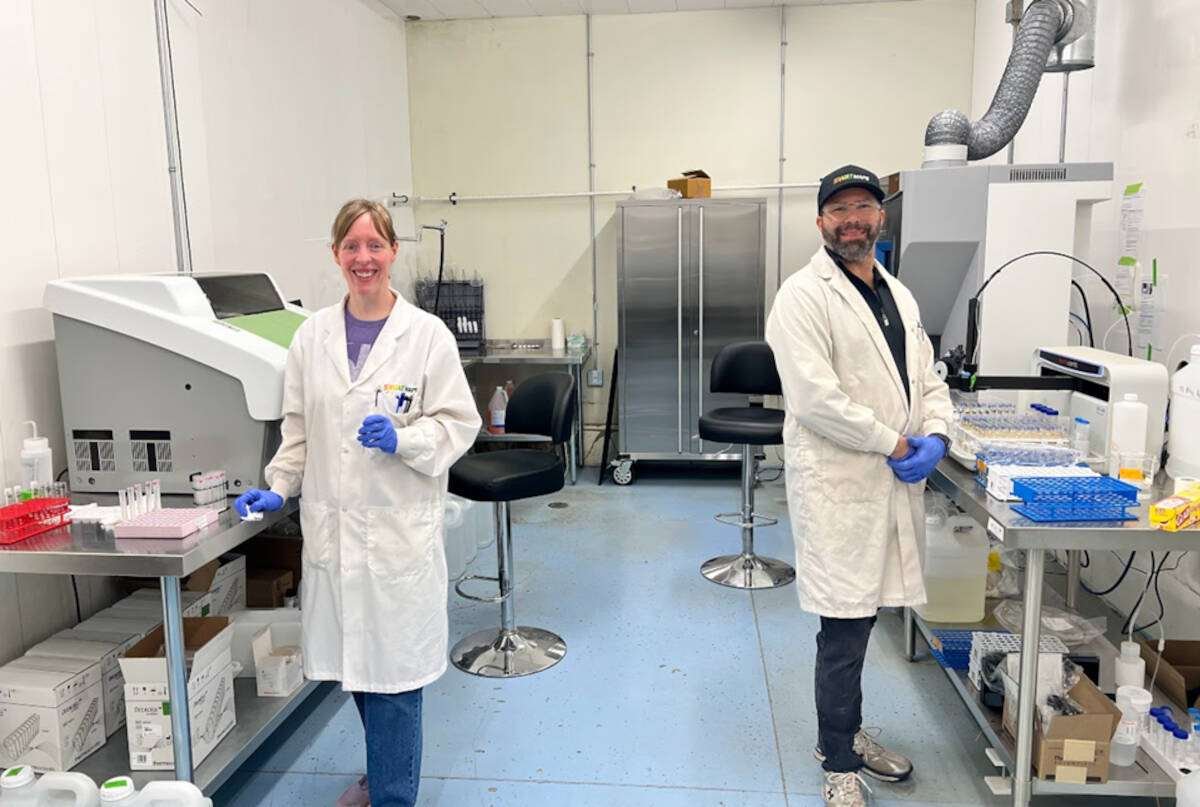
Photo: Croptimistic
Croptimistic soil scientist Joel Ens says that variability is something his team deals with directly.
Differences in extraction methods, sampling strategies and lab procedures make it difficult to directly compare results, particularly when data is being combined across multiple fields or regions.
“We can convert one lab’s results into another,” he said. “But there’s always that loss in accuracy.”
That’s part of the reason Croptimistic has moved to bring soil testing in-house with the launch of SWAT Labs in January, a new facility designed to connect sampling, analysis and digital records within a single system.
Controlling workflow
By controlling that entire workflow, the company aims to improve consistency in how soil data is generated and interpreted. It also allows for the development of larger, internally consistent datasets that can be used to refine recommendations over time.
“We have direct comparable results to other fields,” Ens said.
“It’s not just what’s happening in your field.”
That broader dataset is central to how the system works. Rather than relying solely on individual soil tests, Croptimistic’s approach connects fields through shared data, allowing patterns to emerge across similar soil types and conditions.
At the same time, the company is careful not to treat that data as interchangeable across all situations. Comparisons are made within similar environments, recognizing that variability between regions and soil types still matters.
The goal isn’t to eliminate complexity, Ens said, but to manage it.
“When we bring everything together — mapping, sampling, prescription development — we can build tools so that complicated systems become easy to use,” he said.
The post How soil variability is shaping ag technology appeared first on Farmtario.


