How The Top Football Colleges Bring In $13.1 Billion a Year
The top football colleges collect billions of dollars in revenue each year, with more than $13 billion flowing into athletics programs across the Football Bowl Subdivision (FBS).
But where does all that money come from? From lucrative media rights to ticket sales, athletics at top football colleges draw revenue from a wide range of sources.
This visualization, created in partnership with Terzo, breaks down the categories of athletics funding within the FBS, which is the classification for athletics programs with the highest-profile college football competition. It’s part of our Markets in a Minute series that delivers quick economic insights.
A Breakdown of Revenue at Top Football Colleges
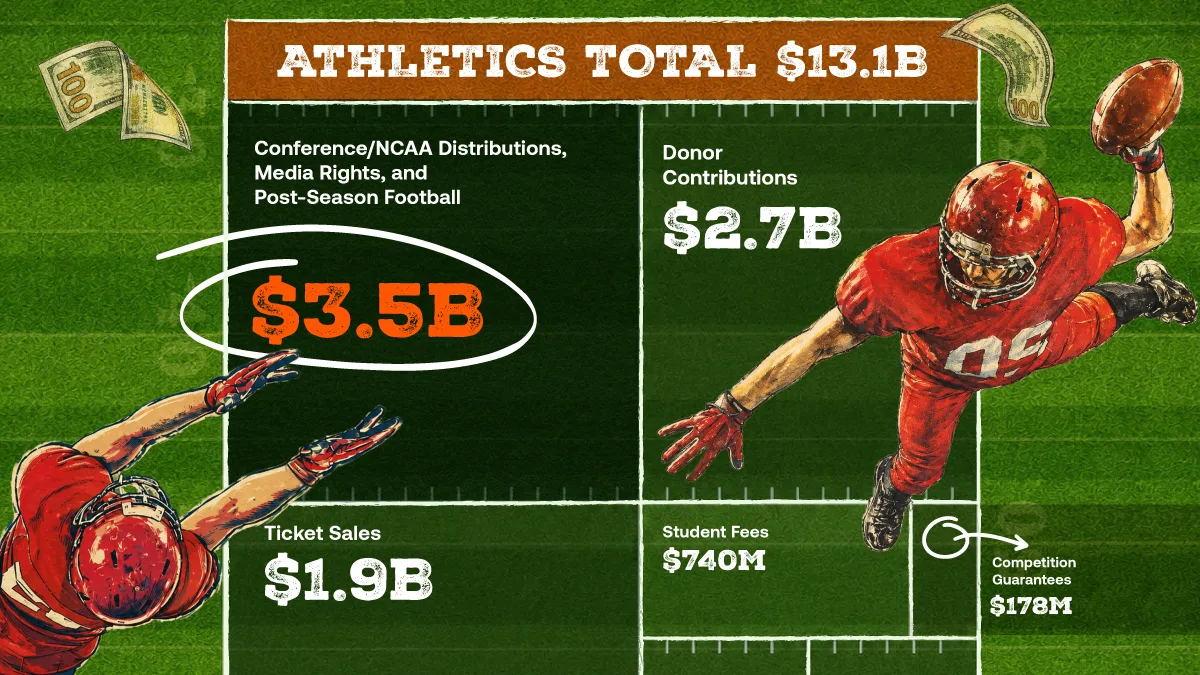
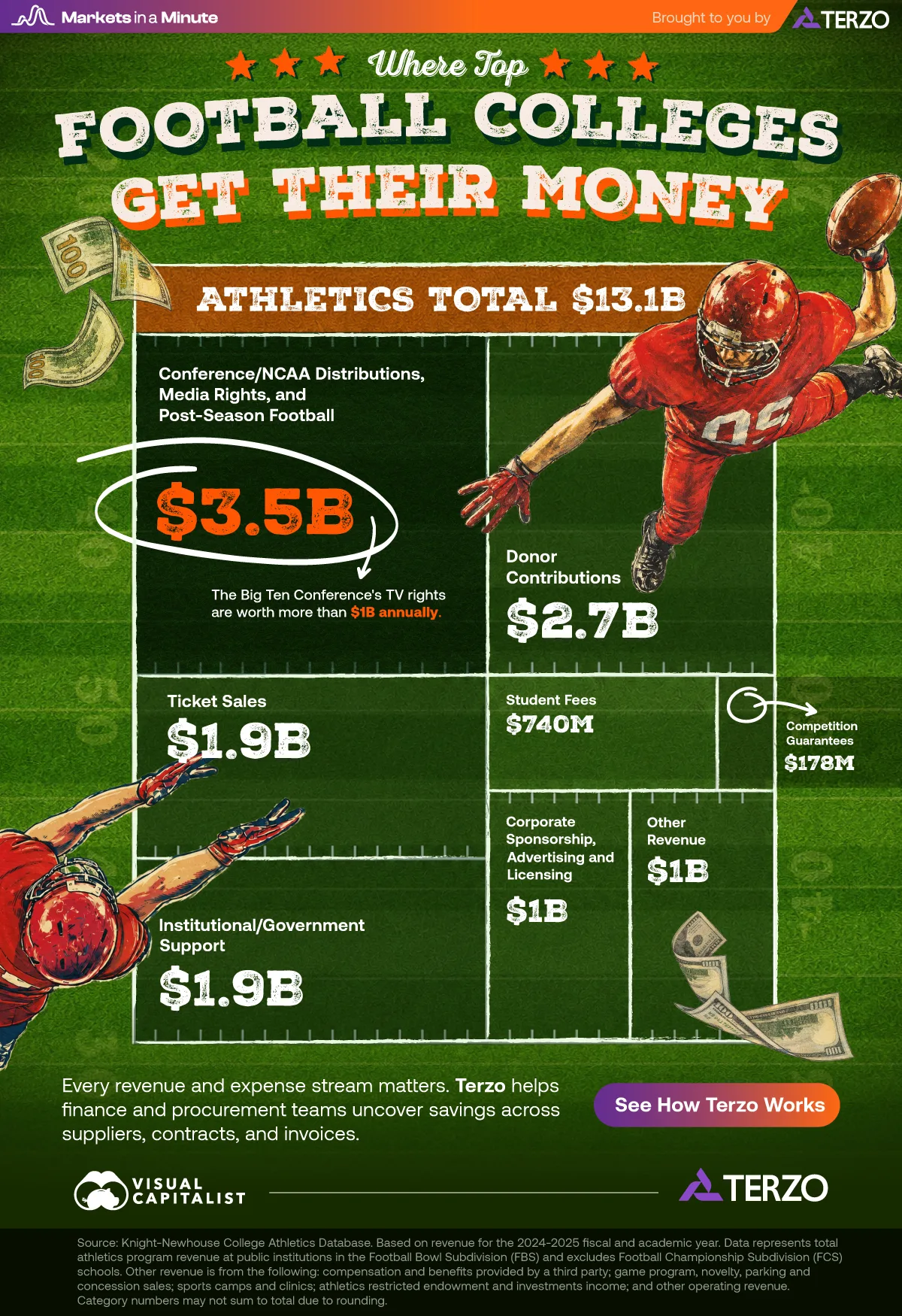
Conference/NCAA distributions, media rights, and post-season football make up 27% of revenue. In particular, TV rights generate big dollars for teams.
The Big Ten Conference, which includes the Ohio State Buckeyes and the Michigan Wolverines, has TV rights worth more than $1 billion annually. Similarly, the Southeastern Conference’s media deal generates roughly $710 million each year.
Beyond college athletics, it’s worth noting that media rights also play a large role in the global market value of the sports industry.
| Category | 2025 Football Bowl Subdivision (FBS) Revenue |
|---|---|
| Conference/NCAA Distributions, Media Rights, and Post-Season Football | $3.5B |
| Donor Contributions | $2.7B |
| Ticket Sales | $1.9B |
| Institutional/Government Support | $1.9B |
| Corporate Sponsorship, Advertising, Licensing | $1.0B |
| Student Fees | $740M |
| Competition Guarantees | $178M |
| Other Revenue | $1.0B |
| Total | $13.1B |
Source: Knight-Newhouse College Athletics Database. Based on revenue for the 2024-2025 fiscal and academic year. Data represents total athletics program revenue at public institutions in the Football Bowl Subdivision (FBS) and excludes Football Championship Subdivision (FCS) schools. Other revenue is from the following: compensation and benefits provided by a third party; game program, novelty, parking and concession sales; sports camps and clinics; athletics restricted endowment and investments income; and other operating revenue. Category numbers may not sum to total due to rounding.
The second-largest category of revenue is donor contributions. This includes donations from individuals, companies, associations, foundations, clubs, or other organizations. Among these donors are famous billionaires such as Shark Tank investor Mark Cuban and Nike founder Phil Knight.
Following donations, ticket sales and institutional/government support both amounted to nearly $2 billion in revenue. The latter includes funds the university or college provides to athletics, along with the value of indirect university support, such as administrative services and free use of athletics facilities.
The Economics of College Athletics
Athletics teams at top football colleges get their money from a variety of sources, making them less vulnerable to drops in any one area. However, expenses have been rising faster than generated revenue, meaning reliance on student fees and government/institutional support is increasing.
Both on and off the field, every revenue and expense stream matters. Terzo helps finance and procurement teams uncover savings across suppliers, contracts and invoices.

Uncover 10% or more annual cost savings with Terzo.
-
 Economy2 weeks ago
Mapped: Where Workers Are Becoming More Productive in America
Some states are producing more while working fewer hours. See where productivity surged, and where it fell behind.
-

 Housing1 month ago
Mapped: New Home Building Permits By State
Idaho led the country in new home building permits per capita from June 2025 to May 2026. Find out which states came next.
-
 Sports1 month ago
Breaking Down the $655 Million World Cup Prize Money
Winning the World Cup earns $50 million, but even teams eliminated in the group stage take home $9 million in prize money.
-
 Housing1 month ago
Where U.S. Home Prices Have Outpaced Income the Most
See where home prices have risen far faster than incomes across U.S. metro areas, with Bend, Oregon leading the nation since 1990.
-
 Education2 months ago
Ranked: America’s 20 Lowest-Paying College Degrees
Salary is only one factor in choosing a major, but the lowest-paying college degrees can have a significant impact on lifetime earnings. What are they?
-
 Education2 months ago
Ranked: America’s 20 Highest-Paying College Degrees
The highest-paying college degrees can shape a graduate’s earning potential for decades—which ones top the list?
-
 Revenue2 months ago
Ranked: The Biggest U.S. Companies by Revenue
Amazon ends Walmart’s 13-year reign at the top, reshaping the 2026 leaderboard of the biggest U.S. companies by revenue.
-

 Culture3 months ago
The Biggest Summer Blockbusters Since 2010, by Box Office Sales
See which highest grossing summer movies ruled the box office since 2010, and why only one original film reached No. 1.
-
 Trade3 months ago
U.S. Trade is Falling With China—but Surging With Taiwan and Vietnam
U.S. trade is being reshaped by AI demand, tariffs, and companies shifting toward alternative manufacturing hubs.
-

 Housing4 months ago
Where Luxury Housing Prices Surged the Most in 2025
Luxury housing prices climbed in 2025, led by Tokyo’s nearly 60% jump. See which global cities saw the fastest growth.
-
 GDP4 months ago
Which U.S. States Have the Highest GDP per Capita
See how GDP per capita varies widely across U.S. states, from under $60K in Mississippi to nearly $280K in Washington, D.C.
-
 GDP4 months ago
Ranked: 2026 GDP Growth Forecasts for the World’s 20 Largest Economies
Which major economies are set to grow the fastest in 2026? Explore GDP growth projections for the world’s 20 largest countries.
-
 Currency5 months ago
Ranked: Currencies Soaring Against the U.S. Dollar
See the top-performing currencies against the U.S. dollar and what’s driving their gains, from strong foreign investment to interest rates.
-
 Money5 months ago
Breaking Down the $417 Billion Sports Industry
At an estimated $417 billion in total value today, the sports market continues to expand rapidly. What are the top revenue streams?
-

 Business6 months ago
Ranked: The World’s Top Startup Hubs
Startup ecosystems are emerging around the world, but a small group of countries continues to lead the charge.
-

 Inflation6 months ago
Ranked: The Biggest Price Shocks Businesses Are Facing
Wholesale turkey prices have gone up a whopping 70%. Where else are businesses being hit by high inflation?
-

 Business7 months ago
What a CFO’s Hour is Worth: Ranking the Top Earners
Top CFOs are earnings thousands per hour in compensation. Who’s leading the pack, and how much are they making?
-

 Markets7 months ago
Breaking Down America’s $13 Trillion ETF Market
This visualization breaks down the U.S. $13.4 trillion ETF market by asset class, showing how ETFs allocate capital across equities, bonds, and more.
-

 Markets8 months ago
2025 in Review: The Ups, Downs, and Returns of Global Markets
Which country led stock markets in 2025? See the biggest shocks, rebounds, and year-end returns in this global recap.
-

 Markets9 months ago
Mapped: The Biggest Housing Bubble Risks Globally
Which global cities are most at risk of a housing bubble? This new map ranks the world’s most overheated real estate markets.
-

 Technology9 months ago
Ranked: The Top Factors That Build AI Trust
Want AI your team will trust? Pull back the curtain on the top factors that make people believe in artificial intelligence.
-

 Technology9 months ago
Ranked: AI Hallucination Rates by Model
Find out how common AI hallucination is for leading models, and what that means for the businesses that rely on them.
-

 Technology9 months ago
The Dangers of AI: Visualizing the Top Risks Companies Face
Among the dangers of AI, one stands apart as causing trouble for almost a third of companies. What do leaders need to know?
-
 Business9 months ago
Ranked: Which Universities Build the Most Entrepreneurs?
Which university has had the most alumni become entrepreneurs in the last decade? Hint: its not Stanford or Harvard.
-
 Economy10 months ago
Mapped: Where Workers Are Supporting the Most Seniors
In many advanced economies, the number of retirees is climbing while the working-age population shrinks. What are the countries where workers are supporting the most seniors?
-
 Economy10 months ago
The United States of Unemployment
The national unemployment rate for the U.S. rose to 4.3% in August 2025. But that figure masks vast differences in local labor market health across states.
-
 Markets10 months ago
Ranked: The Economies Most Dependent on International Trade
A trade war has threatened economic ties in 2025. Which economies are most exposed to these shifts in international trade?
-
 Economy10 months ago
Top Countries Behind U.S. Tariff Revenue
Tariff rates vary by country, as does the value of goods each nation exports to the U.S. Which countries contribute the most?
-

 Business11 months ago
Industries Hiring and Firing the Most Employees
As the U.S. labor market cools, which industries are still hiring—and which are cutting back their workforces?
-

 Markets11 months ago
The $150T Global Debt Market
Global debt continues to climb, reaching $150T in Q1 2025. Which countries carry the heaviest burdens?
-
 Money11 months ago
NEW: Fed Rate Cuts vs. Other G7 Countries
How do Fed rate cuts in the U.S. compare with the interest rate changes in other G7 countries, and what does it mean for business?
-
 Jobs12 months ago
Ranked: The Fastest Growing Jobs (2024-2034)
Explore the fastest growing jobs by projected growth rate, plus salary insights, in a rapidly changing job market.
-

 Investor Education1 year ago
The $127 Trillion Global Stock Market in One Giant Chart
This graphic pieces together the $127T global stock market to reveal which countries and regions dominate—and how much equity they control.
-

 Personal Finance1 year ago
Late to the Ladder: The Rise in First-Time Home Buyers’ Age
The median age of first-time home buyers has reached a historic high. See just how long it’s taking people to get on the property ladder.
-
 Markets1 year ago
Unpacking Real Estate Ownership by Generation (1991 vs. 2025)
The Silent Generation’s share of real estate has dropped dramatically as people age, but how have Baby Boomers, Gen X, and Millennials fared?
-

 Business1 year ago
America’s Economic Engines: The Biggest Industry in Every State
Real estate is the biggest industry by GDP in 26 states. Find out why it dominates—and what fuels the rest of the country.
-
 Maps1 year ago
Mapped: Manufacturing as a Share of GDP, by U.S. State
Tariffs are rising to boost American-made goods. Which states gain the most—and least—from manufacturing today?
-

 Technology1 year ago
Profit Powerhouses: Ranking The Top 10 U.S. Companies by Net Income
Collectively, the ten most profitable U.S. companies have a net income of $684 billion—more than the entire GDP of Belgium.
-

 Money1 year ago
Millionaire Hubs: Mapping the World’s Wealthiest Cities
New York City has the highest millionaire population globally. Which other cities attract the world’s wealthiest?
-
 Economy1 year ago
Tomorrow’s Growth: GDP Projections in Key Economies
The global economy is expected to have slighter slower growth going forward. Which countries are on track to have the biggest GDP increases?
-
 Money1 year ago
Mapped: Interest Rates by Country in 2025
The U.S. has kept their target rate the same at 4.25-4.50%. What do interest rates look like in other countries amid economic uncertainty?
-
 Markets1 year ago
U.S. Housing Prices: Which States Are Booming or Cooling?
The national housing market saw a 4.5% rise in house prices. This graphic reveals which states had high price growth, and which didn’t.
-

 Investor Education1 year ago
The Silent Thief: How Inflation Erodes Investment Gains
If you held a $1,000 investment from 1975-2024, this chart shows how the inflation rate can drastically reduce the value of your money.
-

 Politics1 year ago
Trade Tug of War: America’s Largest Trade Deficits
Trump cites trade deficits—the U.S. importing more than it exports—as one reason for tariffs. Which countries represent the largest deficits?

- Source: https://www.visualcapitalist.com/sp/ter02-how-top-football-colleges-bring-in-13-1-billion-a-year/