
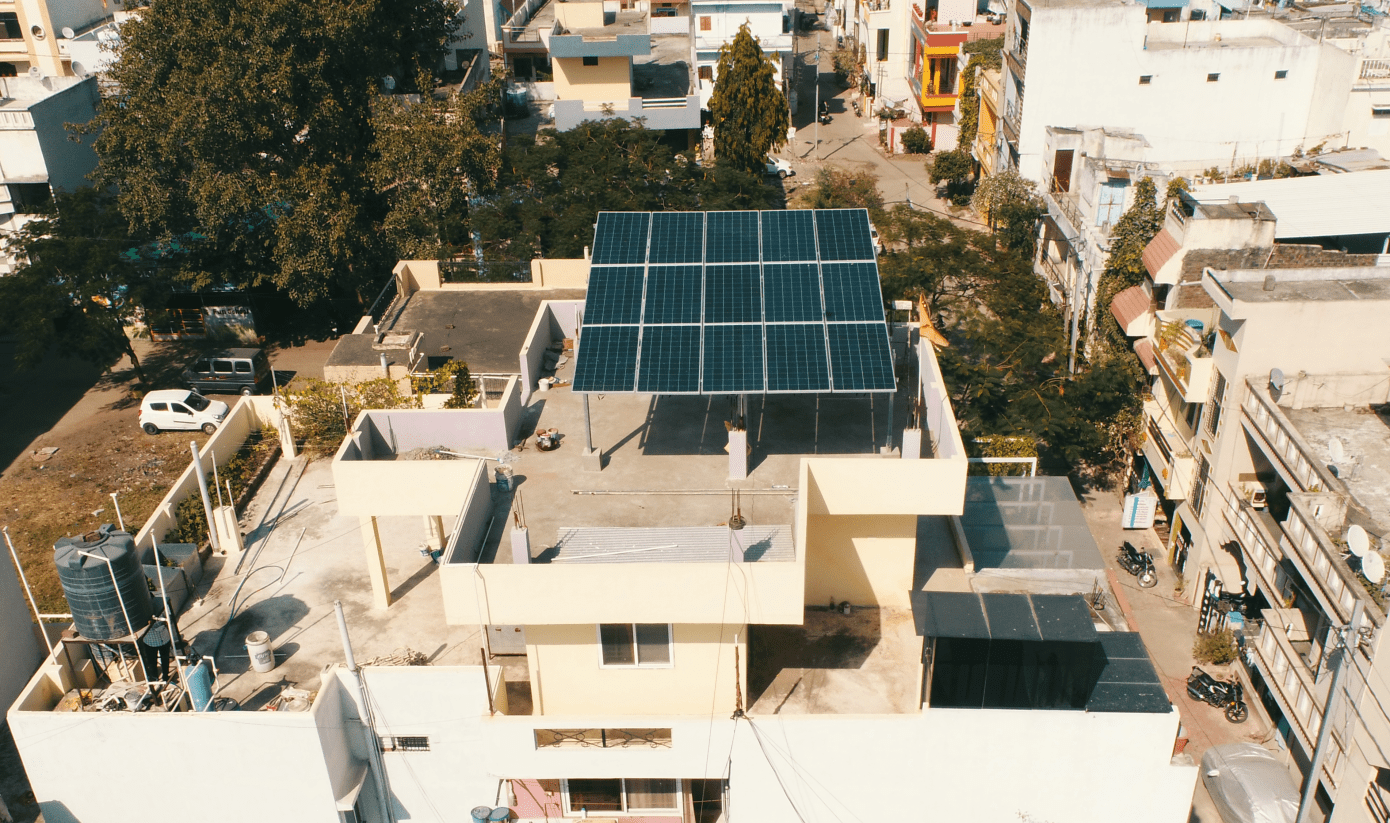
Somewhere in Mumbai right now, a two-person crew is bolting solar panels to a concrete rooftop while the homeowner watches from the shade with a cup of tea. Tomorrow the team will do it again, three houses down. Then again, the day after. This is what India’s booming electric economy looks like up close.
Odds are, that crew belongs to SolarSquare, India’s go-to brand for rooftop solar. The company’s obsessive focus on customer satisfaction is paying off—when their electric-blue vans roll into a neighborhood, heads turn the way they do for an ice cream truck on a summer day. They’ve earned their spot as one of the top 10 residential solar installers in the world by liberating more than 35,000 homes from the perils of grid dependence.
SolarSquare is driving India’s buildout of silicon and glass. In 2025, 1.5 million homes went solar, with 200,000 more strapping power plants to their roofs each month this year. India is on track to add 500 GW of clean power by the end of the decade. If there are three things the country has in big supply, it’s sunshine, rising energy costs, and a massive population that’s sick of burning coal.
The Elephant in the Room.
Let’s get the obvious out of the way: India has a big population. It’s ticking up to 1.5 billion. They’re young, they’re urbanizing fast, and their economy is surging. India’s electric power consumption per capita is a tenth that of the US and a fifth of China’s. That gap is a measure of what’s coming: an expanding middle class and a boom in consumer spending on air conditioners, EVs, and refrigeration. All of that and more run on electrons that India currently doesn’t produce at scale.
Right now, the country imports nearly 87% of its crude oil. That’s the kind of dependency that keeps prime ministers up at night, and it’s exactly why India has set a 2047 target for energy self-reliance. The next two decades represent a historic, century-scale transition. India can either double down on tanker ships, coal, and smoggy skies. Or they can build out the cheapest power source ever invented on the 260 million rooftops they already own. They’re choosing the rooftop.
A Nudge from New Delhi.
The typical version of the Indian solar story starts with the sun and its size. While true, it paints an incomplete picture. What few people outside of the country have noticed is that the Indian government quietly assembled the most comprehensive regulatory architecture for residential solar anywhere in the world.
In 2020, India enshrined the right to net meter rooftop solar into its national Electricity Rules, meaning consumers’ ability to sell power back to the grid was elevated almost to a civil right. Then the government built the National Solar Portal to centralize the subsidy and permitting application process into one accessible platform serving the entire country. The time to solarize 100,000 homes through the portal has since dropped to about 17 days.
Then Modi took it further. In 2024, the government committed to solarizing 10 million rooftops—a target that looked almost comically aspirational at the time but is starting to look conservative. New Delhi then rolled out direct subsidies and middle-class tax incentives to make sure even more ordinary Indians could afford it.
The government can build the architecture, but it can’t run the business. When the incentives hit, thousands of mom-and-pop shops rushed in. The husband-and-wife team who had been there for a decade were already waiting.
The Width and Height of SolarSquare.
SolarSquare was founded by Neeraj Jain, a recovering Deutsche Bank investment banker who quit finance to bootstrap a commercial solar business with his family’s savings. For years, SolarSquare installed panels on factories and college campuses, building a strong foundation by working through the mechanics of solar development—installation, financing, subsidies.
The company did well, but it reached cruising altitude when his wife, Shreya Mishra, joined with an eye for the consumer. Shreya had previously built and sold Flyrobe, India’s largest B2C apparel rental platform. Shreya knows how to make consumers fall in love with a brand. Neeraj knows how to put panels on a roof.
The pivot to residential changed everything. When we first backed SolarSquare, India was installing roughly 6,000 rooftops a month. That number is now north of 200,000, and SolarSquare is riding the wave. They act as the consumer-facing node between a solar installer and a homeowner, helping the 97% of Indian households without solar navigate the web of steps that stand between wanting a solar roof and actually having one.
Switching to solar is a big decision. After all, you’re installing an operational power plant in your home. But the math is hard to argue with: a standard rooftop system pays for itself in as few as three years and then generates free electricity for twenty more. Of course, that only works if the system actually performs over its lifetime. When you’re buying a 25-year energy machine, you want to make sure the seller isn’t going to leave you on read.
If sunshine is abundant on the Indian subcontinent, trust for solar technicians is in short supply. The government’s subsidy program brought 4 to 5,000 new installers into the market last year alone. Most of them are chasing the money and not the customer. Half of what they install underperforms within two years. And a quarter of them blow off the roof in heavy winds.
The safe bet is to turn to the most trusted company listed on the portal: SolarSquare. They’ve earned that spot by building for conditions most solar companies never think about, like engineering products that can survive multiple monsoons and double as shade between them. As Shreya puts it, they’re not selling solar; they’re selling peace of mind and electricity savings.
Putting Some Numbers on Peace of Mind.
SolarSquare is the first brand in the world to offer a savings guarantee on residential solar through its GoodZero product. The basic tier covers one year. The standard product covers 5—the favored option since a panel pays itself back in about 3 years. No other solar company on Earth offers anything like it. GoodZero now accounts for 83% of bookings.
That kind of confidence is contagious. Referrals drive a third of new orders. That’s a third of the business delivered without marketing just because someone’s neighbors’ electricity bills disappeared. In an industry where companies live and die by customer acquisition costs, SolarSquare spends an order of magnitude less than its Western counterparts to win a sale. To capitalize on that demand, SolarSquare launched a process innovation called Speed Order to compress booking-to-install from 45 days to about a week.
GoodZero. Speed Order. These are product names that don’t leave much to the imagination, and neither do their outcomes. The sum result is margin expansion from three directions at once: premium pricing, free acquisition, and density economics that drop fulfillment costs as you scale within a city.
The Most Mispriced Market
The venture world has systematically undervalued global residential solar companies by benchmarking them against US counterparts, but the Indian market structures produce fundamentally different economics. The investor base reflects this reality. SolarSquare has drawn backing from every direction—India’s top tech founders at seed, prominent international growth investors in later rounds, and folks like us who saw the opportunity from the beginning. New Delhi created the perfect conditions for a historic boom in residential solar adoption, and SolarSquare is smack in the middle of it. Reach out if you don’t want to get left behind.
The post How to Electrify a Subcontinent appeared first on Lowercarbon Capital.


