

Researchers in Iran have investigated the effect of random interface texturing on the performance of methylammonium lead iodide (MAPbI₃) perovskite solar cells. Using a coupled two-dimensional finite-element optoelectronic simulation framework, they systematically analyzed how introducing nanostructured textures across all layers of the device influences its behavior.
In particular, their model captures the interplay between optical effects—such as enhanced light trapping and absorption—and electronic processes including charge transport and recombination, providing insight into how multi-layer texturing can be used to optimize overall device efficiency.
“While many studies apply random or periodic textures, we systematically compare three different random morphologies and show that device performance is not simply governed by increased roughness or surface area,” corresponding author Maryam Zoghi told pv magazine. “Instead, the key is the trade-off between enhanced useful absorption in the perovskite layer and transport penalties caused by morphology-dependent tortuosity.”
She added that the team is currently exploring scalable fabrication routes capable of reproducibly producing the morphologies identified in this work. “The team also plans to investigate the long-term stability of these textured interfaces, as nanoscale morphologies can influence defect formation, ion migration, and degradation pathways—an aspect that was not explicitly modeled in the present simulations but is critical for real-world applications,” Zoghi added.
The simulation-based study investigated three representative random interface morphologies: pyramidal, bumpy, and quasi-sinusoidal. The pyramidal morphology exhibited the lowest roughness, interface-area ratio, and feature depth. The bumpy morphology provided a larger interface area and deeper features, but also the highest transport tortuosity. The quasi-sinusoidal morphology combined the largest interface area and deepest features with moderate tortuosity, resulting in the best overall photovoltaic performance.
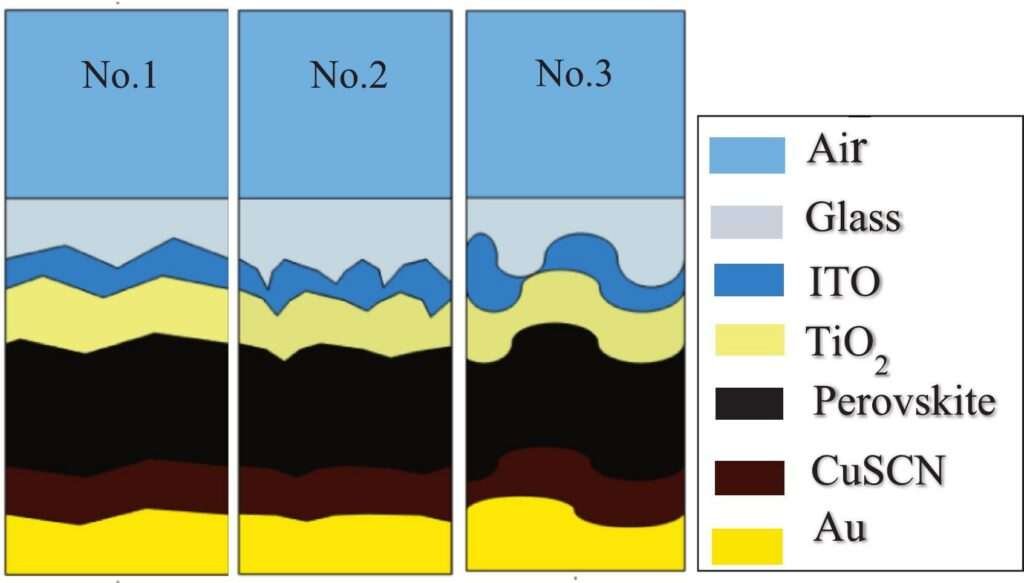
The performance of each textured morphology was evaluated against a planar perovskite solar cell reference. All cells—both textured and planar—used identical materials and layer thicknesses. The simulated device consisted of a 50 nm indium tin oxide (ITO) front electrode, a 90 nm titanium dioxide (TiO₂) electron-transport layer, a 200 nm MAPbI₃ perovskite absorber layer, an 80 nm CuSCN hole-transport layer, and a 100 nm gold (Au) back electrode, resulting in an ITO/TiO₂/MAPbI₃/CuSCN/Au device architecture.
“The most surprising result for us was that the quasi-sinusoidal texture, which is neither the sharpest nor the most irregular morphology, consistently outperformed the pyramidal and bumpy structures. We initially expected that a more aggressive texture (like the bumpy one) would yield the highest photocurrent due to stronger light scattering,” Zoghi said.
More specifically, the quasi-sinusoidal morphology provided the most favorable optical–electrical balance, yielding a short-circuit current density of 25.1 mA cm⁻² and a power conversion efficiency of 21.38% for a device with a 200 nm absorber layer, corresponding to a 15% increase in Jsc relative to the planar reference.
“However, we found that while the bumpy structure provided some optical benefit, it suffered from a much larger electrical penalty, likely due to increased tortuosity and series resistance,” she added. “In contrast, the smoother quasi-sinusoidal shape achieved the best optical–electrical balance, increasing the short-circuit current density by 15% and the power conversion efficiency by over 20% relative to the planar reference. This counterintuitive result highlights that ‘more texture’ is not always better.”
The research findings were presented in “Random textured interfaces for efficiency enhancement of perovskite solar cells,” published in Results in Physics. Scientists from Iran’s Tarbiat Modares University and University of Tehran have participated in the research.
The post Improving perovskite solar cell efficiency with random textured interfaces appeared first on pv magazine Global.


