An effort was undertaken to investigate the mechanisms responsible for internal pressure build up within thermal protection system (TPS) materials subjected to high-enthalpy environments. Understanding how gases evolve, migrate, and interact with the microstructure of a TPS is essential for predicting degradation and failure modes such as spallation. To this end, complementary experimental approaches were employed that provided both chemical and mechanical insight into subsurface processes.
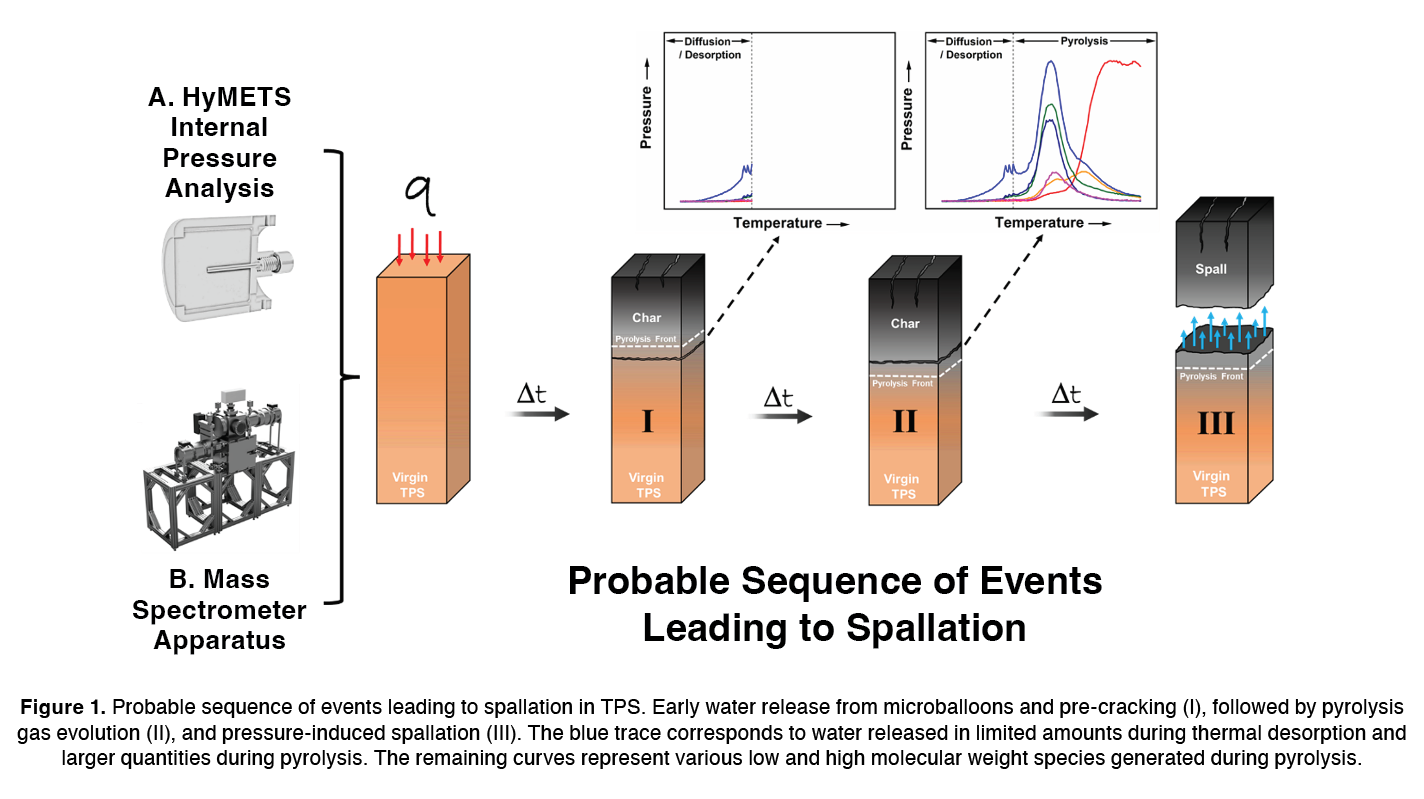
Chemical evolution and internal pressure buildup were identified using the processes illustrated in Figure 1. In part A, in-depth pressure measurements obtained during testing in the Hypersonic Materials Environmental Test System (HyMETS) quantified the dynamic buildup of subsurface pressure as gases evolved. In part B, mass spectrometry was applied to characterize volatile species released as the TPS decomposed under heating. This analysis distinguished between species that desorb at lower temperatures, such as water release prior to significant changes in permeability, and those produced during the breakdown of the polymer backbone through high-temperature pyrolysis. Together, these data sets established a quantitative link between chemical decomposition and mechanical response, forming a foundation for interpreting how microscale chemical processes manifest as macroscale material instability.
Lessons gleaned from mass spectrometry and HyMETS testing led to an enhanced understanding of the spallation mechanisms of TPS, as illustrated in Figure 1. Initial heating of the TPS induces the release of absorbed water from microballoons and the surrounding matrix before extensive pyrolysis (I). This early release of exiguous water can generate localized stresses when the material is in a state of low permeability and may result in localized crack formation before pyrolysis. As heating continues, the pyrolysis front advances, liberating a significant amount of gas and a rapid buildup of pressure occurs (II). If the internal pressure surpasses the local material strength, sudden ejection of fragments follows, marking a spallation event (III). This sequence highlights the probable interplay between early-stage volatile release, pyrolysis gas evolution, and stress generation, all of which govern the stability of TPS material under entry conditions.
For information, contact Dr. Brody K. Bessire. brody.k.bessire@nasa.gov