

Ireland’s solar sector is preparing for a significant test under the country’s sixth Renewable Electricity Support Scheme auction (RESS 6), which introduces new EU-driven criteria alongside the traditional focus on price.
“We expect solar to compete strongly in RESS 6,” Leanne Donovan, Policy Manager, Solar Ireland, told pv magazine, as Ireland’s solar industry prepares for the government-run sixth renewable energy auction (RESS 6) process.
RESS 6 is the first Irish auction to incorporate the European Union’s Net-Zero Industry Act (NZIA) rules around pricing. Since December 2025, Article 26 of the NZIA requires Member States to apply non-price criteria in renewable energy auctions to boost competitiveness while also promoting the integration of renewable resources into national grids.
Under Ireland’s interpretation of these rules, price accounts for 85% of the overall score, with the remainder allocated non-price criteria.
RESS 6 will have separate technology pots for solar and onshore wind which allows both a fairer chance to compete, said Donovan. In RESS 5, around 853 MW of solar was successful compared with 219 MW of onshore wind.
“Solar’s previous performance gives us confidence, but it is still too early to predict the outcome of RESS 6. This will depend on the capacity available within the solar pot, the number of qualifying projects, bid prices, financing conditions and whether the wider grid and regulatory framework will support project delivery. Ultimately, success should be judged not only by the capacity awarded, but by whether those projects can be financed, connected, and built,” Donovan said.
Solar has performed very well in previous auctions, securing the largest volume of successful capacity in each one to date. However, as with any new system, the market needs time to adjust and Donovan believes it is to early to predict the outcome of RESS 6. “Cost competitiveness will remain the dominant factor,” she said.
Solar capacity will remain at 11% despite a proposal to change it to 14%. Donovan said Solar Ireland welcomes this. “The 14% proposal was based on a high-output scenario intended to represent the technical capability of solar plants. However, we believed the auction should use an assumption that more closely reflects actual operating experience in Ireland. Using a realistic capacity factor provides a clearer and more credible basis for developers preparing their projects and avoids calculations being based on an expectation of annual output that may not be achieved in practice.”
Non-price criteria
Outside of the 85% price weighting, RESS 6 allocates 10% to energy system integration and 5% to system resilience.
The 10% energy system integration score will allocate up to 2.5% for projects incorporating a secondary technology and 7.5% for battery storage.
According to Donovan, the government needs to act fast to ensure Ireland’s regulatory policy lines up with the new RESS 6 rules.
“An auction incentive can only work if the wider electricity market and regulatory framework allow developers to deliver and operate those projects effectively.” Donovan added that the utility regulator’s decision to enable the sharing of Maximum Export Capacity is a good start, but it needs to be implemented quickly. Plus, it is currently limited to co-located projects where the different technologies are separately registered and operate independently, with a single legal entity behind the connection point.
Further reforms are needed to facilitate integrated hybrid units and energy sharing behind the connection point, including allowing batteries to store renewable electricity that would otherwise be wasted.
“Ireland needs arrangements that accommodate multiple legal entities behind one connection point, alongside clear rules covering charging, metering, settlement, dispatch, grid-code compliance and access to system services and other storage revenues. Until those reforms are in place, developers may be incentivized through RESS 6 to commit to capabilities that the wider system does not yet fully support,” said Donovan, warning that “Closing that gap will be essential if the new criteria are to translate into deliverable projects and genuine system benefits.”
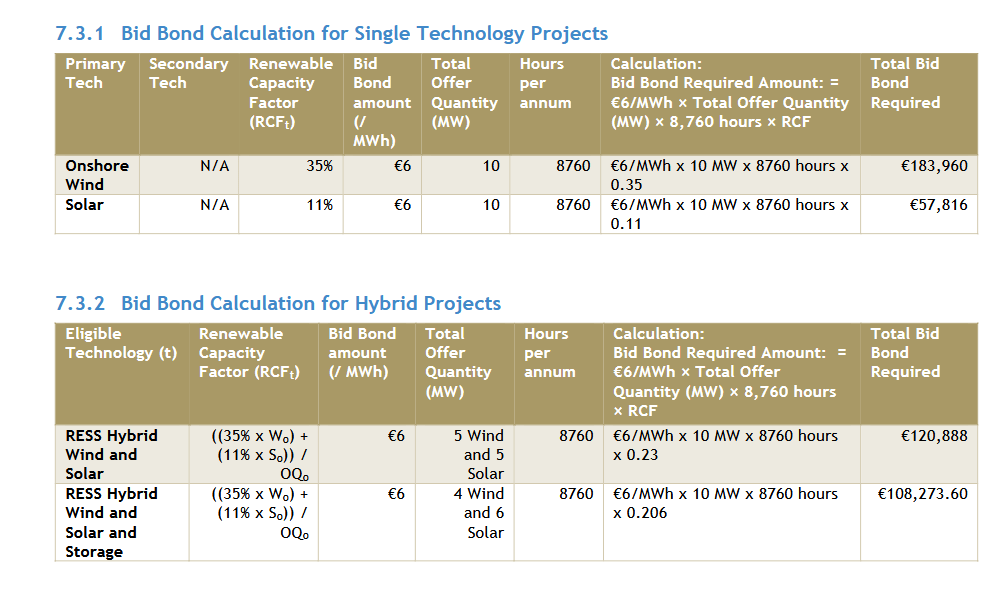
The qualification window is open to interested parties until August 27, and final qualification decisions will be announced on Oct. 21.
Before qualification, applicants are required to submit a RESS 6 qualification declaration, a Bid Bond Submission Form and a Bid Bond Application Return Form. Following the final qualification decisions, applicants deemed qualified must submit a financial questionnaire to the government. Applicants are also obliged to submit a resilience declaration declaring their RESS 6 project complies with the minimum resilience requirements.
Full details can be found in EirGrid’s information pack here. The final RESS 6 auction results will be announced on 2 Dec., with awardees to be notified on 10 Dec. The auction submission window will open on 29 Oct. through to 5 Nov. and provisional results will be announced on 18 Nov.
The post Ireland’s sixth renewables auction puts solar to the test under new NZIA rules appeared first on pv magazine Global.


