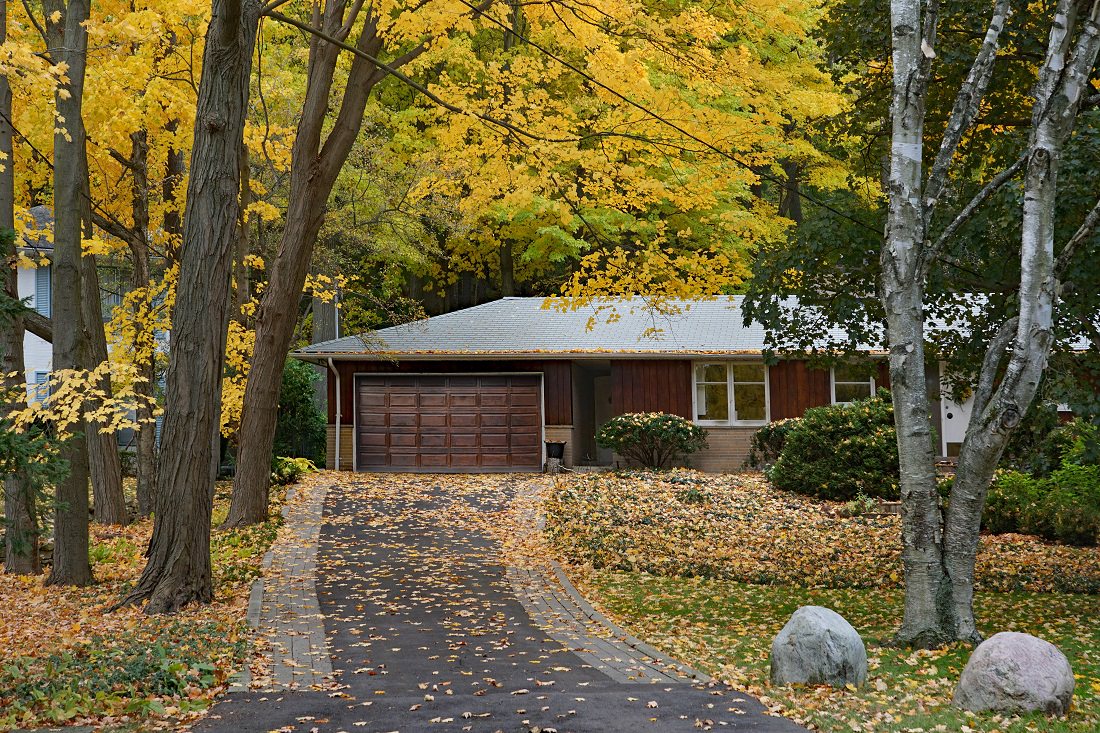
Many people want to install solar panels but their roofs are very shaded. Is it worthwhile to install solar panels?
A chimney casting light-to-medium shade across a rooftop array costs roughly 7% to 9% of the system’s annual production, depending on how the panels are built and wired. That is a real loss, and it is a good deal smaller than most homeowners assume when they look at their roof and decide solar is off the table. Shade remains the most common reason a rooftop system falls short of its production estimate. It is also the design problem the industry has spent the past decade chipping away at, through panel wiring, bypass diodes, and electronics that let each panel work independently.
Meanwhile, the financial picture has moved in the other direction: the 30% federal residential tax credit ended on December 31, 2025, which raises the energy savings bar for what a partially shaded roof needs to deliver. Here is how to tell whether your shaded roof still makes sense, and what to do if it does not.
Measure the Shade Before You Judge It
Eyeballing a roof in July tells you very little about December, when the sun sits lower and shadows run long. Start with a modeling tool and then confirm with a site visit.
- PVWatts, the free calculator from the National Renewable Energy Laboratory, estimates annual solar production for any address and lets you edit the azimuth field to test different roof faces. It does not model the shadows of trees in your yard, so treat its number as a guide, not a definitive confirmation of panel performance.
- Satellite and lidar tools estimate shade from surrounding trees and buildings. The Department of Energy maintains a rundown of rooftop solar potential tools, including Google’s Project Sunroof, Aurora Solar, the National Laboratory of the Rockies’ free desktop app System Advisor Model, Energy Sage, and Sun Number.
- An on-roof shade measurement, taken by the installer with a fisheye or handheld solar pathfinder tool, produces the month-by-month numbers a good proposal should be built on. Ask for it. If a quote arrives without one and your roof has obstructions, that is a reason to keep shopping.
Solar Orientation: Your Angle on the Sun
For optimal power production, it’s best to install the solar panels on a south-facing roof. East- and west-facing arrays give up part of the day: east-facing panels produce well in the morning and taper off by late afternoon, and west-facing panels do the reverse. North-facing panels receive almost no direct sunlight, so they are rarely worth installing in the continental United States.
The gap between south and east or west is narrower than it once was, because panels have gotten more efficient and cheaper per watt. Where utilities charge time-of-use rates that peak in the late afternoon and evening, a west-facing array can also be worth more per kilowatt-hour than a south-facing one, even while producing less overall.
Check your utility’s rate schedule before assuming south-facing panels are the only option.
Trees Are Not Just an Obstacle
Trees on the south side of a house block the midday sun that matters most for production, and they also block winter solar gain that would otherwise cut heating use. Deciduous trees shade panels less in winter once their leaves drop, though bare branches still cost you output. Conifers shade year-round. Small ornamentals can be pruned; a mature Douglas fir in not likely to be pruned into cooperation with your energy goals.
Before reaching for a chainsaw, price what the tree is already doing. Research published in Arboriculture & Urban Forestry found that three well-placed trees — two on the west side of a house, one on the east — cut annual cooling energy use by 10% to 50% in California climate zones. Across U.S. cities, the World Resources Institute estimates that urban trees reduce electricity use by nearly 39 million megawatt-hours a year. A tree that shades your west wall through a heat wave may be earning its keep more reliably than the panels it would make room for. Removing canopy also gives up carbon storage, stormwater absorption, and habitat that a rooftop array does not replace.
Selective limbing, rather than removal, often recovers most of the lost production. A certified arborist and your solar installer should be in the same conversation before anything gets cut.
Dormers, Gables, and Chimneys
Roof features throw hard-edged shadows that move across a solar array during the day. There is no clever workaround for a chimney, so you must place panels judiciously; an experienced installer positions panels where shadows fall least, which often means a smaller array than the roof could otherwise hold.
What has changed is how much a shadow costs once it lands. Modules used to be wired as a single series string, so shading a few cells forced a bypass diode to route current around a third of the panel. Today’s panels are cut into two independently wired halves, which limits the lost output when shadows hit them. Annual simulations from the Zurich University of Applied Sciences, published by the IEA Photovoltaic Power Systems Programme, put numbers on it for a rooftop array under light-to-medium chimney shading. Figures below are annual energy relative to the same array with no shade at all.
| Panel design | No shade | Shaded, string inverter | Shaded, optimizers on shaded panels |
|---|---|---|---|
| Full-cell (older design) | 100 | 90.7 | 92.1 |
| Half-cut cell (today’s standard) | 100 | 91.7 | 92.7 |
| Shingled, shade-resistant | 100 | 93.0 | 93.8 |
| Extra bypass diodes, shade-resistant | 100 | 92.9 | 93.4 |
Source: Baumgartner and Allenspach, ZHAW / IEA-PVPS Task 13, annual simulation of light-to-medium chimney shading.
The spread between the worst and best panel design in that scenario is about 2 percentage points of annual output. A small win, but not the difference between a viable roof and a dead one.
Shade Tolerance Is a Panel Feature
Half-cut cells are the default across every major residential manufacturer, so you will get that architecture whether anyone sells it to you as an upgrade. Some manufacturers now build modules with more than the standard three bypass diodes, or use shingled cell layouts that create additional parallel current paths to maximize production in shady settings. Those designs hold onto measurably more output under partial shade, as the table shows.
Efficiency has climbed, too. Most residential modules on the market now convert 20% to 23% of incoming sunlight into electricity, up from roughly 15% a decade ago, and premium products have crossed 25%. LONGi’s Hi-MO 9 Prime, introduced in June 2026 at 25.2% efficiency, is marketed partly on improved shading tolerance; it’s a sign that manufacturers now treat shade as a design problem rather than an installer’s problem.
Higher efficiency matters most where shade is an issue, because it lets you reach your target system size using the smaller patch of roof that stays sunny.
Microinverters and Optimizers
Module-level power electronics are the standard sales answer to shade. In a conventional array, panels are wired together in a chain, and every panel in that chain has to run at the same electrical setting — so one panel sitting in shade holds back the sunlit ones alongside it. Two products break that link. Microinverters convert each panel’s output into household AC current right on the roof. DC optimizers let each panel run at whatever setting suits the light falling on it, then pass the power along to a single inverter. Both work, and the size of the benefit depends heavily on how much shade you actually have.
An NREL side-by-side test of two identical 8 kW arrays found that microinverters increased production by 3.7% under light shading, 7.8% under moderate shading, and 12.3% under heavy shading compared with a conventional string inverter. The ZHAW modeling points the same direction with more granularity:
- Light shading: a single chimney throwing a small shadow. A plain string inverter with good panels performs as well as or better than an optimized system, because the electronics add roughly 2% in conversion losses of their own.
- Medium shading: a chimney plus a vent pipe, or a dormer clipping a few modules. Putting optimizers only on the affected panels delivers the best result. Shade-resistant modules with extra bypass diodes are the better buy when a whole group of panels is affected.
- Heavy shading: a dormer plus a neighboring building. An optimizer on every panel will pay for itself. Expect annual output to land 10% or more below an unshaded equivalent even so.
Two cost details rarely make it into a sales pitch. Optimizer datasheet efficiency figures are measured in an operating mode that does not reflect daily rooftop conditions, so real-world performance consistently runs below reported level. And electronics sitting on a hot roof may need replacement sooner than the inverter would; asking about a warranty is worthwhile before you buy.
Other Locations for Solar Panels
A shaded roof does not have to be the only site on the property. Panels can go on a garage, a carport, a ground mount in a sunny corner of the yard, an awning, or a pergola. Ground mounts and carports add cost, including for racking, footings, a trench for the wire run, but they let you point the array wherever the sun is, at whatever tilt you want, and they remain accessible for cleaning and repair.
These structures can perform a second role, as a solar carport can shades a vehicle and host an EV charger where the power is generated. A pergola with panels overhead can cool a patio. Where roof shade is the constraint, these extra uses can be what makes the numbers work.
Subscribe to a Community Solar Project
Community solar farms let households subscribe to a share of an off-site array and receive credits on their utility bill, with no equipment on the property. They remain the most practical option for renters, apartment dwellers, and anyone whose roof loses the shade argument.
The solar industry has matured considerably since this article first ran. The Department of Energy counts at least one community solar project in 44 states plus the District of Columbia, with 24 states having passed enabling legislation that encourages or requires the programs, and 19 states plus D.C. maintaining policies for low-income household participation. States with enabling legislation generally have more projects and more open subscriptions.
However, solar growth is uneven. Cumulative U.S. community solar capacity passed 10 gigawatts in late 2025, according to Wood Mackenzie and the Coalition for Community Solar Access, but annual installations fell 25% that year as adoption in New York and Maine slowed. Analysts expect 12% growth in 2026, led by Illinois and the Mid-Atlantic, followed by an average 5% annual contraction through 2030 in existing state programs. Minnesota, New York, Massachusetts, Illinois, New Jersey, Maryland, and Colorado host the largest community solar cluster.
Review a community solar subscription agreement the way you would a lease. Check the term length, the cancellation terms, whether the credit is priced at the retail rate or a value-stack formula, and whether the savings are guaranteed or estimated.
The Federal Math Changed in 2026
The 30% Residential Clean Energy Credit under Section 25D applied to systems placed in service through December 31, 2025. The credit is not available for any property placed in service after that date. Homeowners who bought and installed in time can still carry unused credit forward against future tax years. Anyone buying a system with cash or a loan in 2026 gets no federal credit.
Two paths remain. Third-party ownership, such as through a lease or power purchase agreement, leaves the system in the developer’s hands, and the commercial credit the developer claims can be passed through to you as a lower monthly payment. State and utility incentives, net metering rules, and low-income programs are untouched by the federal change and vary widely; your state energy office is the place to check. Consult a tax professional about your own situation rather than relying on an installer’s summary.
For a shaded roof, the practical benefits of incentives and low-income programs is straightforward. Losing 8% to 12% of production to shade was easier to absorb when the federal government covered nearly a third of the cost. Now, these local and private subsidies are important to making the payback numbers work; however, as energy prices rise, solar will only continue to outperform fossil fuel-generated electricity on price.
Where to Start
- Run your address through PVWatts to establish a best-case production estimate, then ask installers to show their shade measurement and explain the gap.
- Get at least three quotes, and make each one specify panel model, inverter or optimizer configuration, and modeled annual production in kilowatt-hours.
- Ask what the array would produce without the electronics upgrade. If the difference is small, the upgrade may not be worth its cost or its replacement risk.
- Price selective tree pruning against tree removal, and against simply accepting lower production. Bring an arborist into the decision.
- Look at the garage roof, the yard, and the driveway before concluding the property cannot host solar.
- Check whether your state has a community solar program with open subscriptions. For many shaded roofs, that is the option that pencils out.
Related Reading on Earth911
Editor’s Note: Originally published by Sarah Lozanova on August 6, 2019, this article was substantially updated in July 2026.
The post Is My Roof Too Shaded for Solar Panels? appeared first on Earth911.