
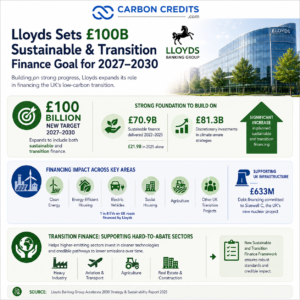
Lloyds Banking Group is setting a new £100 billion sustainable and transition finance target for 2027 through 2030, giving the UK banking group a larger role in financing companies as they cut emissions and invest in cleaner technologies.
The new goal is part of Lloyds’ Accelerate 2030 strategy. It broadens the bank’s focus on sustainable finance. Now, it also includes transition finance. This helps higher-emitting companies and sectors shift to lower-carbon business models.
The target comes after Lloyds delivered £70.9 billion of sustainable finance from 2022 through 2025, including £21.9 billion in 2025 alone. The new four-year target therefore represents a significant increase in the bank’s planned financing activity.
Lloyds Expands Its Sustainable Finance Ambition
Lloyds’ new target builds on several existing sustainable finance commitments. The bank previously targeted £30 billion of sustainable finance for Commercial Banking customers from 2024 through 2026.
It also set goals for £10 billion of EV financing and £11 billion of mortgage lending for EPC A and B-rated properties from 2025 through 2027.
The new £100 billion goal is broader. It covers both sustainable finance and transition finance. This allows Lloyds to support businesses that may not yet qualify for green finance but have credible plans to reduce emissions.
That distinction is important for sectors such as heavy industry, transport, agriculture and real estate. Many of these industries cannot switch to low-carbon systems overnight.
Transition finance offers loans and other financial products. This helps companies invest in cleaner equipment, boost energy efficiency, or change their production systems.
£70.9B Already Deployed Sets the Stage for More
Lloyds has made sustainable finance a growing part of its broader business strategy. The bank reported £70.9 billion of sustainable finance since 2022, with £21.9 billion supported in 2025. It also reported £81.3 billion in discretionary investments in climate-aware strategies.
The bank’s sustainable finance activity covers several areas, including:
- Clean energy,
- Energy-efficient housing,
- Electric vehicles,
- Social housing,
- Agriculture and
- Other projects linked to the UK’s transition.
Lloyds also committed £633 million in debt financing to Sizewell C, the UK’s new nuclear power project. The bank says one in eight electric vehicles on UK roads is financed by the Group. These figures show that the new £100 billion goal is not a standalone climate pledge. It builds on an existing lending and investment business.
Transition Finance Targets Hard-to-Abate Sectors
The biggest change is the addition of transition finance. The UK government defines transition finance as financial products and services that help higher-emitting companies and activities reduce emissions over time. These products should support a credible pathway that aligns with global climate goals.
This matters because many businesses cannot immediately move to zero-emission operations.
A steel producer, for example, may need years to replace equipment. An airline may need time to adopt sustainable aviation fuel and more efficient aircraft. Farmers may need financing to change equipment and farming practices.
Transition finance can help fund these steps. Lloyds’ 2025 Sustainable Financing Framework already said it was reviewing how to include transition finance. The bank has now developed a new Sustainable and Transition Finance Framework to support the expanded target.
The framework is intended to give the bank a consistent basis for deciding which activities qualify for sustainable and transition finance.
The UK Needs Billions More to Fund Energy Transition
Lloyds is expanding its target as the UK works to increase private investment in the energy transition. UK energy transition investment hit £51.1 billion in 2024, according to government data from BloombergNEF. This is a drop from £58.1 billion in 2023, but still higher than early 2020s levels.
The UK government is also trying to make London a larger global center for sustainable finance.
In 2025, the government said 70% of FTSE 100 companies had already developed many of the key elements of a transition plan. It also said net-zero sectors were growing three times faster than the overall economy in the previous year, based on CBI Economics data.
Energy Secretary Ed Miliband noted:
“This government is determined to make the UK the sustainable finance capital of the world as we seize the huge economic opportunities provided by clean energy.”
The government has backed recommendations from its Transition Finance Market Review to help expand the market. For banks such as Lloyds, that creates an opportunity to finance companies that need capital to meet changing climate and energy requirements.
Lloyds Sees Climate Finance as a Growth Opportunity
Lloyds is also presenting the new target as a commercial opportunity. The bank’s wider Accelerate 2030 strategy targets mid-single-digit compound annual income growth from 2027 through 2030. It also aims for a cost-to-income ratio below 45% and return on tangible equity of about 20% by 2030.
That means sustainable finance is being placed alongside the bank’s broader growth plans. This approach is becoming more common across the financial sector. Banks are looking at the transition not only as a climate issue but also as a source of new lending, investment and advisory opportunities.
Lloyds says its purpose is to “Help Britain Prosper.” Its sustainability strategy links financing the transition with long-term economic growth and resilience.
The bank will provide over £35 billion in new finance to UK companies in 2026. This includes £9.5 billion specifically for small and medium-sized businesses.
Lloyds’ Own Net-Zero Targets Raise the Stakes
As a major lender, Lloyds also faces pressure to reduce emissions linked to its own operations and financing activities.
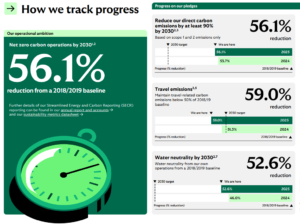
The bank has a target to achieve net-zero carbon operations by 2030. It also aims to cut its Scope 1 and 2 emissions by at least 90% by 2030 and reduce supply-chain Scope 3 emissions by 50%.
- More importantly for a bank, Lloyds aims to reduce bank-financed emissions by more than 50% by 2030, on the path to net zero by 2050 or sooner.

The bank has also set sector-specific financed-emissions targets. These targets make the new £100 billion financing goal more significant. Lloyds will need to grow transition finance while also managing the emissions risks within its lending portfolio.
The £100B Question: Will the Finance Deliver Real Cuts?
The expansion of transition finance also creates a challenge. Not every loan labelled “transition” will automatically deliver meaningful emissions reductions. The quality of the underlying transition plan matters.
This is why Lloyds’ framework and measurement rules will be important. The bank says its transition approach includes client engagement, assessment of transition risks and opportunities, and greater use of data to support decisions. Its 2025 sustainability report also highlighted work with clients in sectors where emissions and transition risks are material.
The UK government has also stressed the need for high-integrity transition finance. Its Transition Finance Market Review called for instruments that can attract long-term capital while maintaining market confidence.
For Lloyds, the value of the £100 billion target depends on two things. First, how much money it helps to raise. Then, where that money goes and the environmental results it achieves.
A Bigger Role for Banks in the UK Transition
Lloyds’ new £100 billion sustainable and transition finance target marks a major expansion of its climate-finance ambitions. This plan helps the bank bring transition finance into its core target. The move also comes as the UK seeks more private capital for clean energy, energy efficiency and industrial decarbonisation.
For Lloyds, the opportunity is also commercial. Transitioning businesses need financing for new equipment, cleaner energy, efficiency upgrades and other investments. Yet, the bank also needs to show that its financing supports genuine progress rather than simply increasing the amount of capital labelled sustainable.
If Lloyds can combine its £100 billion financing goal with strong transition standards and measurable emissions results, the strategy could make the bank a larger force in both the UK’s financial sector and its wider path toward net zero.
The post Lloyds Sets £100B Sustainable Finance Target to Power the UK’s Net-Zero Shift appeared first on Carbon Credits.


