

Researchers from Spain and Brazil have developed a novel, low-cost methodology for assessing rooftop PV potential in informal settlements. It integrates uncrewed aerial vehicle (UAV) photogrammetry, GIS-based irradiance analysis, and an open-access Python tool to automatically estimate module allocation and PV capacity at the rooftop scale.
“Energy transition is not only a technical challenge but also a social and territorial issue, directly related to the principles of energy inclusion and socio-environmental justice,” noted the researchers. “In this context, it becomes important to advance spatial methods and analytical tools capable of revealing the energy potential of historically excluded territories and informing fairer and more territorially sensitive public policies.”
The novel methodology was demonstrated in the Marielle Franco and Alto da Conquista communities, located in the municipality of Simões Filho, Bahia, northeast Brazil. Both communities exhibit characteristics common to precarious settlements, such as absence of land regularization, improvised electrical networks, and high housing density. In addition, their geographic location is favorable to solar capture.
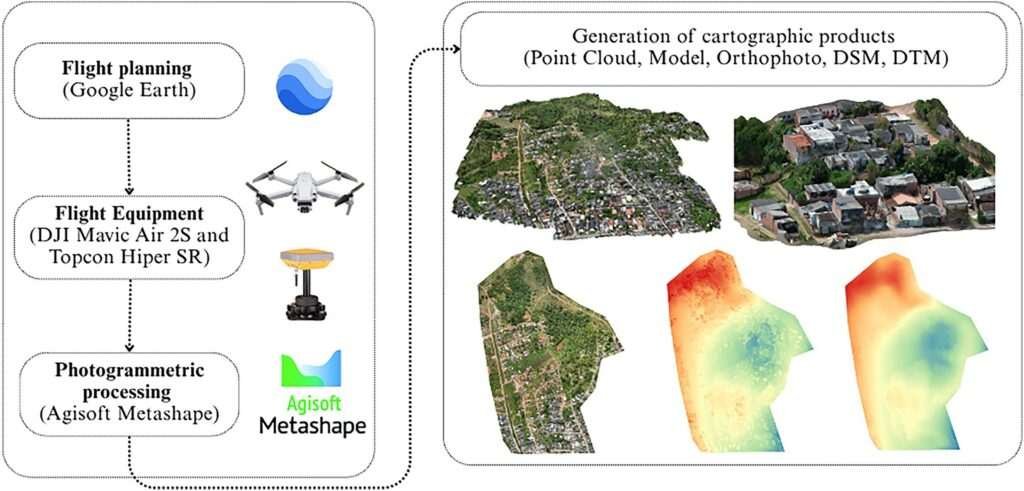
The method begins with flight planning on Google Earth. A UAV is then flown over the informal settlement to collect aerial imagery, with ground control points for accuracy. These images are processed in Agisoft Metashape to generate an orthophoto, a dense point cloud, a digital surface model (DSM), a digital terrain model (DTM), and a 3D mesh. Next, the orthophoto and DSM are imported into ArcGIS Pro, where usable rooftops are manually vectorized, and annual solar irradiance is calculated for each roof.
Next, the rooftop polygons and irradiance data are loaded into an open-access Python decision-support tool, which tests different module orientations and rotations, shifts the module grid to improve fitting, and keeps only modules contained within each usable rooftop. The tool then selects the layout with the maximum number of modules, calculates installed PV capacity and annual energy generation, and exports the results as a GeoPackage and an interactive HTML map.
That method was validated against a detailed PV*SOL 3D simulation to assess its reliability for pre-feasibility assessment. For that, the group imported the UAV-derived 3D mesh into PVSOL Premium and manually defined 46 rooftop mounting areas while excluding south-facing roof surfaces. The software then simulated the system using hourly meteorological data, the Perez sky model, and detailed models of shading, orientation, inclination, temperature, and electrical losses.
Results from the novel method indicated that approximately 577 modules, each rated at 585 W, could be installed, corresponding to an installed capacity of about 338 kWp and an estimated annual generation of 437,000 kWh. Assuming a household demand of 150 kWh/month, the system would correspond to approximately 61% of the average monthly electricity demand of each household.
“The results demonstrated a consistent level of agreement between the automated approach and the detailed simulations performed in PV*SOL Premium, with relative differences below 20% for aggregated indicators,” the group concluded. “This level of deviation is consistent with ranges reported in the literature for pre-feasibility assessments and reflects the methodological differences between simplified irradiance-based models and dynamic simulation approaches that incorporate temporal variability, shading effects, and system losses.”
The tool was presented in “An open-access decision-support tool for rooftop PV potential assessment in informal settlements,” published in Applied Energy. Researchers from Spain’s University of Jaén and Brazil’s Federal University of Bahia have contributed to the research.
The post Low-cost open-access tool for rooftop PV assessment in informal settlements appeared first on pv magazine Global.


