

The scale is easy to underestimate. The pipeline for data centers in the Europe, Middle East and Africa (EMEA) region is growing more than 40% year on year. FLAP-D available data center capacity has fallen to around 6%, with over 80% of it pre-let before completion. Yet most building is happening outside Europe. BloombergNEF counted roughly 23 GW of capacity under construction globally in September 2025 – about 16 GW of it in the United States.
Grid access is the major bottleneck, especially for Europe. The International Energy Agency expects around 20% of planned data center projects worldwide to face delays from grid constraints, and in May, the European grid operator association ENTSO-E warned that system operators may be forced to reduce renewables penetration if demand keeps growing without clearer rules on how these loads connect and behave.
National policy
Ireland now ties any new connection to self-supply (see pp.34-37). After a four-year freeze on new connections, in December 2025 the process reopened for data centers that bring their own power. This should consist of dispatchable capacity matched to a data center’s load, plus renewable generation covering at least 80% of usage.
Constrained areas can still be refused. Roughly 97% of Irish data centers sit in greater Dublin, where EirGrid has signaled they will accept no new applications in the near future.
In Germany, all data centers above 300 kW have to cover their electricity use with renewables on a balance-sheet basis, with the requirement set at 50% since 2024 and, as the law currently stands, 100% from 2027. The government has agreed to push that final step back to 2030.
The Netherlands has gone furthest, confining hyperscalers to two northern municipalities, and barring new data centers of any size in Amsterdam until at least 2030. Yet a €1 billion ($1.1 billion) Microsoft-tenanted campus was approved in Amsterdam anyway, reportedly by splitting the project into three separate planning applications.
Time to power then drives the economics. Large-tenant lease rates in the major hubs are now above $200 per kilowatt per month, so a well-leased facility earns millions of dollars per megawatt, per year. For a 100 MW campus, connecting one year earlier is worth hundreds of millions. Three responses regularly come up when developers model projects in Gridcog.
Non-firm connections
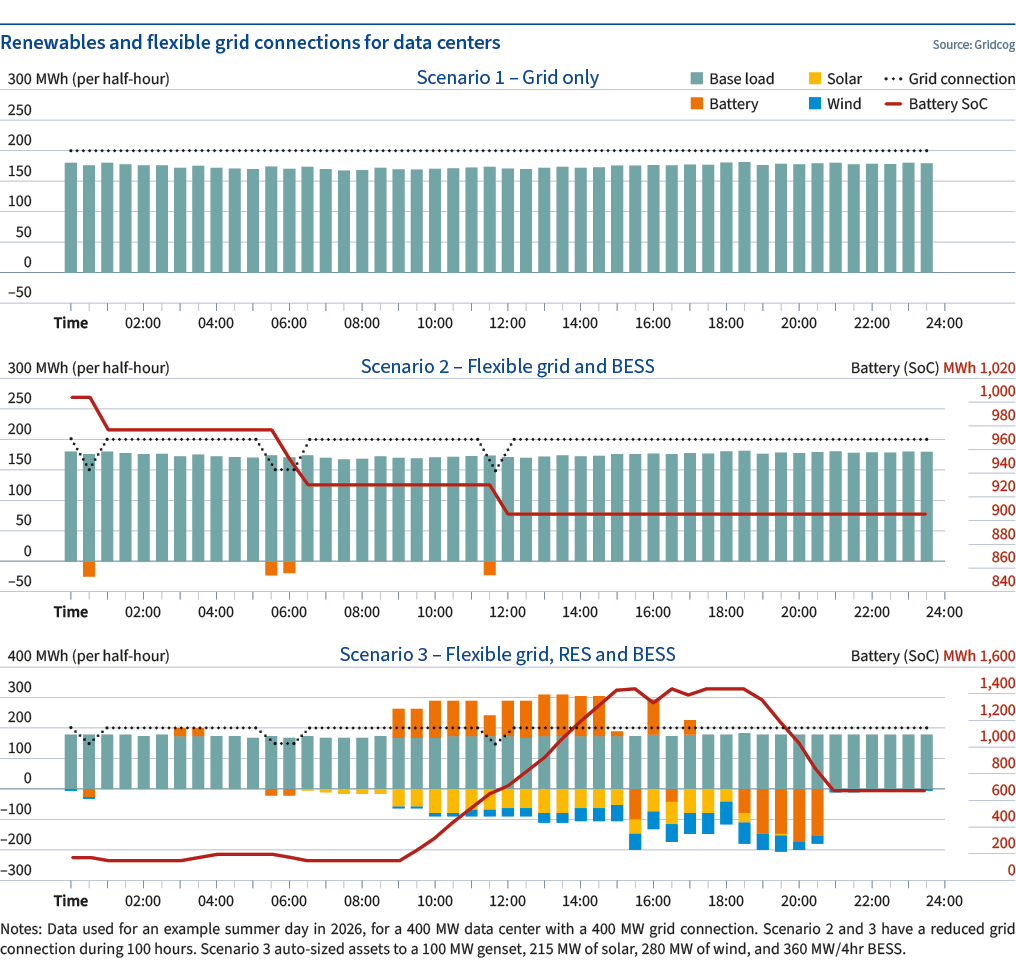
The first is to accept a non-firm grid connection, trading firm capacity for faster access. The operator can curtail when the grid is congested, and behind-the-meter energy assets carry the load for those hours. Aligned Data Centers is doing this in the US Pacific Northwest, integrating a 31 MW two-hour battery to secure an earlier connection.
When curtailment is limited, say 100 hours per year, (see chart, scenario 2) storage can cover it and the early connection ensures return on investment. However, more curtailment requires a more complex and expensive microgrid. Meeting real data-center reliability standards – 26 minutes downtime per year for tier-4 data centers – will usually require backup thermal generation.
Designing the optimal mix of embedded thermal and renewable generation and storage is a difficult modeling challenge.
Private wire
The second path is to build power on site, or nearby, with a smaller grid connection – pairing generation and storage with a private wire. A non-firm connection keeps the grid as the main supply with storage covering gaps, but a small grid connection makes on-site generation the primary power source and the grid has a supporting role. This costs more and increases project delivery risk, but is essential in very constrained regions.
The third option is to skip a new connection and use one that already exists, retrofitting compute onto sites that already hold firm capacity or co-locating load with generation on the system.
In the United Kingdom, some developers are chasing spare distribution capacity, balancing on-site generation, batteries and grid import behind an existing connection. An existing connection is worth more than a new one with a 10-year wait.
Several independent power producers operating existing solar or wind farms are being approached by data center developers to host sites. This can be attractive, given the increasingly challenging economics of standalone renewables due to price cannibalization and the withdrawal of government support schemes.
Each option leans on storage and is an attempt to buy quicker commissioning. Investment firm Jefferies puts the hyperscale battery opportunity at 20 GW through 2035 – a measure of how far developers will go to get around the queue.
What approach works best comes down to the site, how often the connection is curtailed, what the storage does across those hours, and how that stacks up against revenue. That is what Gridcog is built for; running projects interval by interval and across multiple markets, so that developers can be confident they have found the best option for their project before committing capital. Laura Hoffmann-Ostenhof
About the author

Laura Hoffmann-Ostenhof is Europe industry lead at Gridcog, where she helps customers model their clean energy projects and supports product development with her industry expertise across key European markets, including Germany. She has experience working with solar, wind, battery storage and digital energy clients. Hoffmann-Ostenhof holds a master’s degree in energy systems from the University of Oxford and a bachelor’s degree in physics from the University of Warwick.
The post Making the data center business case appeared first on pv magazine Global.


