
“A radical new way of thinking about soil has partially solved the mystery of why adding manure improves crop yields and gives flood and drought resilience.” – Dr Andy Neal, Rothamsted Research
Why do forests thrive without fertilizer? Why do roadside ditches grow lush vegetation without a single pound of applied nitrogen?
For decades farmers and agronomists have focused on macronutrients—nitrogen, phosphorus, potassium – as primary drivers of crop productivity. Increasingly, research suggests the answer to soil health may lie in something less obvious, yet far more foundational: carbon – and how soil microbes use it.
Carbon’s influence
Recent X-ray imaging research that integrate soil chemistry, physics, and microbiology revealed a more porous and interconnected structure in carbon-rich soils that improved the movement of water, air, and nutrients. These characteristics were more evident in long-term grassland soils compared to cropped soils.
The carbon-to-nitrogen (C:N) ratio reflects how soil microbes use nitrogen to decompose carbon. In “healthy” soils with abundant carbon, relatively low nitrogen availability can limit carbon breakdown. Instead, microbes transform carbon and release part of it as sticky extracellular polymeric substances (EPS). These compounds act as a “biological glue”, binding soil particles into stable aggregates. Over time, this process creates the interconnected pore networks that define healthy soil structure.
Conversely, in cropping systems with abundant nitrogen, microbes tend to consume more carbon for energy rather than converting it into stable byproducts like EPS. This reduces the formation of biological “glue,” gradually depleting soil carbon and weakening soil structure. As soils become denser and less aerated, microbial processes shift, increasing reliance on nitrogen and sulphur for energy and raising the risk of nutrient losses and greenhouse gas emissions. Long-term, soils receiving only inorganic fertilizers develop fundamentally different microbial processes compared to soils that regularly receive carbon-rich organic inputs like manure.
Why manure matters
Livestock-based farms with diverse forage rotations and regular manure applications tend to demonstrate improved soil resilience for drought, better water infiltration, and more active, and robust soil biology. Manure is a source of nutrients, but also an important source of carbon.
The quantity and quality of carbon in manure varies depending on manure type, animal diet, bedding, storage, and treatment. Liquid manures generally contain less total carbon and a higher proportion of readily degradable (labile) carbon, while solid manures or those containing bedding contribute more total and stable carbon. These differences influence how effectively manure contributes to soil organic matter and structure.
Liquid manure vs. digestate
Liquid dairy manure (raw slurry), for example, can provide a more functional carbon source than the same manure after anaerobic digestion. Raw slurry contains a higher proportion of biologically active carbon, including partially digested plant fibres (cellulose, hemicellulose etc.). These materials stimulate microbial activity and promote the production of EPS—the “biological glue” critical for soil aggregation.
In contrast, anaerobic digestate has already undergone microbial processing. The most energy-rich carbon has been converted into biogas, leaving behind a more processed material. This remaining carbon behaves more like spent fuel, contributing less to microbial activity and producing less “biological glue”, resulting in a reduced impact on soil structure formation.
Manure synergy
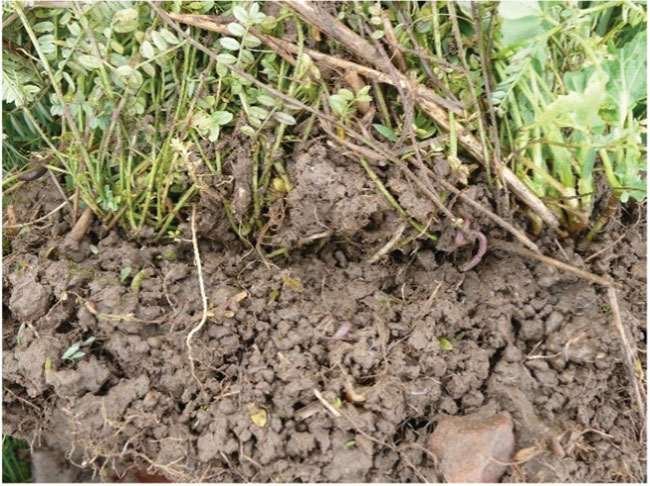
While not all manures contribute equally to soil structure, their benefits become evident when paired with living plants. With application of diluted manures or digestate, the supplied nitrogen can stimulate cover crop growth, increasing biomass production (see lead image). That biomass—both above and below ground—returns carbon to the soil, supporting microbial activity, aggregate formation, and long-term soil health. In this way, manure becomes an indirect driver of soil carbon accumulation, even when its own carbon contribution is limited.
While not every farm can integrate livestock or perennial forages, the underlying principles still apply: improving soil structure and function is a gradual process that depends on consistent carbon inputs combined with thoughtful management.
Options for non-livestock systems include:
- Diversifying crop rotations to include cover crops and continuous living cover
- Minimizing soil disturbance and retaining crop residues
- Avoiding traffic on wet soils to limit compaction
- Using alternative organic amendments where livestock manure is not available
There is no quick fix for rebuilding soil structure. Meaningful change takes years, but the direction is clear. At the heart of soil health is carbon… and the biology that it supports. •


