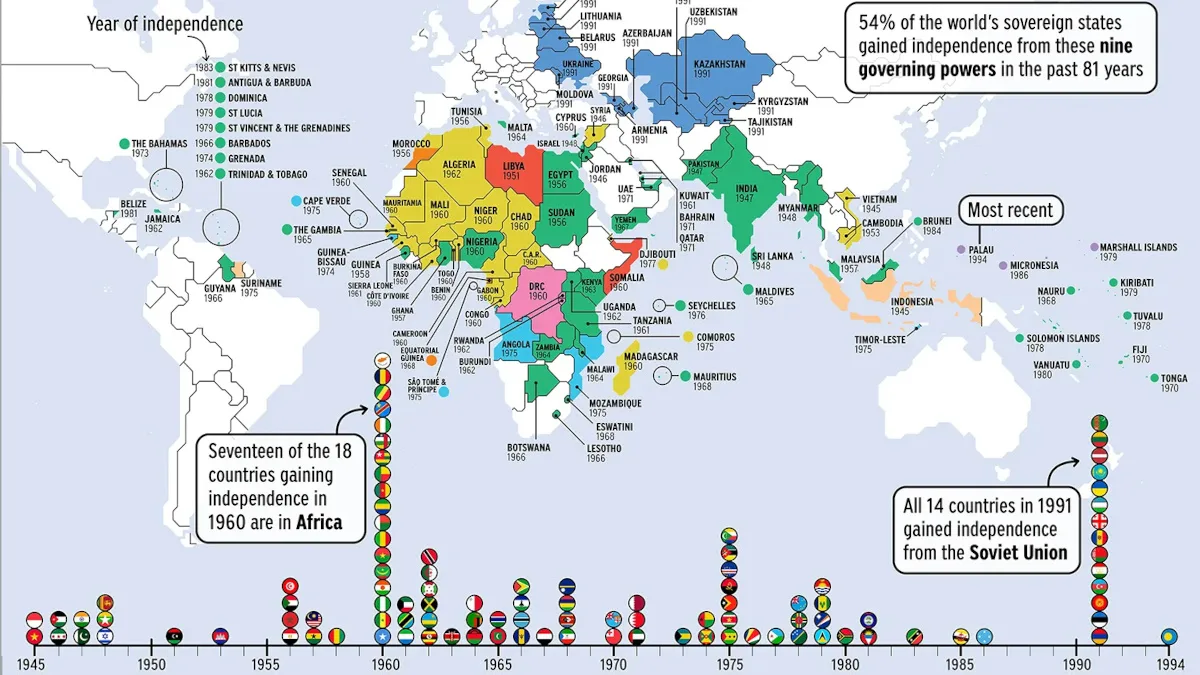
Mapped: Every Country That Gained Independence Since WWII
This was originally posted on our Voronoi app. Download the app for free on iOS or Android and discover incredible data-driven charts from a variety of trusted sources.
Key Takeaways:
- More than half (54%) of today’s sovereign states gained independence between 1945 and 1994.
- Britain and France together account for 62 of the 81 countries shown, reflecting the scale of postwar decolonization.
- Two years stand out on the timeline: Africa’s “Year of Independence” in 1960 and the breakup of the Soviet Union in 1991.
Today’s political map is far younger than many people realize. The borders of dozens of modern states were established during the second half of the 20th century as colonial empires dissolved and multinational states fragmented.
This visualization, created by Julie R. Peasley using data consolidated from Wikipedia’s List of National Independence Days, maps every country that gained independence after 1945 and identifies the governing power from which it separated.
The Countries That Gained Independence Since WWII
The table below lists every country included in the visualization, along with its year of independence and the governing power from which it separated.
| Country | Year | Independence from |
|---|---|---|
 Palau Palau |
1994 | U.S. |
 Armenia Armenia |
1991 | Soviet Union |
 Azerbaijan Azerbaijan |
1991 | Soviet Union |
 Belarus Belarus |
1991 | Soviet Union |
 Estonia Estonia |
1991 | Soviet Union |
 Georgia Georgia |
1991 | Soviet Union |
 Kazakhstan Kazakhstan |
1991 | Soviet Union |
 Kyrgyzstan Kyrgyzstan |
1991 | Soviet Union |
 Latvia Latvia |
1991 | Soviet Union |
 Lithuania Lithuania |
1991 | Soviet Union |
 Moldova Moldova |
1991 | Soviet Union |
 Tajikistan Tajikistan |
1991 | Soviet Union |
 Turkmenistan Turkmenistan |
1991 | Soviet Union |
 Ukraine Ukraine |
1991 | Soviet Union |
 Uzbekistan Uzbekistan |
1991 | Soviet Union |
 Micronesia Micronesia |
1986 | U.S. |
 Brunei Brunei |
1984 | UK |
 St Kitts and Nevis St Kitts and Nevis |
1983 | UK |
 Antigua and Barbuda Antigua and Barbuda |
1981 | UK |
 Belize Belize |
1981 | UK |
 Vanuatu Vanuatu |
1980 | UK |
 Kiribati Kiribati |
1979 | UK |
 Marshall Islands Marshall Islands |
1979 | U.S. |
 St Lucia St Lucia |
1979 | UK |
 St Vincent and the Grenadines St Vincent and the Grenadines |
1979 | UK |
 Dominica Dominica |
1978 | UK |
 Solomon Islands Solomon Islands |
1978 | UK |
 Tuvalu Tuvalu |
1978 | UK |
 Djibouti Djibouti |
1977 | France |
 Seychelles Seychelles |
1976 | UK |
 Angola Angola |
1975 | Portugal |
 Cape Verde Cape Verde |
1975 | Portugal |
 Comoros Comoros |
1975 | France |
 Mozambique Mozambique |
1975 | Portugal |
 São Tomé and Príncipe São Tomé and Príncipe |
1975 | Portugal |
 Suriname Suriname |
1975 | Netherlands |
 Timor-Leste Timor-Leste |
1975 | Portugal |
 Grenada Grenada |
1974 | UK |
 Guinea-Bissau Guinea-Bissau |
1974 | Portugal |
 Bahamas, the Bahamas, the |
1973 | UK |
 Bahrain Bahrain |
1971 | UK |
 Qatar Qatar |
1971 | UK |
 United Arab Emirates United Arab Emirates |
1971 | UK |
 Fiji Fiji |
1970 | UK |
 Tonga Tonga |
1970 | UK |
 Equatorial Guinea Equatorial Guinea |
1968 | Spain |
 Eswatini Eswatini |
1968 | UK |
 Mauritius Mauritius |
1968 | UK |
 Nauru Nauru |
1968 | UK |
 Yemen Yemen |
1967 | UK |
 Barbados Barbados |
1966 | UK |
 Botswana Botswana |
1966 | UK |
 Guyana Guyana |
1966 | UK |
 Lesotho Lesotho |
1966 | UK |
 Gambia, The Gambia, The |
1965 | UK |
 Maldives Maldives |
1965 | UK |
 Malawi Malawi |
1964 | UK |
 Malta Malta |
1964 | UK |
 Zambia Zambia |
1964 | UK |
 Kenya Kenya |
1963 | UK |
 Algeria Algeria |
1962 | France |
 Burundi Burundi |
1962 | Belgium |
 Jamaica Jamaica |
1962 | UK |
 Rwanda Rwanda |
1962 | Belgium |
 Trinidad and Tobago Trinidad and Tobago |
1962 | UK |
 Uganda Uganda |
1962 | UK |
 Kuwait Kuwait |
1961 | UK |
 Sierra Leone Sierra Leone |
1961 | UK |
 Tanzania Tanzania |
1961 | UK |
 Benin Benin |
1960 | France |
 Burkina Faso Burkina Faso |
1960 | France |
 Cameroon Cameroon |
1960 | France |
 Central African Republic Central African Republic |
1960 | France |
 Chad Chad |
1960 | France |
 DR Congo DR Congo |
1960 | Belgium |
 Congo, Republic of the Congo, Republic of the |
1960 | France |
 Côte d’Ivoire Côte d’Ivoire |
1960 | France |
 Cyprus Cyprus |
1960 | UK |
 Gabon Gabon |
1960 | France |
 Madagascar Madagascar |
1960 | France |
 Mali Mali |
1960 | France |
 Mauritania Mauritania |
1960 | France |
 Niger Niger |
1960 | France |
 Nigeria Nigeria |
1960 | UK |
 Senegal Senegal |
1960 | France |
 Somalia Somalia |
1960 | Italy |
 Togo Togo |
1960 | France |
 Guinea Guinea |
1958 | France |
 Ghana Ghana |
1957 | UK |
 Malaysia Malaysia |
1957 | UK |
 Egypt Egypt |
1956 | UK |
 Morocco Morocco |
1956 | France/Spain |
 Sudan Sudan |
1956 | UK |
 Tunisia Tunisia |
1956 | France |
 Cambodia Cambodia |
1953 | France |
 Libya Libya |
1951 | Italy |
 Israel Israel |
1948 | UK |
 Myanmar Myanmar |
1948 | UK |
 Sri Lanka Sri Lanka |
1948 | UK |
 India India |
1947 | UK |
 Pakistan Pakistan |
1947 | UK |
 Jordan Jordan |
1946 | UK |
 Syria Syria |
1946 | France |
 Indonesia Indonesia |
1945 | Netherlands |
 Vietnam Vietnam |
1945 | France |
Postwar Decolonization in Britain and France
Of the 81 countries shown, 36 gained independence from the United Kingdom, making Britain the largest governing power represented in the dataset. France follows with 26 former colonies, while the Soviet Union accounts for 14 republics that became independent following its dissolution in 1991.
Far fewer countries separated from Portugal (5), Belgium (3), the United States (3), Italy (2), the Netherlands (2), and Spain (1).
These figures reflect the immense geographic reach of the British and French empires, which at their peaks controlled territories across Africa, Asia, and the Middle East. The British Empire became the largest empire in history by land area, covering nearly one-quarter of Earth’s land surface at its height.
Why Africa Became the Epicenter of Independence
The year 1960 is often called the “Year of Africa,” and the visualization shows why. Eighteen countries achieved independence that year, including Nigeria, Chad, Senegal, Mali, Madagascar, and Cameroon. Seventeen of the 18 were in Africa.
African independence movements accelerated after World War II as European powers faced mounting economic pressures, growing nationalist movements, and increasing international support for self-determination.
Countries followed different paths to independence, ranging from negotiation to prolonged conflict, but collectively reshaped the continent within a few decades.
The Soviet Union’s Collapse Created Another Wave
The second major spike occurred in 1991, when the dissolution of the Soviet Union produced 14 newly independent states stretching from the Baltic Sea to Central Asia.
Unlike the gradual decolonization of Africa and Asia, countries including Ukraine, Kazakhstan, Armenia, Georgia, and the Baltic states emerged within a single year as one multinational political union fragmented into sovereign republics.
While historians continue to debate whether the Soviet Union functioned as a colonial power in the traditional sense, its breakup redrew international borders and substantially increased the number of independent states.
The Lasting Legacy of Decolonization
Independence reshaped borders, but it did not erase the influence of empire. Many newly sovereign countries inherited colonial-era borders, export-oriented economies, legal systems, and administrative institutions.
Some transitions to independence were also accompanied by political instability or armed conflict, underscoring the challenges of state formation. These legacies continue to influence governance, trade, language, migration, cultural identity, and geopolitical relationships across former empires.
Learn More on the Voronoi App 
To explore more visualizations on geopolitics and how countries are governed today, check out Types of Government: A Population-Adjusted Breakdown on the Voronoi app.