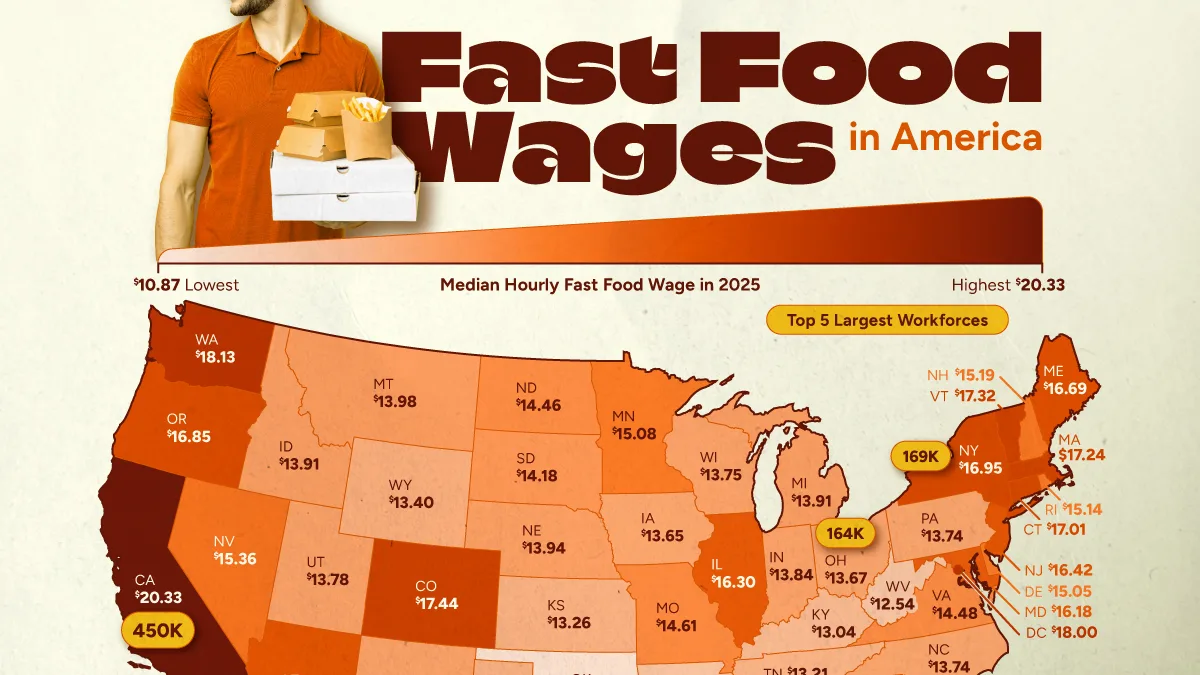
Mapped: Fast Food Wages in Every U.S. State
See visuals like this from many other data creators on our Voronoi app. Download it for free on iOS or Android and discover incredible data-driven charts from a variety of trusted sources.
Key Takeaways
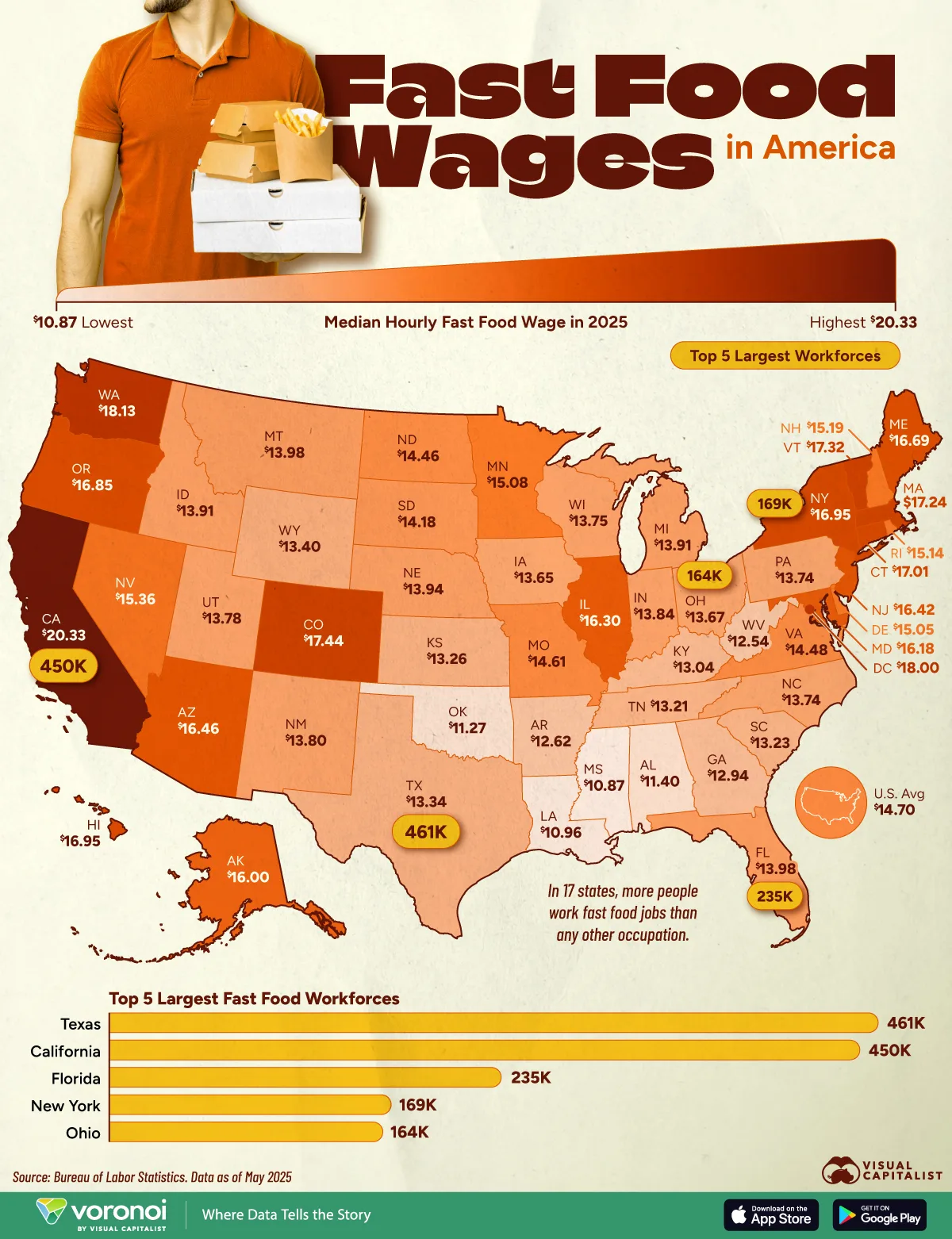
- Fast food workers earn anywhere from $10.87 to $20.33 an hour depending on where they live.
- California is the only state where median fast food pay exceeds $20 an hour, while Mississippi ranks last.
- Texas employs the nation’s largest fast food workforce, with 461,000 workers.
Nearly four million Americans work in fast food occupations, making the industry one of the nation’s largest sources of employment.
In 2025, the median fast food worker earns just $10.87 an hour in Mississippi, compared with $20.33 in California—an 87% difference for the same occupation.
This map uses Bureau of Labor Statistics data to compare median fast food wages across all 50 states and Washington, D.C., highlighting where workers earn the most and least across America.
Ranked: Fast Food Wages by State
Fast food wages vary widely across the country, with West Coast and Northeastern states generally reporting the highest pay levels.
The gap is large enough to reshape annual earnings. A full-time fast food worker earning the median wage would make roughly $42,000 a year in California, compared with about $22,600 in Mississippi, a difference of nearly $20,000 for the same occupation.
The following table shows the median hourly wage of fast food workers by state.
| Rank | State | Median Hourly Fast Food Wage 2025 |
Total Employment |
|---|---|---|---|
| 1 | California | $20.33 | 450K |
| 2 | Washington | $18.13 | 95K |
| 3 | District of Columbia | $18.00 | 6K |
| 4 | Colorado | $17.44 | 82K |
| 5 | Vermont | $17.32 | 7K |
| 6 | Massachusetts | $17.24 | 86K |
| 7 | Connecticut | $17.01 | 36K |
| 8 | Hawaii | $16.95 | 24K |
| 9 | New York | $16.95 | 169K |
| 10 | Oregon | $16.85 | 60K |
| 11 | Maine | $16.69 | 17K |
| 12 | Arizona | $16.46 | 77K |
| 13 | New Jersey | $16.42 | 94K |
| 14 | Illinois | $16.30 | 128K |
| 15 | Maryland | $16.18 | 49K |
| 16 | Alaska | $16.00 | 6K |
| 17 | Nevada | $15.36 | 46K |
| 18 | New Hampshire | $15.19 | 15K |
| 19 | Rhode Island | $15.14 | 13K |
| 20 | Minnesota | $15.08 | 59K |
| 21 | Delaware | $15.05 | 13K |
| 22 | Missouri | $14.61 | 29K |
| 23 | Virginia | $14.48 | 104K |
| 24 | North Dakota | $14.46 | 11K |
| 25 | South Dakota | $14.18 | 15K |
| 26 | Florida | $13.98 | 235K |
| 27 | Montana | $13.98 | 15K |
| 28 | Nebraska | $13.94 | 30K |
| 29 | Idaho | $13.91 | 26K |
| 30 | Michigan | $13.91 | 103K |
| 31 | Indiana | $13.84 | 97K |
| 32 | New Mexico | $13.80 | 28K |
| 33 | Utah | $13.78 | 52K |
| 34 | Wisconsin | $13.75 | 68K |
| 35 | North Carolina | $13.74 | 92K |
| 36 | Pennsylvania | $13.74 | 142K |
| 37 | Ohio | $13.67 | 164K |
| 38 | Iowa | $13.65 | 40K |
| 39 | Wyoming | $13.40 | 7K |
| 40 | Texas | $13.34 | 461K |
| 41 | Kansas | $13.26 | 47K |
| 42 | South Carolina | $13.23 | 65K |
| 43 | Tennessee | $13.21 | 91K |
| 44 | Kentucky | $13.04 | 42K |
| 45 | Georgia | $12.94 | 145K |
| 46 | Arkansas | $12.62 | 36K |
| 47 | West Virginia | $12.54 | 6K |
| 48 | Alabama | $11.40 | 41K |
| 49 | Oklahoma | $11.27 | 53K |
| 50 | Louisiana | $10.96 | 46K |
| 51 | Mississippi | $10.87 | 31K |
| — |  United States United States |
$14.70 | 3.9M |
Why Fast Food Pay Varies Across America
States along the West Coast and in the Northeast dominate the top of the rankings, while much of the South clusters near the bottom. California leads the nation, while Washington, Colorado, Massachusetts, and Connecticut also rank among the highest-paying states.
By contrast, Mississippi, Louisiana, Alabama, and Oklahoma all report median hourly wages below $12.
Geography is one of the biggest factors shaping fast food pay in America. While cost of living explains part of the gap, state minimum wage laws, labor shortages, and local competition for workers also influence how much employers are willing to pay.
Why California Tops the Ranking
California’s leading position is partly driven by a landmark law that established a $20 minimum wage for many fast food workers beginning in 2024. The policy affected hundreds of thousands of employees across one of the nation’s largest restaurant markets.
Supporters argue the increase helps workers keep pace with rising housing, transportation, and living costs. Critics contend it raises operating expenses for restaurant owners and could contribute to higher menu prices.
Regardless of the debate surrounding the policy, its impact is visible in the data. California’s fast food workers now earn a median wage above $20 an hour, a level unmatched by any other state.
Where Fast Food Employs the Most Workers
While California pays the highest wages, Texas employs more fast food workers than any other state.
Overall, Texas has roughly 461,000 fast food workers, narrowly ahead of California’s 450,000. Florida ranks third with 235,000 workers, followed by New York and Ohio.
Together, these five states account for more than 1.4 million fast food jobs, or roughly one-third of the industry’s national workforce.
The contrast between Texas and California is especially striking. Although the two states employ a similar number of fast food workers, the typical worker in California earns about $14,500 more per year than a counterpart in Texas based on median wages.
One of America’s Largest Industries
Nearly 3.9 million Americans work in fast food occupations, making it one of the country’s largest employment categories. If the industry’s workforce were a state, it would be larger than the populations of Connecticut and Utah.
Because the workforce is so large, changes in fast food pay can have effects far beyond the restaurant industry. Wage increases influence household incomes, hiring costs, consumer spending, and local labor markets.
The sector’s reach is especially visible in smaller states and communities where fast food jobs account for a significant share of employment. In 17 states, fast food occupations employ more workers than any other job category.
That helps explain why debates over fast food pay often attract national attention. Even modest wage changes can affect hundreds of thousands of workers and businesses.
Learn More on the Voronoi App 
To learn more about this topic, check out this graphic on the 30 highest-paying jobs in America.