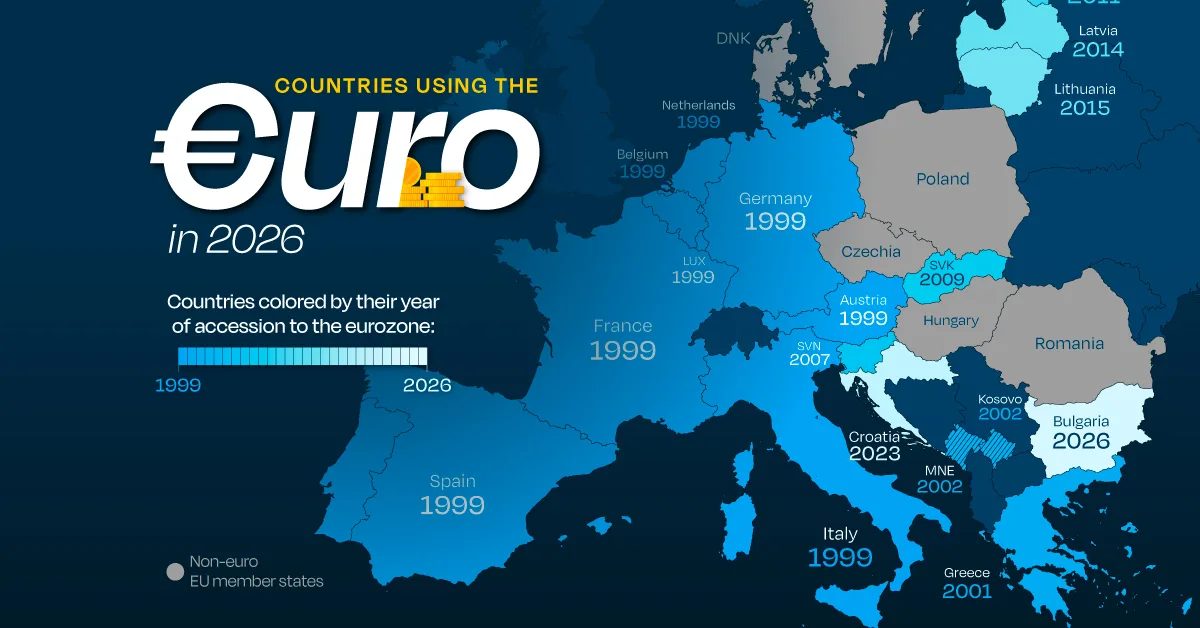
Mapped: How the Euro Spread Across Europe Since 1999
See visuals like this from many other data creators on our Voronoi app. Download it for free on iOS or Android and discover incredible data-driven charts from a variety of trusted sources.
Key Takeaways
- The eurozone has grown from 12 countries in 1999 to 21 in 2026.
- Bulgaria became the latest member in 2026, adopting the euro.
- Five EU countries have yet to join, despite being expected to eventually adopt the currency.
Since its launch in 1999, the euro has spread across much of Europe, becoming one of the world’s most widely used currencies.
This map highlights how the eurozone has expanded since its founding in 1999, utilizing official 2026 European Union statistics.
In January 2026, Bulgaria became the 21st eurozone member—marking the first expansion of the currency bloc since Croatia joined in 2023.
Eurozone: Growth Snapshot
- 1999: 12 founding members
- 2001–2015: Gradual expansion across Southern and Eastern Europe
- 2023–2026: Two new members (Croatia and Bulgaria)
- Today: 21 total countries using the euro
The Eurozone as of 2026
The eurozone was formed in 1999 by 12 founding members in Northern and Western Europe, including France, Germany, Italy, and Spain. Since then, nine more countries have joined, including most recently Croatia in 2023 and Bulgaria in 2026.
Per monetary agreements with the European Union, four European microstates can also use the euro despite not being eurozone members: Andorra, Monaco, San Marino, and Vatican City.
The following data table lists European countries alongside the year they began to use the euro.
| Country | Euro Adopted in Year |
|---|---|
 Austria Austria |
1999 |
 Belgium Belgium |
1999 |
 Finland Finland |
1999 |
 France France |
1999 |
 Germany Germany |
1999 |
 Ireland Ireland |
1999 |
 Italy Italy |
1999 |
 Luxembourg Luxembourg |
1999 |
 Netherlands Netherlands |
1999 |
 Portugal Portugal |
1999 |
 Spain Spain |
1999 |
 Andorra Andorra |
1999 |
 Monaco Monaco |
1999 |
 San Marino San Marino |
1999 |
 Vatican City Vatican City |
1999 |
 Greece Greece |
2001 |
 Kosovo Kosovo |
2002 |
 Montenegro Montenegro |
2002 |
 Slovenia Slovenia |
2007 |
 Cyprus Cyprus |
2008 |
 Malta Malta |
2008 |
 Slovakia Slovakia |
2009 |
 Estonia Estonia |
2011 |
 Latvia Latvia |
2014 |
 Lithuania Lithuania |
2015 |
 Croatia Croatia |
2023 |
 Bulgaria Bulgaria |
2026 |
The eurozone is the largest currency union in the world, and has its monetary policy set by the European Central Bank, headquartered in Frankfurt, Germany. Currencies on other continents, such as the West African CFA franc, are pegged to the euro as a legacy of their historical relationship to the French franc.
In total, 21 of the European Union’s current 27 member countries have joined, including the bloc’s five largest economies and all of its founding members. The union famously came into crisis in the late 2000s and early 2010s as multiple eurozone members, including Italy, Greece, and Spain, suffered simultaneous financial crises.
The Future of the Eurozone
All EU member countries are expected to adopt the euro upon reaching certain monetary criteria. The only exception to this rule is Denmark, which negotiated a permanent opt-out in the 1990s allowing it to legally avoid euro adoption as long as it wanted. Prior to leaving the EU in 2020, the United Kingdom had also obtained this opt-out.
Five EU countries—Czechia, Hungary, Poland, Romania, and Sweden—still don’t use the euro, despite being expected to adopt it eventually.
However, progress has been uneven. Joining the euro requires meeting strict economic criteria, and participation in the ERM II system remains voluntary—slowing the path to adoption for several countries.
Unilateral Euro Adoption
In addition to the 21 members of the eurozone and the four microstates with monetary agreements, there are two European countries which have unilaterally adopted the euro: Kosovo and Montenegro.
These two countries, which each broke away from Serbia in the 2000s, adopted the euro in 2002 after having previously used the German mark instead of the Yugoslav dinar. At the transition from the mark to the euro, both switched to the new currency, despite no authorization to do so by the European Union and subsequently no ability to mint their own banknotes.
The EU generally frowns upon this practice of non-EU countries adopting the euro unilaterally. In fact, EU officials have even indicated that unilateral euro adoption could jeopardize a country’s eventual accession to the European Union.
Learn More on the Voronoi App 
If you enjoyed today’s post, check out The $19 Trillion European Union Economy on Voronoi.Use This Visualization