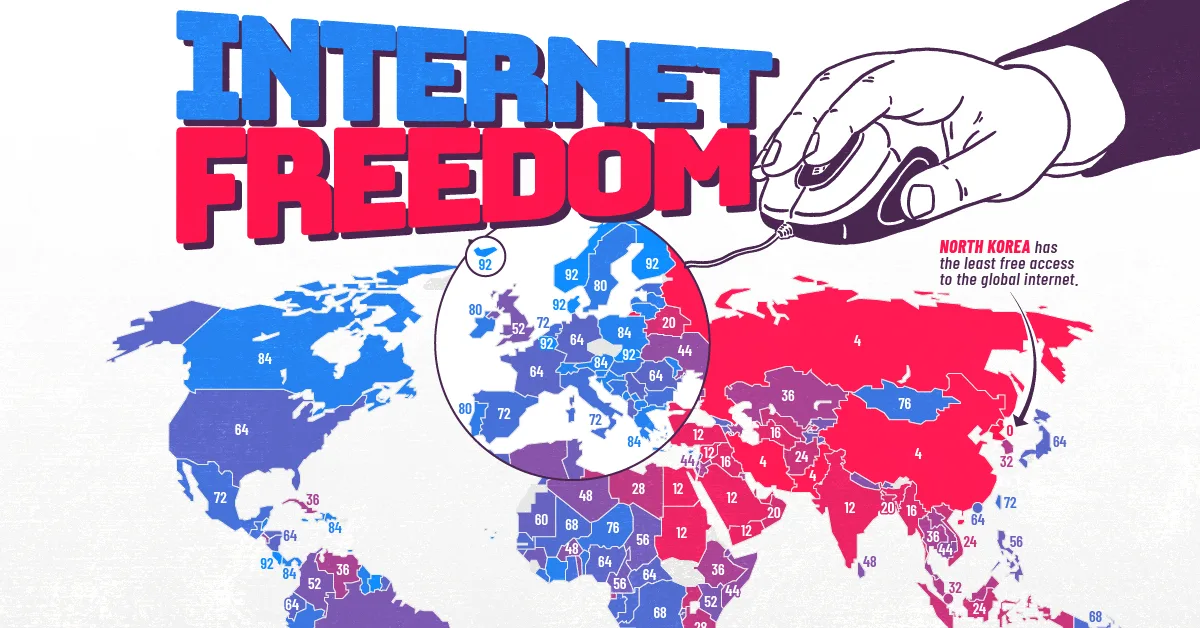
Mapped: Internet Freedom Around the World in 2026
See visuals like this from many other data creators on our Voronoi app. Download it for free on iOS or Android and discover data-driven charts from a variety of trusted sources.
Key Takeaways
- 11 countries tie for the world’s freest internet (score: 92), spanning Europe, Latin America, and Asia.
- North Korea ranks last (0), with China, Russia, Iran, and Pakistan close behind (4).
- The U.S. (64) and UK (52) rank mid-pack, trailing leaders like Norway and Costa Rica.
How free is the internet where you live?
This map ranks 171 countries based on how freely people can access the internet. The results reveal stark global differences, from highly open systems in parts of Europe and Latin America to tightly controlled networks in countries like North Korea and China.
The data comes from a 2026 internet freedom index by Cloudwards, which evaluates national policies across four areas: torrenting, VPN availability, adult content, and political and civic expression.
Where Does the U.S. Rank?
The United States scores 64 out of 100, placing it in the global middle. It ranks alongside countries like Japan and Australia, and below top performers such as Norway (92) and Canada (84).
The UK scores even lower at 52, reflecting stricter regulations in areas like online content access.
The Freest Internet Access Worldwide
No country achieves a perfect score, but 11 countries across four continents share the top spot at 92.
These countries are Belgium, Costa Rica, Denmark, Finland, Iceland, Liechtenstein, New Zealand, Norway, Slovakia, Suriname, and Timor-Leste.
The data table below lists countries worldwide alongside their internet freedom scores.
| Country | Internet Freedom Score |
|---|---|
 Belgium Belgium |
92 |
 Costa Rica Costa Rica |
92 |
 Denmark Denmark |
92 |
 Finland Finland |
92 |
 Iceland Iceland |
92 |
 Liechtenstein Liechtenstein |
92 |
 New Zealand New Zealand |
92 |
 Norway Norway |
92 |
 Slovakia Slovakia |
92 |
 Suriname Suriname |
92 |
 Timor-Leste Timor-Leste |
92 |
 Andorra Andorra |
84 |
 Austria Austria |
84 |
 Belize Belize |
84 |
 Canada Canada |
84 |
 Cape Verde Cape Verde |
84 |
 Chile Chile |
84 |
 Côte d’Ivoire Côte d’Ivoire |
84 |
 Croatia Croatia |
84 |
 Dominican Republic Dominican Republic |
84 |
 Greece Greece |
84 |
 Guyana Guyana |
84 |
 Haiti Haiti |
84 |
 Jamaica Jamaica |
84 |
 Kosovo Kosovo |
84 |
 Lithuania Lithuania |
84 |
 Luxembourg Luxembourg |
84 |
 Malta Malta |
84 |
 Moldova Moldova |
84 |
 Montenegro Montenegro |
84 |
 North Macedonia North Macedonia |
84 |
 Panama Panama |
84 |
 Poland Poland |
84 |
 Seychelles Seychelles |
84 |
 Slovenia Slovenia |
84 |
 Switzerland Switzerland |
84 |
 Trinidad & Tobago Trinidad & Tobago |
84 |
 Uruguay Uruguay |
84 |
 Ireland Ireland |
80 |
 Latvia Latvia |
80 |
 Portugal Portugal |
80 |
 Sweden Sweden |
80 |
 Argentina Argentina |
76 |
 Benin Benin |
76 |
 Bolivia Bolivia |
76 |
 Bosnia & Herzegovina Bosnia & Herzegovina |
76 |
 Cyprus Cyprus |
76 |
 Fiji Fiji |
76 |
 Gambia Gambia |
76 |
 Hungary Hungary |
76 |
 Liberia Liberia |
76 |
 Madagascar Madagascar |
76 |
 Mongolia Mongolia |
76 |
 Namibia Namibia |
76 |
 Niger Niger |
76 |
 Peru Peru |
76 |
 Bulgaria Bulgaria |
72 |
 Estonia Estonia |
72 |
 Ghana Ghana |
72 |
 Guatemala Guatemala |
72 |
 Italy Italy |
72 |
 Mexico Mexico |
72 |
 Netherlands Netherlands |
72 |
 Paraguay Paraguay |
72 |
 Spain Spain |
72 |
 Taiwan Taiwan |
72 |
 Angola Angola |
68 |
 Democratic Republic of Congo Democratic Republic of Congo |
68 |
 Gabon Gabon |
68 |
 Malawi Malawi |
68 |
 Mali Mali |
68 |
 Mauritius Mauritius |
68 |
 Mozambique Mozambique |
68 |
 Papua New Guinea Papua New Guinea |
68 |
 Republic of the Congo Republic of the Congo |
68 |
 Senegal Senegal |
68 |
 Albania Albania |
64 |
 Australia Australia |
64 |
 Botswana Botswana |
64 |
 Central African Republic Central African Republic |
64 |
 Ecuador Ecuador |
64 |
 France France |
64 |
 Georgia Georgia |
64 |
 Germany Germany |
64 |
 Guinea-Bissau Guinea-Bissau |
64 |
 Honduras Honduras |
64 |
 Hong Kong SAR China Hong Kong SAR China |
64 |
 Japan Japan |
64 |
 Lesotho Lesotho |
64 |
 Maldives Maldives |
64 |
 Morocco Morocco |
64 |
 Nicaragua Nicaragua |
64 |
 Nigeria Nigeria |
64 |
 Romania Romania |
64 |
 Serbia Serbia |
64 |
 South Africa South Africa |
64 |
 United States United States |
64 |
 Mauritania Mauritania |
60 |
 Armenia Armenia |
56 |
 Burundi Burundi |
56 |
 Cameroon Cameroon |
56 |
 Chad Chad |
56 |
 Eswatini Eswatini |
56 |
 Guinea Guinea |
56 |
 Lebanon Lebanon |
56 |
 Palestine Palestine |
56 |
 Philippines Philippines |
56 |
 Rwanda Rwanda |
56 |
 Tajikistan Tajikistan |
56 |
 Tunisia Tunisia |
56 |
 Bhutan Bhutan |
52 |
 Brazil Brazil |
52 |
 Colombia Colombia |
52 |
 Kenya Kenya |
52 |
 Kyrgyzstan Kyrgyzstan |
52 |
 United Kingdom United Kingdom |
52 |
 Zambia Zambia |
52 |
 Algeria Algeria |
48 |
 Burkina Faso Burkina Faso |
48 |
 Djibouti Djibouti |
48 |
 Nepal Nepal |
48 |
 Sri Lanka Sri Lanka |
48 |
 Tongo Tongo |
48 |
 Zimbabwe Zimbabwe |
48 |
 Cambodia Cambodia |
44 |
 El Salvador El Salvador |
44 |
 Israel Israel |
44 |
 Somalia Somalia |
44 |
 Ukraine Ukraine |
44 |
 Azerbaijan Azerbaijan |
36 |
 Cuba Cuba |
36 |
 Equatorial Guinea Equatorial Guinea |
36 |
 Ethiopia Ethiopia |
36 |
 Jordan Jordan |
36 |
 Kazakhstan Kazakhstan |
36 |
 Kuwait Kuwait |
36 |
 Laos Laos |
36 |
 Thailand Thailand |
36 |
 Venezuela Venezuela |
36 |
 Bahrain Bahrain |
32 |
 Malaysia Malaysia |
32 |
 Singapore Singapore |
32 |
 South Korea South Korea |
32 |
 Libya Libya |
28 |
 Tanzania Tanzania |
28 |
 Afghanistan Afghanistan |
24 |
 Brunei Brunei |
24 |
 Indonesia Indonesia |
24 |
 Qatar Qatar |
24 |
 Uganda Uganda |
24 |
 Uzbekistan Uzbekistan |
24 |
 Vietnam Vietnam |
24 |
 Bangladesh Bangladesh |
20 |
 Belarus Belarus |
20 |
 Oman Oman |
20 |
 Iraq Iraq |
16 |
 Myanmar (Burma) Myanmar (Burma) |
16 |
 Turkmenistan Turkmenistan |
16 |
 Egypt Egypt |
12 |
 India India |
12 |
 Saudi Arabia Saudi Arabia |
12 |
 Sudan Sudan |
12 |
 Syria Syria |
12 |
 Türkiye Türkiye |
12 |
 United Arab Emirates United Arab Emirates |
12 |
 Yemen Yemen |
12 |
 China China |
4 |
 Iran Iran |
4 |
 Pakistan Pakistan |
4 |
 Russia Russia |
4 |
 North Korea North Korea |
0 |
European countries make up over half of this top echelon and are especially concentrated in the Nordics, where Sweden (80) is the only exception. The Nordic countries are widely known for their liberal, tolerant governments and societies.
Perhaps more surprising is the high placement of countries like Suriname and Timor-Leste, developing nations in South America and Asia that have nonetheless imposed minimal restrictions on social media use and online access.
The Bottom of the Scoreboard
On the other side of the spectrum is North Korea (0), where very few citizens have access to the global internet. Instead, most rely on the national intranet service, Kwangmyong, which filters out outside information.
Right behind North Korea are China and Russia, which tie with Iran and Pakistan for the next-lowest scores worldwide (4).
China’s Great Firewall is perhaps the world’s best-known censorship system, used to suppress criticism of the country’s leaders or content related to politically sensitive topics such as the Tiananmen Square protests. It also blocks access to foreign platforms like Facebook and YouTube.
Internet Access in the West
The United States (64) sits near the middle of the ranking, alongside developed democracies such as Australia, France, Germany, and Japan. The United Kingdom (52) scores slightly lower, with recent adult content legislation playing a role.
Across much of the Western world, scores remain relatively high, including in Canada (84), Ireland and Portugal (both 80), and Spain and Italy (both 72).
One notable outlier is South Korea (32), which ranks below countries like Cuba, Kazakhstan, and Venezuela (36), underscoring how content restrictions—not just political systems—shape internet freedom scores.
Learn More on the Voronoi App 
If you enjoyed today’s post, check out A Day of Activity on the Internet on Voronoi.Use This Visualization