 See more visualizations like this on the Voronoi app.
Minimum Age Laws for Social Media Around the World
See visuals like this from many other data creators on our Voronoi app. Download it for free on iOS or Android and discover incredible data-driven charts from a variety of trusted sources.
Key Takeaways
- A growing number of governments are setting minimum age thresholds for social media, most commonly under 15 or under 16.
- Australia became the first country to enforce a nationwide under-16 restriction in 2025.
- European countries account for the majority of new proposals, while several U.S. states have adopted their own rules.
Governments around the world are moving to set minimum ages for social media use, citing concerns about online safety and youth mental health.
While approaches differ, most policies focus on preventing children below a certain age—typically 15 or 16—from holding accounts, or requiring parental consent and age verification before access is granted.
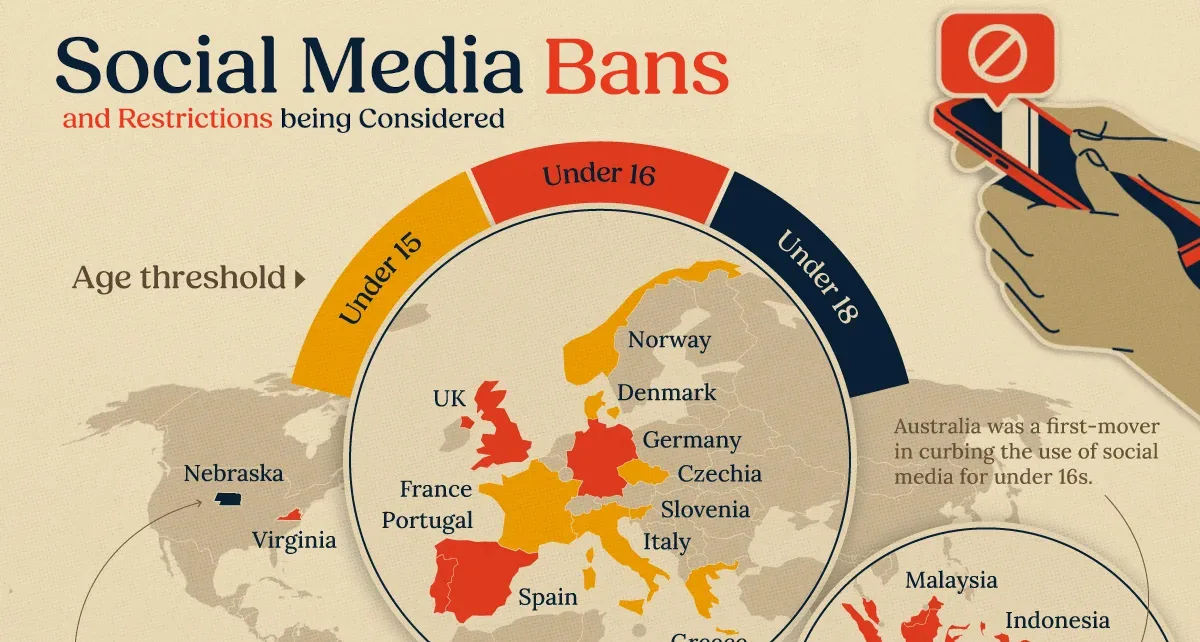
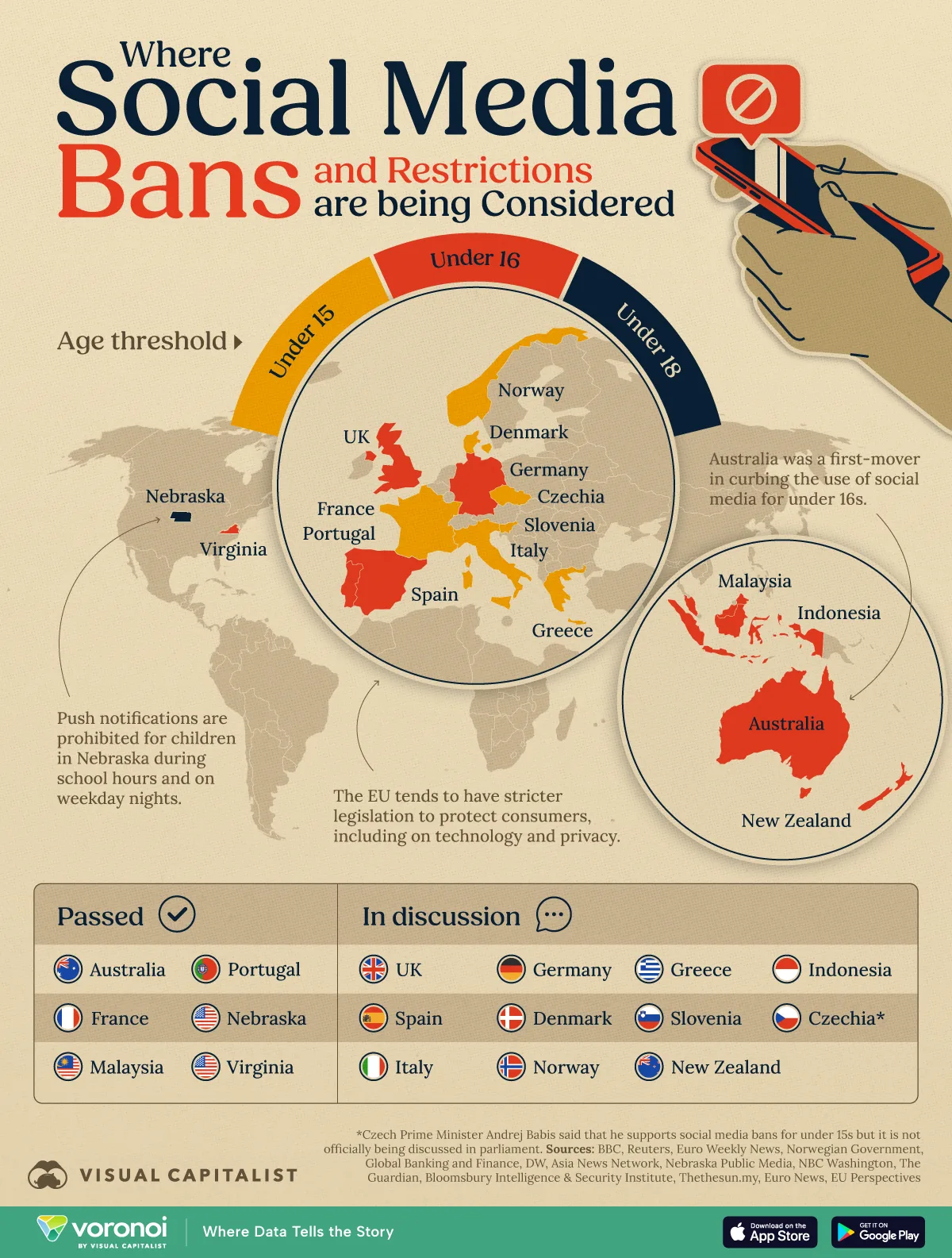
This map highlights 15 countries and two U.S. states that have enacted or are formally considering legal age thresholds for social media platforms, leveraging data from BBC, Reuters, Euro Weekly.
The Countries Restricting Social Media for Children
Australia made history when its social media ban, a world first, came into force in December 2025. Other countries have since followed suit.
The data table below shows the countries and U.S. states that have passed or are discussing social media restrictions, along with the age group that would be affected:
| Country | Regulation Status | Age Threshold |
|---|---|---|
 Australia Australia |
Passed | Under 16 |
 Greece Greece |
In discussion | Under 15 |
 France France |
Passed | Under 15 |
 Spain Spain |
In discussion | Under 16 |
 Portugal Portugal |
Passed | Under 16 |
 Norway Norway |
In discussion | Under 15 |
 Malaysia Malaysia |
Passed | Under 16 |
 United Kingdom United Kingdom |
In discussion | Under 16 |
 Denmark Denmark |
In discussion | Under 15 |
 Czechia Czechia |
In discussion | Under 15 |
 Slovenia Slovenia |
In discussion | Under 15 |
 Germany Germany |
In discussion | Under 16 |
 Italy Italy |
In discussion | Under 15 |
 Indonesia Indonesia |
In discussion | Under 16 |
 New Zealand New Zealand |
In discussion | Under 16 |
 Nebraska Nebraska |
Passed | Under 18 |
| Virginia |
Passed | Under 16 |
Australia’s legislation prevents under-16s from accessing social media, including the largest platforms such as Instagram, TikTok, and YouTube; those who already had accounts were signed out and banned when the law came into force. Social media companies face a fine of up to A$34.9 million if they fail to take “reasonable steps” for age verification.
France’s Assembly, its lower house, voted in favor of creating a statutory minimum age of 15 for social media. The proposed law now needs to be passed in the French Senate, or the upper house. Portugal mandated “express and verified parental consent” for anyone under 16 to use social media in a newly-approved bill, while having an outright ban for children under 13.
Across Europe, additional proposals are under discussion in countries including Greece, Spain, Denmark, Norway, Germany, Italy, Slovenia, and Czechia.
Outside Europe, Malaysia has passed age-based restrictions, while Indonesia and New Zealand are considering similar measures. The United Kingdom is also reviewing potential age-limit policies.
U.S. States Take Different Approaches
In the United States, states have adopted a range of policies.
Virginia introduced a law limiting social media use for minors under 16 to one hour per day by default, unless parental consent is provided.
Nebraska passed legislation aimed at restricting certain platform features for minors, including design elements such as infinite scrolling and autoplay that are intended to increase engagement.
Utah, legislating in 2023, was actually the first to require age verification for under-18s, however the legislation was repealed and replaced with less stringent requirements.
Social Media’s Impact on Young People
Many of the recent proposals are concentrated in Europe, where regulators have historically taken a more active role in technology and privacy policy. However, the approaches vary widely and do not always amount to outright bans.
It comes amid increasing concern around social media’s impacts on young people, who spend 7.5 hours online per day, according to the American Academy of Child and Adolescent Psychiatry.
Independent evidence suggests that excessive social media use can be harmful, while internal research by Facebook, now Meta, found Instagram made some teenage girls feel worse about their bodies. At the same time, independent researchers have called for more nuanced studies that account for socioeconomic factors, age differences, and specific platform use.
Originally developed as a way to connect with friends, social media platforms have also faced criticism over engagement-driven business models built around advertising. The recent wave of age-based laws reflects a broader shift toward increased regulatory oversight of the sector.
Learn More on the Voronoi App
To learn more about the social media ecosystem, check out this graphic which breaks down ad spending on social media platforms.