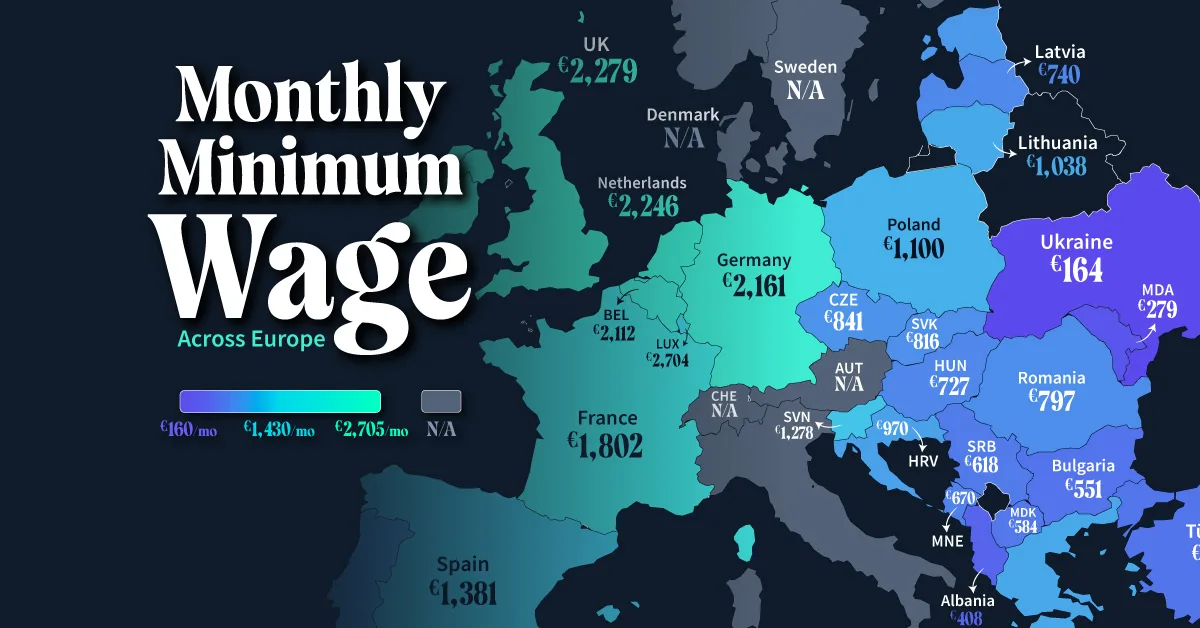
 Click to view this graphic in higher-resolution.
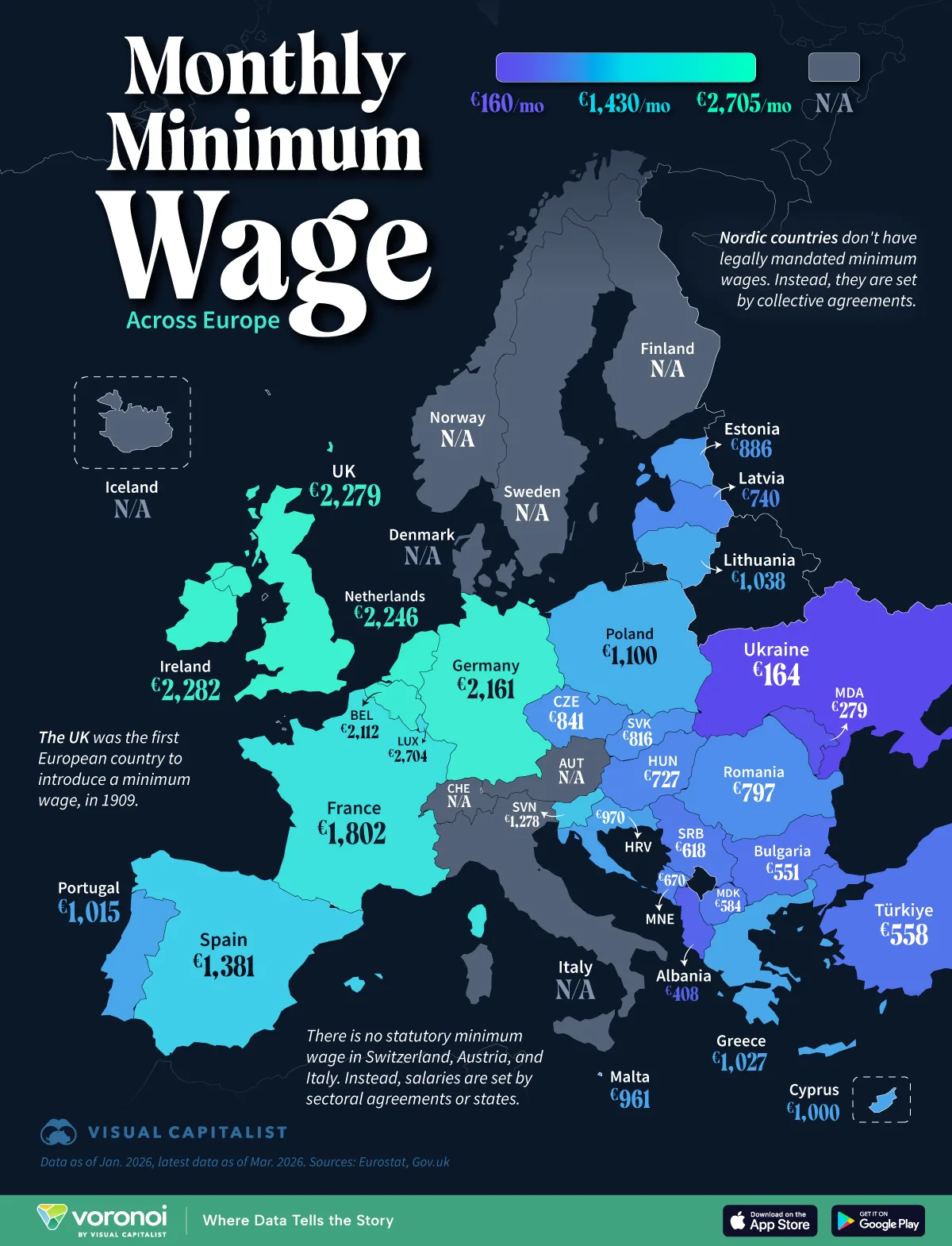
Mapped: Minimum Wages Across Europe
See visuals like this from many other data creators on our Voronoi app. Download it for free on iOS or Android and discover incredible data-driven charts from a variety of trusted sources.
Key Takeaways
- Luxembourg has Europe’s highest minimum wage at €2,704 per month, while Ukraine sits at €164.
- Western Europe dominates the top end of the map, while much of Eastern Europe remains below €1,000 per month.
- Several wealthy European countries, including the Nordics and Switzerland, don’t have a statutory national minimum wage.
Europe’s minimum wages vary dramatically from country to country.
This map uses data from Eurostat to show monthly minimum pay across the continent, revealing a stark divide between Western and Eastern Europe, along with a surprising group of wealthy countries that operate without a statutory national minimum wage.
The East-West Split in Europe’s Minimum Wages
Luxembourg has Europe’s highest monthly minimum wage at €2,704, while Ukraine sits at just €164.
That means a minimum wage worker in Luxembourg earns more than 16 times as much per month as one in Ukraine.
| Rank | Country | Country | Monthly minimum wage (€) |
|---|---|---|---|
| 1 |  Luxembourg Luxembourg |
Luxembourg | 2,704 |
| 2 |  Ireland Ireland |
Ireland | 2,282 |
| 3 |  United Kingdom United Kingdom |
United Kingdom | 2,279 |
| 4 |  Netherlands Netherlands |
Netherlands | 2,246 |
| 5 |  Germany Germany |
Germany | 2,161 |
| 6 |  Belgium Belgium |
Belgium | 2,112 |
| 7 |  France France |
France | 1,802 |
| 10 |  Spain Spain |
Spain | 1,381 |
| 11 |  Slovenia Slovenia |
Slovenia | 1,278 |
| 12 |  Poland Poland |
Poland | 1,100 |
| 13 |  Lithuania Lithuania |
Lithuania | 1,038 |
| 14 |  Greece Greece |
Greece | 1,027 |
| 15 |  Portugal Portugal |
Portugal | 1,015 |
| 16 |  Cyprus Cyprus |
Cyprus | 1,000 |
| 17 |  Croatia Croatia |
Croatia | 970 |
| 18 |  Malta Malta |
Malta | 961 |
| 19 |  Estonia Estonia |
Estonia | 886 |
| 20 |  Czechia Czechia |
Czechia | 841 |
| 21 |  Slovakia Slovakia |
Slovakia | 816 |
| 22 |  Romania Romania |
Romania | 797 |
| 23 |  Latvia Latvia |
Latvia | 740 |
| 24 |  Hungary Hungary |
Hungary | 727 |
| 25 |  Montenegro Montenegro |
Montenegro | 670 |
| 26 |  Serbia Serbia |
Serbia | 618 |
| 27 |  North Macedonia North Macedonia |
North Macedonia | 584 |
| 28 |  Türkiye Türkiye |
Türkiye | 558 |
| 29 |  Bulgaria Bulgaria |
Bulgaria | 551 |
| 30 |  Albania Albania |
Albania | 408 |
| 31 |  Moldova Moldova |
Moldova | 279 |
| 32 |  Ukraine Ukraine |
Ukraine | 164 |
| — |  Austria Austria |
Austria | NA |
| — |  Italy Italy |
Italy | NA |
| — |  Switzerland Switzerland |
Switzerland | NA |
| — |  Denmark Denmark |
Denmark | NA |
| — |  Finland Finland |
Finland | NA |
| — |  Iceland Iceland |
Iceland | NA |
| — |  Norway Norway |
Norway | NA |
| — |  Sweden Sweden |
Sweden | NA |
People in Ireland are paid the second-highest in Europe, at €2,282. The island has become the de-facto hub for U.S. firms in Europe, and is home to many large tech companies, which means average salaries are likely to be much more.
The UK followed at €2,279, a figure calculated from the statutory hourly minimum wage from the Gov.uk website for a 37.5 hour work-week, which is typical in the country. The UK was the first European country to introduce a minimum wage, in 1909.
There’s a clear split between the eastern and western sides of Europe, with only two countries in Eastern Europe—Poland and Slovenia—seeing monthly minimum wages above €1,000.
Countries Without a Legal Minimum Wage
Some countries don’t have statutory minimum wages inscribed into law, but they do exist. In Nordic countries — Denmark, Sweden, Finland and Iceland — wages are set by collective agreements instead.
Switzerland also doesn’t have a statutory minimum wage, but salary floors are set by states or sectors. In Geneva, one of the most well-paid areas, minimum wage would amount to €4,667 per a 40-hour work week.
In Austria, a €1,700 benchmark has been set via agreements. Italy’s minimum wage is also set by sectoral agreements but it differs widely depending on sector and skill level.
Interestingly, countries without statutory minimum wages are also some of the world’s happiest and richest.
Learn More on the Voronoi App
To learn more about minimum wages, check out this graphic which ranks salaries across U.S. states.