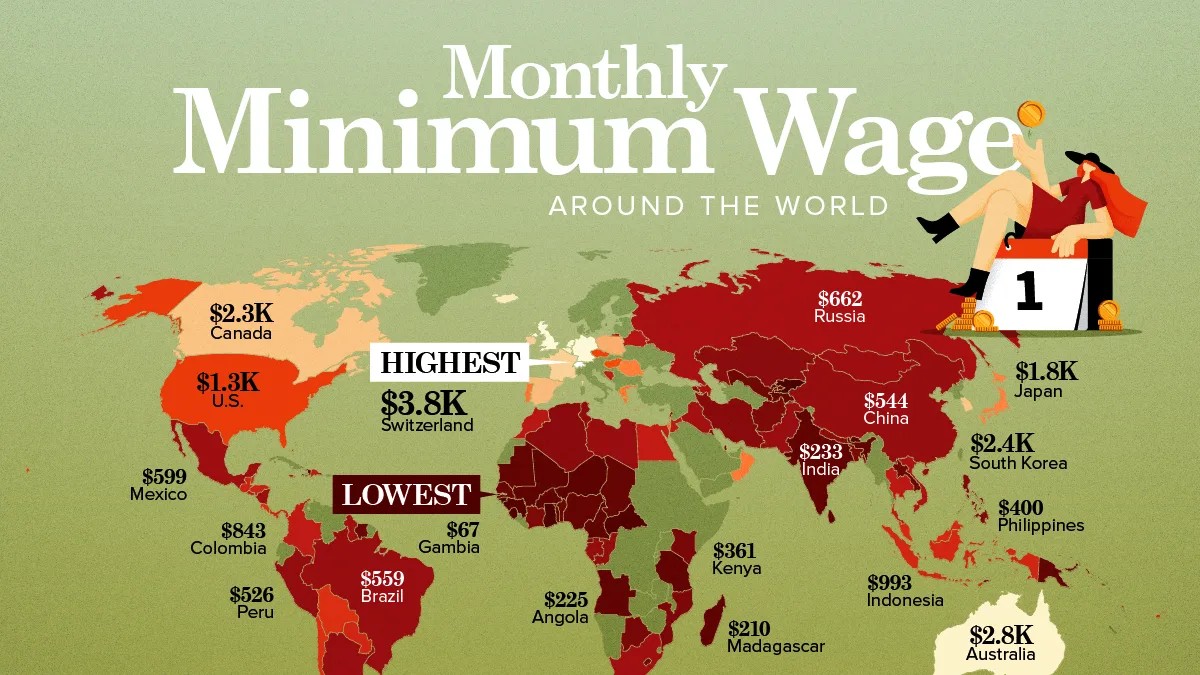
Mapped: Minimum Wages Around the World
Key Takeaways
- Switzerland has the highest figure in the dataset at $3,804 per month, although its minimum wages are set regionally rather than nationwide.
- Eight of the top 10 countries are European, with Australia and New Zealand rounding out the group.
- The U.S. ranks 25th out of 130 countries at $1,257 per month, based on the federal minimum wage of $7.25 an hour.
Minimum wages vary widely around the world, but comparing headline wage rates alone can obscure how much workers can actually buy with them.
This visualization compares monthly minimum wages using 2024 data from the International Labour Organization. Figures are expressed in purchasing power parity (PPP)-adjusted U.S. dollars, making wages more comparable based on what they can buy locally.
Where no single national minimum exists, ILOSTAT uses other applicable wage floors to make comparisons across countries.
The Countries With the Highest Minimum Wages
Switzerland tops the dataset at $3,804 per month, based on a regional rather than nationwide minimum wage. Germany, the UK, and the Netherlands follow at roughly $2,900. Eight of the top 10 countries are in Europe, while Australia and New Zealand are the only two outside the region.
South Korea stands out at $2,362, the highest figure in Asia. The U.S. sits much lower at $1,257 per month, ranking 25th overall. The ILO uses the federal minimum wage of $7.25 an hour rather than the $10.69 average state minimum in 2024.
| Rank | Country | Monthly Minimum Wage, PPP-Adjusted |
|---|---|---|
| 1 |  Switzerland Switzerland |
$3,804 |
| 2 |  Germany Germany |
$2,928 |
| 3 |  UK UK |
$2,902 |
| 4 |  Netherlands Netherlands |
$2,876 |
| 5 |  Australia Australia |
$2,819 |
| 6 |  Belgium Belgium |
$2,752 |
| 7 |  Iceland Iceland |
$2,730 |
| 8 |  New Zealand New Zealand |
$2,673 |
| 9 |  France France |
$2,465 |
| 10 |  Ireland Ireland |
$2,433 |
| 11 |  South Korea South Korea |
$2,362 |
| 12 |  San Marino San Marino |
$2,339 |
| 13 |  Canada Canada |
$2,324 |
| 14 |  Spain Spain |
$2,248 |
| 15 |  Poland Poland |
$2,141 |
| 16 |  Japan Japan |
$1,839 |
| 17 |  Romania Romania |
$1,799 |
| 18 |  Oman Oman |
$1,757 |
| 19 |  Greece Greece |
$1,735 |
| 20 |  Portugal Portugal |
$1,713 |
| 21 |  Israel Israel |
$1,630 |
| 22 |  Bahrain Bahrain |
$1,590 |
| 23 |  Hungary Hungary |
$1,409 |
| 24 |  Czechia Czechia |
$1,319 |
| 25 |  U.S. U.S. |
$1,257 |
| 26 |  Hong Kong SAR Hong Kong SAR |
$1,186 |
| 27 |  Costa Rica Costa Rica |
$1,093 |
| 28 |  Bolivia Bolivia |
$1,078 |
| 29 |  Chile Chile |
$1,076 |
| 30 |  Malaysia Malaysia |
$1,035 |
| 31 |  Bahamas Bahamas |
$1,017 |
| 32 |  Fiji Fiji |
$1,010 |
| 33 |  Dominica Dominica |
$1,000 |
| 34 |  Indonesia Indonesia |
$993 |
| 35 |  Paraguay Paraguay |
$986 |
| 36 |  Guatemala Guatemala |
$963 |
| 37 |  Panama Panama |
$943 |
| 38 |  Belize Belize |
$940 |
| 39 |  Honduras Honduras |
$929 |
| 40 |  Trinidad and Tobago Trinidad and Tobago |
$909 |
| 41 |  Palau Palau |
$889 |
| 42 |  Egypt Egypt |
$863 |
| 43 |  Bosnia and Herzegovina Bosnia and Herzegovina |
$850 |
| 44 |  Colombia Colombia |
$843 |
| 45 |  Dominican Republic Dominican Republic |
$826 |
| 46 |  Thailand Thailand |
$822 |
| 47 |  Jordan Jordan |
$809 |
| 48 |  Morocco Morocco |
$773 |
| 49 |  Saint Vincent and the Grenadines Saint Vincent and the Grenadines |
$766 |
| 50 |  Seychelles Seychelles |
$766 |
| 51 |  Belarus Belarus |
$766 |
| 52 |  El Salvador El Salvador |
$760 |
| 53 |  Mauritius Mauritius |
$753 |
| 54 |  Saint Kitts and Nevis Saint Kitts and Nevis |
$740 |
| 55 |  Grenada Grenada |
$705 |
| 56 |  Antigua and Barbuda Antigua and Barbuda |
$702 |
| 57 |  Viet Nam Viet Nam |
$693 |
| 58 |  Jamaica Jamaica |
$670 |
| 59 |  Russia Russia |
$662 |
| 60 |  Azerbaijan Azerbaijan |
$654 |
| 61 |  Iraq Iraq |
$626 |
| 62 |  South Africa South Africa |
$620 |
| 63 |  Guyana Guyana |
$619 |
| 64 |  Mexico Mexico |
$599 |
| 65 |  Barbados Barbados |
$592 |
| 66 |  Mongolia Mongolia |
$591 |
| 67 |  Maldives Maldives |
$587 |
| 68 |  Pakistan Pakistan |
$570 |
| 69 |  Argentina Argentina |
$568 |
| 70 |  Nicaragua Nicaragua |
$565 |
| 71 |  Brazil Brazil |
$559 |
| 72 |  Libya Libya |
$553 |
| 73 |  China China |
$544 |
| 74 |  Gabon Gabon |
$529 |
| 75 |  Peru Peru |
$526 |
| 76 |  Congo Congo |
$517 |
| 77 |  Tunisia Tunisia |
$513 |
| 78 |  Nepal Nepal |
$490 |
| 79 |  Kazakhstan Kazakhstan |
$483 |
| 80 |  Armenia Armenia |
$476 |
| 81 |  Algeria Algeria |
$473 |
| 82 |  Iran Iran |
$466 |
| 83 |  Vanuatu Vanuatu |
$458 |
| 84 |  Samoa Samoa |
$440 |
| 85 |  Equatorial Guinea Equatorial Guinea |
$425 |
| 86 |  Kuwait Kuwait |
$408 |
| 87 |  Philippines Philippines |
$400 |
| 88 |  Afghanistan Afghanistan |
$393 |
| 89 |  Bangladesh Bangladesh |
$379 |
| 90 |  Mozambique Mozambique |
$379 |
| 91 |  Qatar Qatar |
$363 |
| 92 |  Kenya Kenya |
$361 |
| 93 |  Botswana Botswana |
$354 |
| 94 |  Lebanon Lebanon |
$344 |
| 95 |  Côte d’Ivoire Côte d’Ivoire |
$320 |
| 96 |  Uzbekistan Uzbekistan |
$311 |
| 97 |  Lesotho Lesotho |
$306 |
| 98 |  Kiribati Kiribati |
$289 |
| 99 |  Laos Laos |
$286 |
| 100 |  Suriname Suriname |
$283 |
| 101 |  Cape Verde Cape Verde |
$282 |
| 102 |  Senegal Senegal |
$280 |
| 103 |  Papua New Guinea Papua New Guinea |
$268 |
| 104 |  Benin Benin |
$261 |
| 105 |  Timor-Leste Timor-Leste |
$252 |
| 106 |  Chad Chad |
$252 |
| 107 |  Tajikistan Tajikistan |
$252 |
| 108 |  Nigeria Nigeria |
$245 |
| 109 |  Mauritania Mauritania |
$244 |
| 110 |  Togo Togo |
$235 |
| 111 |  India India |
$233 |
| 112 |  Tanzania Tanzania |
$228 |
| 113 |  Burkina Faso Burkina Faso |
$226 |
| 114 |  Angola Angola |
$225 |
| 115 |  Solomon Islands Solomon Islands |
$219 |
| 116 |  Comoros Comoros |
$218 |
| 117 |  Cameroon Cameroon |
$212 |
| 118 |  Madagascar Madagascar |
$210 |
| 119 |  Mali Mali |
$208 |
| 120 |  Sri Lanka Sri Lanka |
$200 |
| 121 |  Niger Niger |
$196 |
| 122 |  Bhutan Bhutan |
$180 |
| 123 |  Haiti Haiti |
$167 |
| 124 |  Guinea Guinea |
$153 |
| 125 |  Central African Republic Central African Republic |
$133 |
| 126 |  Sierra Leone Sierra Leone |
$121 |
| 127 |  Ghana Ghana |
$100 |
| 128 |  Kyrgyzstan Kyrgyzstan |
$91 |
| 129 |  Guinea-Bissau Guinea-Bissau |
$83 |
| 130 |  Gambia Gambia |
$67 |
After adjusting for purchasing power, the U.S. federal minimum wage is less than half Germany’s, despite the U.S. having one of the highest average incomes in the world.
Minimum-wage systems aren’t identical across countries. The U.S. figure uses the federal minimum, while Canada’s figure represents the median of provincial rates. As a result, the figures should be read as standardized country comparisons rather than the wage floor faced by every worker.
Countries where wage floors are set primarily through collective bargaining, including Sweden, Norway, Denmark, Finland, Austria, and Italy, are shown as having no comparable data.
Why the U.S. Minimum Wage Ranks 25th
One reason for America’s position is that the federal minimum wage hasn’t increased in 17 years. It has remained at $7.25 an hour since July 2009, the longest stretch without an increase since the federal minimum wage was established.
Inflation has steadily eroded what that $7.25 paycheck can buy. To match the purchasing power of the federal minimum wage when it took effect in 2009, workers would need to earn $11.47 an hour today. In other words, its purchasing power has fallen by roughly 37% since 2009.
Many Americans earn above the federal wage floor. Thirty states and Washington, D.C., have minimum wages above $7.25, while some cities set even higher rates. Still, the long federal freeze helps explain why the U.S. sits significantly below many other high-income economies.
How Cost of Living Reshuffles the Ranking
Adjusting for local prices produces some surprising comparisons. Poland ranks 15th globally at $2,141 per month, close to Spain at $2,248 and ahead of Japan at $1,839.
In Latin America, Costa Rica leads at $1,093, just $164 below the U.S. federal minimum on a purchasing-power basis. Last year, Costa Rica raised private-sector minimum wages using a formula that considers both the cost of living and productivity growth.
These figures offer a better sense of what minimum wages can buy locally, but they don’t account for taxes or benefits. Because the adjustments are national, they can also mask large differences in housing costs between cities and regions.
Learn More on the Voronoi App
To learn more about this topic, check out this graphic comparing minimum wages across countries and U.S. states, adjusted for living costs.
- Source: https://www.visualcapitalist.com/mapped-minimum-wages-around-the-world-adjusted-for-cost-of-living/