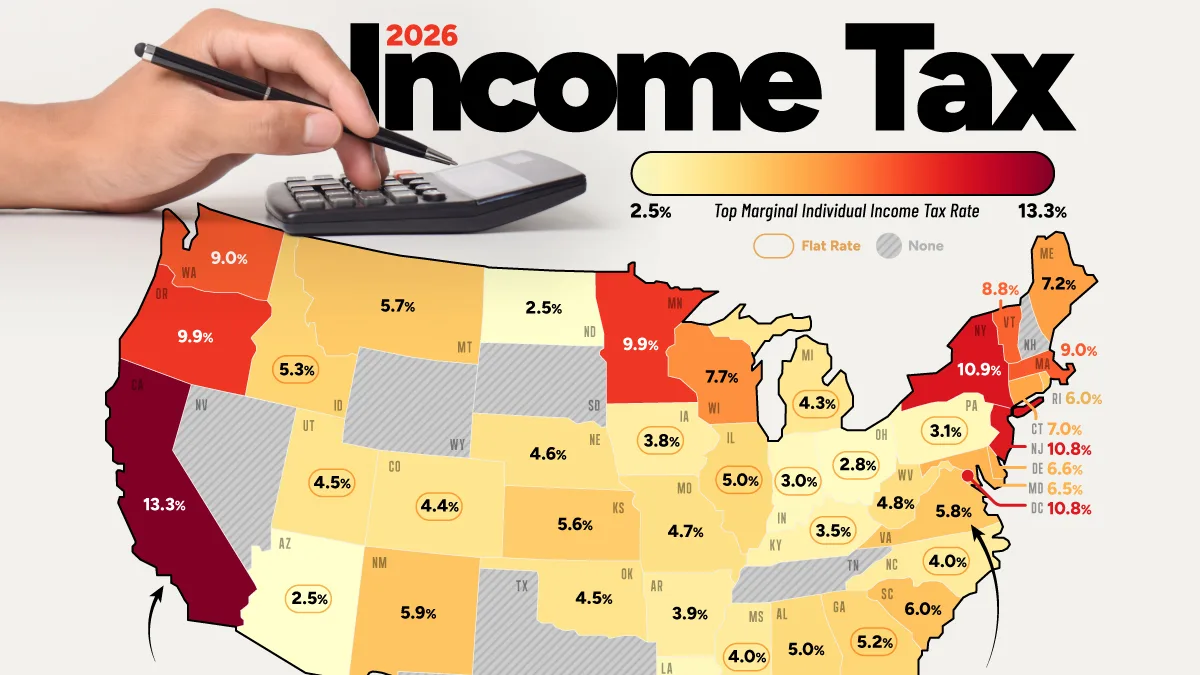
How State Income Tax Rates Compare in 2026
Key Takeaways
- Eight U.S. states levy no individual income tax: Alaska, Florida, Nevada, New Hampshire, South Dakota, Tennessee, Texas, and Wyoming.
- California has the highest top marginal income tax rate in the country (13.3%), followed by Hawaii (11%).
- Fifteen states, including Illinois (4.95%) and North Carolina (3.99%), levy flat individual income taxes.
Where you live can make a major difference in the state income tax rate applied to your earnings, with systems ranging from no individual income tax to top marginal rates above 10%.
This map compares U.S. states based on their top marginal individual income tax rate in 2026 using Tax Foundation data. Both local and federal income tax rates are excluded.
Which States Have No Individual Income Tax?
Eight states levy no individual income tax: Alaska, Florida, Nevada, New Hampshire, South Dakota, Tennessee, Texas, and Wyoming.
New Hampshire is a relatively recent addition to the list, having repealed its tax on interest and dividends in 2025.
The table below lists all U.S. states and Washington, D.C., alongside their top marginal income tax rate and tax system.
| State | Top marginal tax rate in 2026 (%) | Income Tax System |
|---|---|---|
| Alabama | 5 | Graduated-Rate |
| Alaska | 0 | None |
| Arizona | 2.5 | Flat |
| Arkansas | 3.9 | Graduated-Rate |
| California | 13.3 | Graduated-Rate |
| Colorado | 4.4 | Flat |
| Connecticut | 6.99 | Graduated-Rate |
| Delaware | 6.6 | Graduated-Rate |
| Florida | 0 | None |
| Georgia | 5.19 | Flat |
| Hawaii | 11 | Graduated-Rate |
| Idaho | 5.3 | Flat |
| Illinois | 4.95 | Flat |
| Indiana | 2.95 | Flat |
| Iowa | 3.8 | Graduated-Rate |
| Kansas | 5.58 | Graduated-Rate |
| Kentucky | 3.5 | Flat |
| Louisiana | 3 | Flat |
| Maine | 7.15 | Graduated-Rate |
| Maryland | 6.5 | Graduated-Rate |
| Massachusetts | 9 | Graduated-Rate |
| Michigan | 4.25 | Flat |
| Minnesota | 9.85 | Graduated-Rate |
| Mississippi | 4 | Flat |
| Missouri | 4.7 | Graduated-Rate |
| Montana | 5.65 | Graduated-Rate |
| Nebraska | 4.55 | Graduated-Rate |
| Nevada | 0 | None |
| New Hampshire | 0 | None |
| New Jersey | 10.75 | Graduated-Rate |
| New Mexico | 5.9 | Graduated-Rate |
| New York | 10.9 | Graduated-Rate |
| North Carolina | 3.99 | Flat |
| North Dakota | 2.5 | Graduated-Rate |
| Ohio | 2.75 | Flat |
| Oklahoma | 4.5 | Graduated-Rate |
| Oregon | 9.9 | Graduated-Rate |
| Pennsylvania | 3.07 | Flat |
| Rhode Island | 5.99 | Graduated-Rate |
| South Carolina | 6 | Graduated-Rate |
| South Dakota | 0 | None |
| Tennessee | 0 | None |
| Texas | 0 | None |
| Utah | 4.5 | Flat |
| Vermont | 8.75 | Graduated-Rate |
| Virginia | 5.75 | Graduated-Rate |
| Washington* | 9 | Graduated-Rate |
| West Virginia | 4.82 | Graduated-Rate |
| Wisconsin | 7.65 | Graduated-Rate |
| Wyoming | 0 | None |
| D.C. | 10.75 | Graduated-Rate |
*Washington rate only applies to capital gains income above $278k.
Having no individual income tax does not mean residents avoid taxes altogether. Each of these eight states levies other taxes to raise government revenue.
Texas, for example, has some of the highest property tax rates in the country, while Tennessee’s high combined state and local sales tax shifts more of the tax burden toward consumer spending.
Some states also benefit from revenue generated by specific industries. Nevada collects substantial gaming taxes, while Alaska taxes oil and gas companies operating in the state.
How Flat Income Taxes Work
Another 15 states use a flat individual income tax, applying a single statutory rate to taxable income rather than progressively higher rates as income rises.
States with flat income taxes include major Midwestern economies such as Illinois (4.95%) and Michigan (4.25%), as well as Mountain West states including Colorado (4.4%) and Utah (4.5%). Idaho’s 5.3% rate is the highest flat individual income tax rate in the country.
Individual tax bills can still vary based on deductions, exemptions, credits, and other state-specific rules. Efforts to replace flat taxes with graduated systems have also failed in some states. In Illinois, for example, voters rejected a 2020 proposal to allow a graduated income tax.
Where Top Marginal Tax Rates Are Highest
Most states instead use graduated income tax systems, in which higher portions of taxable income are subject to higher rates, similar to the federal tax system. Washington, D.C., also uses a graduated system, with a top marginal rate of 10.75%.
California, the largest state economy in the country, has the highest top marginal rate at 13.3%. This rate applies only to taxable income above $1 million for single filers. California is followed by Hawaii at 11% and New York at 10.9%, which also rank among the states with the highest overall tax burdens nationwide.
Top marginal rates do not tell the whole story. The income threshold at which each rate takes effect can significantly affect how much tax a person ultimately owes. In Virginia, for example, the state’s top rate of 5.75% begins above just $17,000 in taxable income, while California’s 13.3% top rate applies above $1 million for single filers.
Learn More on the Voronoi App
To compare personal income tax rates around the world, check out Global Personal Income Tax Rates on Voronoi.