Mapped: The Currencies of Europe in 2026
See visuals like this from many other data creators on our Voronoi app. Download it for free on iOS or Android and discover incredible data-driven charts from a variety of trusted sources.
Key Takeaways
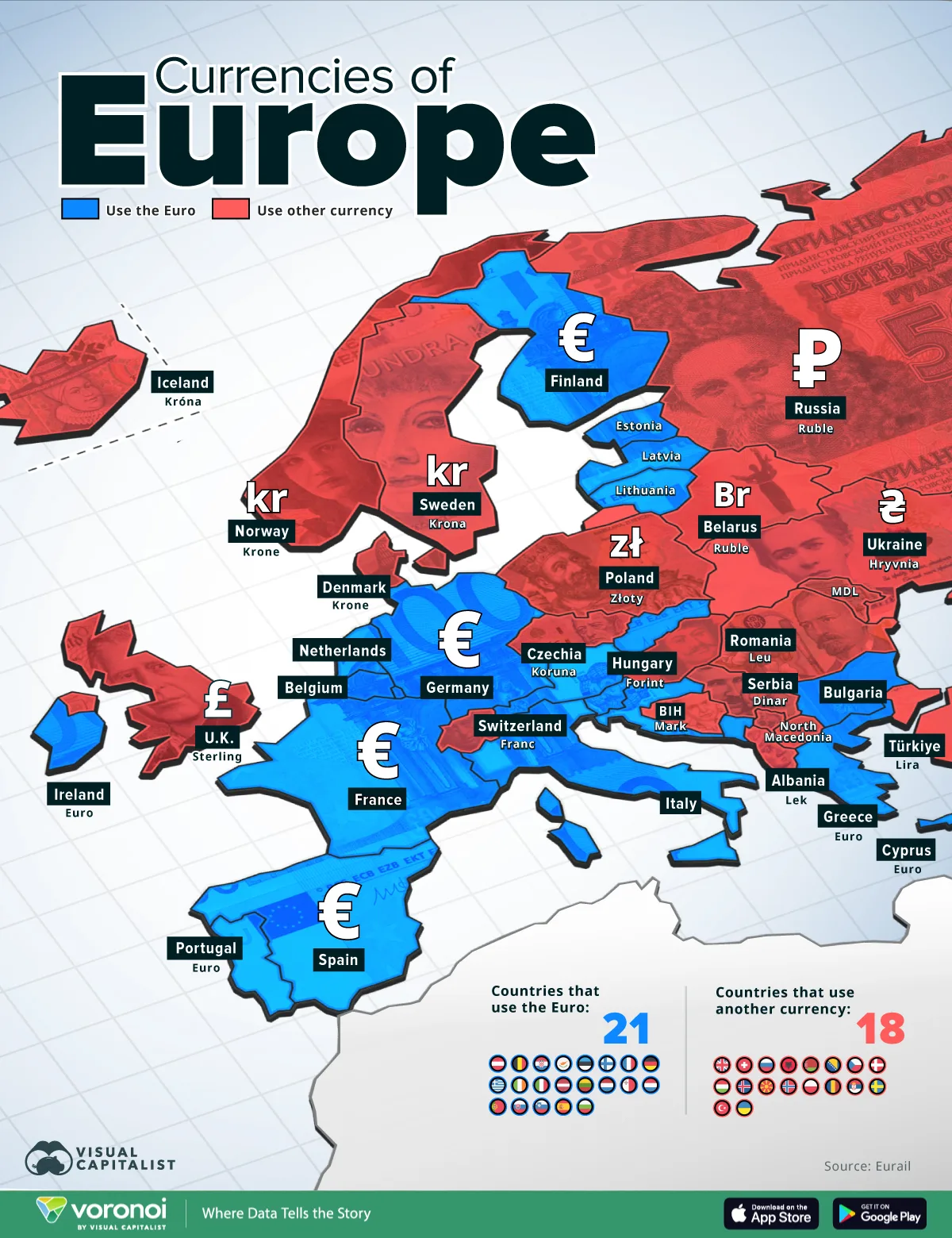
- On January 1, 2026 Bulgaria became the 21st country to use the euro as its currency, following Croatia in 2023.
- Approximately 350 million people use the euro.
Bulgaria joined the eurozone on January 1st, departing from its national currency, the lev, whose name translates to “lion.”.
Introduced in 1999 and entering circulation in 2002, the euro is the world’s second-largest reserve currency. While 21 of the European Union’s 27 member states use the euro, six do not, including Denmark, Sweden, Poland, Hungary, Romania, and Czechia.
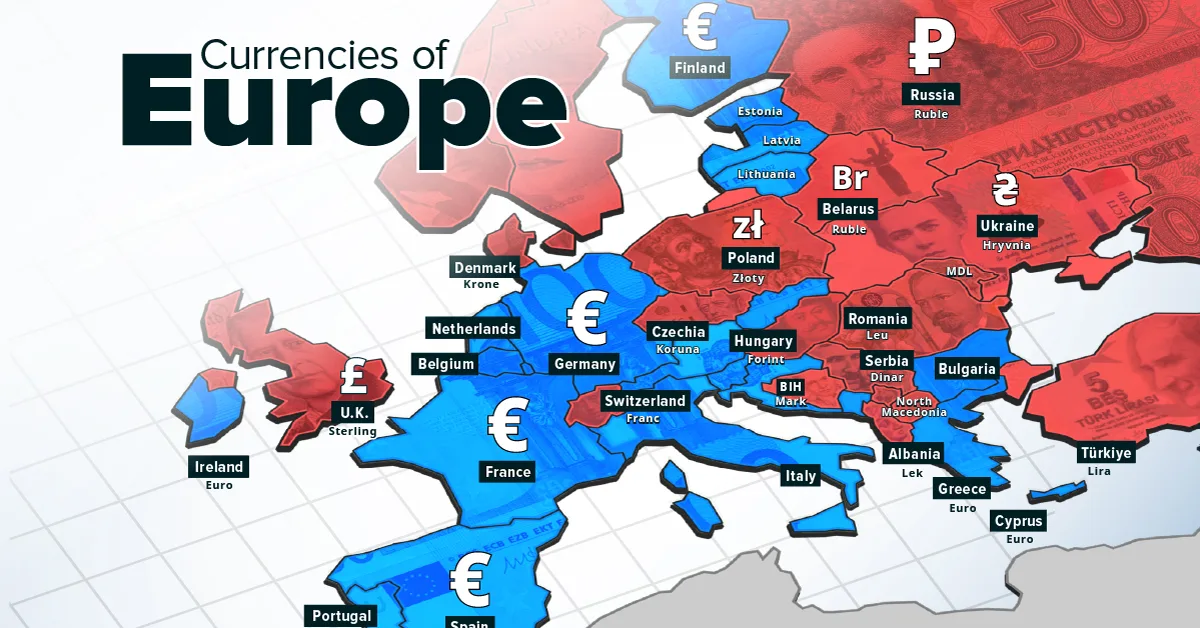
This graphic shows the currencies of Europe, based on data from Eurail.
Breaking Down the Currencies of Europe
Below, we show currencies used across the continent of Europe:
| Country | Currency |
|---|---|
 Austria Austria |
Euro |
 Belgium Belgium |
Euro |
 Bulgaria Bulgaria |
Euro |
 Croatia Croatia |
Euro |
 Cyprus Cyprus |
Euro |
 Estonia Estonia |
Euro |
 Finland Finland |
Euro |
 France France |
Euro |
 Germany Germany |
Euro |
 Greece Greece |
Euro |
 Ireland Ireland |
Euro |
 Italy Italy |
Euro |
 Latvia Latvia |
Euro |
 Lithuania Lithuania |
Euro |
 Luxembourg Luxembourg |
Euro |
 Malta Malta |
Euro |
 Netherlands Netherlands |
Euro |
 Portugal Portugal |
Euro |
 Slovakia Slovakia |
Euro |
 Slovenia Slovenia |
Euro |
 Spain Spain |
Euro |
 Albania Albania |
Lek |
 Belarus Belarus |
Ruble |
 Bosnia and Herzegovina Bosnia and Herzegovina |
Mark |
 Czech Republic Czech Republic |
Koruna |
 Denmark Denmark |
Krone |
 Hungary Hungary |
Forint |
 Iceland Iceland |
Króna |
 North Macedonia North Macedonia |
Denar |
 Norway Norway |
Krone |
 Poland Poland |
Złoty |
 Romania Romania |
Leu |
 Russia Russia |
Ruble |
 Serbia Serbia |
Dinar |
 Sweden Sweden |
Krona |
 Switzerland Switzerland |
Franc |
 Turkey Turkey |
Lira |
 Ukraine Ukraine |
Hryvnia |
 United Kingdom United Kingdom |
Pound Sterling |
In total, 21 countries use the euro, covering a population of 350 million people.
Back in 1999, there were 11 countries to first adopt the euro, including Germany, Spain, and Austria. Later, in 2001, Greece adopted the currency, then countries including Slovenia and Malta transitioned over the decade.
While Bulgaria is the most recent country to adopt the currency, it has not been met without controversy. Supporters argue the move could boost trade and deepen economic integration, particularly amid ongoing geopolitical tensions stemming from the Russia–Ukraine war.
Opponents, however, fear the euro could drive inflation. While historical evidence suggests euro adoption has not led to sustained inflation over time, public opinion in Bulgaria remains roughly split.
Of the countries that use their own currency in Europe, Russia is the largest by population, at 146 million. Other post-Soviet states also fall into this category, including Belarus and Ukraine.
In contrast, three countries out of the 15 post-Soviet nations have adopted the euro since the dissolution of the USSR in 1991, including Estonia, Latvia, and Lithuania transitioning between 2011 and 2015.
Learn More on the Voronoi App 
To learn more about this topic, check out this graphic on Europe population forecasts to 2100.