Mapped: The States Most Prepared for Power Demand Surges
Key Takeaways
- Florida leads all states with 3,003 MW in potential peak demand savings.
- Alabama and Minnesota also rank highly, each exceeding 2,000 MW.
- Rhode Island and Wyoming report no demand-response capacity.
Extreme weather, electrification, AI, and data centers are putting more pressure on America’s power grids.
As demand rises, utilities need flexible tools to reduce strain before outages occur. But which states lead on flexibility?
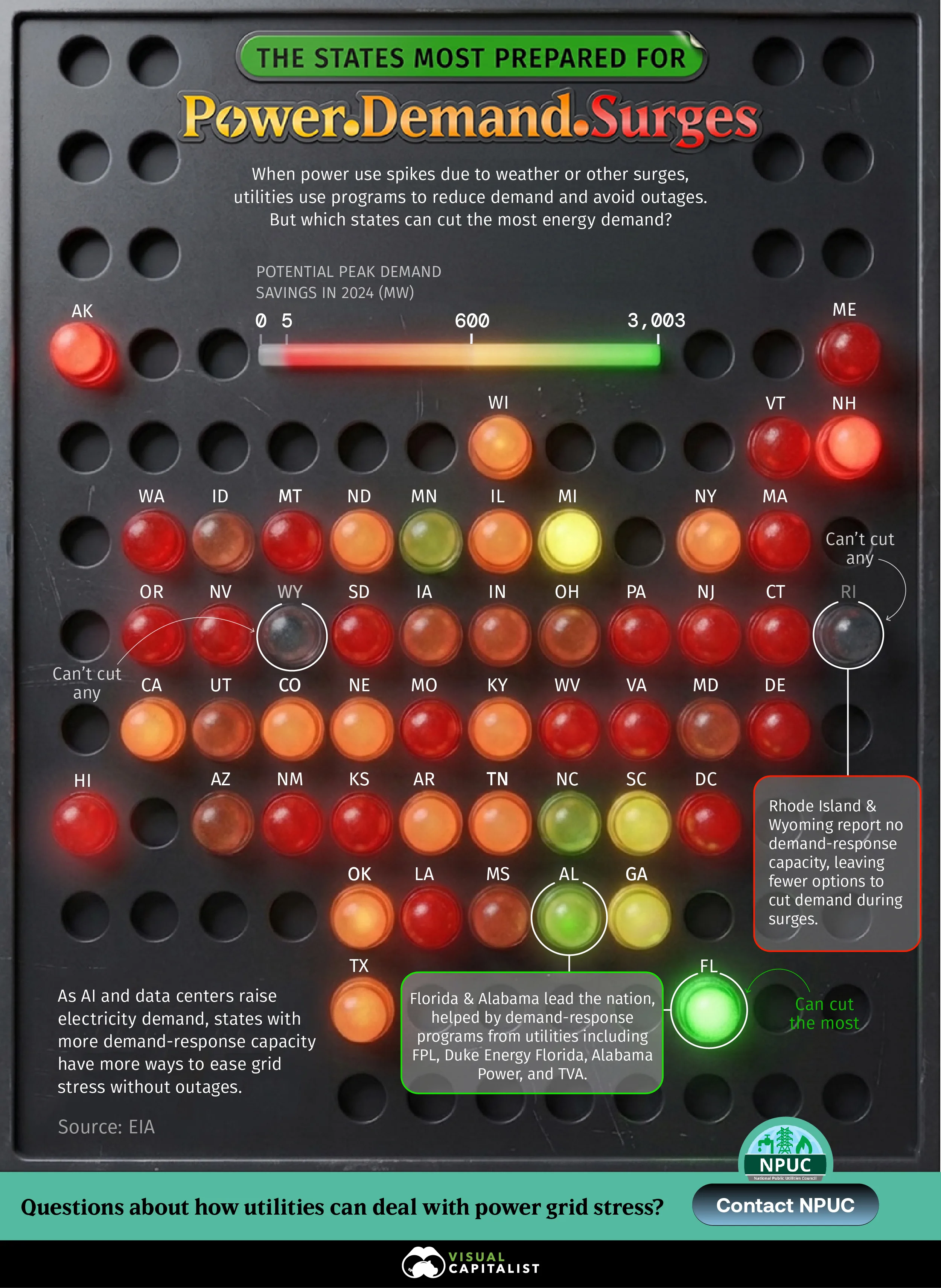
This graphic, in partnership with the National Public Utilities Council, shows the states most prepared for power demand surges using peak potential demand savings data from the EIA.
The States That Can Cut the Most Power Demand
Demand-response programs help utilities lower electricity use during high-stress periods. For example, customers may reduce consumption or shift usage away from peak hours, often in exchange for compensation.
Here is a table showing potential peak-demand savings in MW by state in 2024.
| State | Potential Peak Demand Savings in 2024 (MW) |
|---|---|
| FL | 3,003 |
| AL | 2,153 |
| MN | 2,009 |
| NC | 1,858 |
| MI | 1,550 |
| SC | 1,324 |
| GA | 1,266 |
| IL | 1,143 |
| NY | 1,070 |
| CA | 1,061 |
| TX | 1,050 |
| AR | 1,024 |
| TN | 991 |
| OK | 869 |
| NE | 857 |
| ND | 854 |
| WI | 830 |
| CO | 795 |
| IA | 759 |
| KY | 732 |
| IN | 671 |
| OH | 668 |
| MD | 613 |
| AZ | 555 |
| MS | 522 |
| ID | 466 |
| UT | 336 |
| MO | 307 |
| LA | 267 |
| DE | 246 |
| NV | 200 |
| SD | 180 |
| OR | 178 |
| VA | 163 |
| KS | 143 |
| CT | 135 |
| MA | 120 |
| WA | 112 |
| VT | 72 |
| NM | 69 |
| HI | 58 |
| MT | 52 |
| PA | 43 |
| WV | 34 |
| NJ | 27 |
| DC | 20 |
| AK | 18 |
| ME | 15 |
| NH | 5 |
| RI | 0 |
| WY | 0 |
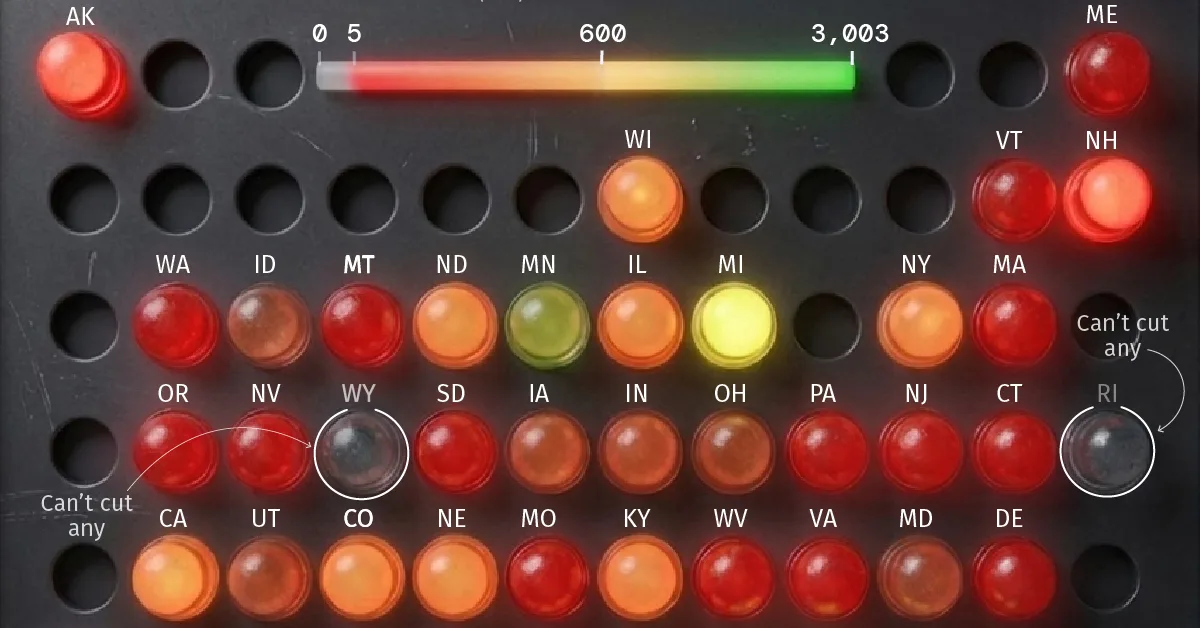
Florida ranks first, with 3,003 MW in potential peak demand savings. Alabama follows at 2,153 MW, while Minnesota places third at 2,009 MW.
Together, these states demonstrate how demand-response capacity can buffer the grid during grid stress. Meanwhile, data center power demand continues to rise as AI adoption grows.
The Southeast Leads the Rankings
Florida and Alabama lead the nation, supported by demand-response programs from utilities including FPL, Duke Energy Florida, Alabama Power, and TVA. North Carolina, South Carolina, and Georgia also rank in the top seven.
As a result, the Southeast stands out for its ability to manage demand spikes. These programs can help utilities avoid outages without adding new generation immediately.
Where Capacity Is Limited—and Why It Matters
At the other end, Rhode Island and Wyoming report no demand-response capacity. That leaves fewer options to cut demand when electricity use surges.
Several northeastern states, including New Hampshire, Maine, and New Jersey, also report minimal demand-response capacity.
As U.S. electricity demand rises from data center construction after years of slower growth, demand-response programs give utilities an important tool to manage peak stress.
-
 Energy4 weeks ago
Ranked: The Most Consistent U.S. Power Sources
A look at which U.S. power sources run most consistently, and why nuclear remains central as utility demand grows.
-
 AI1 month ago
U.S. States Winning and Losing Data Center Market Share
Which U.S. states are winning the data center race? This visualization shows the states gaining and losing data center market share in the next two years.
-
 Environment2 months ago
Mapped: Carbon Offsets by U.S. State
Which states dominate carbon offsets? This U.S. map shows the hotspots as utilities respond to the AI electricity surge.
-
 Energy7 months ago
Ranked: The Top 10 Cleanest Operating Utilities In The U.S.
Just four U.S. utilities operate with over 80% carbon-free generation. This graphic ranks the top 10 cleanest utilities by their fuel mix.
-
 Energy1 year ago
Visualized: Offshore Wind Installations by Region (2023–2033)
This streamgraph shows projected offshore wind capacity by region, according to The Global Wind Energy Council.
-
 Energy1 year ago
Ranked: The Largest Power Outages in the U.S. (2013–2023)
Severe weather caused all ten of the largest U.S. power outages in the past decade, highlighting the importance of grid resiliency.
-
 Batteries1 year ago
Visualized: Countries by Grid Storage Battery Capacity in 2023
This treemap chart uses data from Statistical Review of World Energy to show the top 10 countries with the most battery storage capacity in 2023.
-
 Energy2 years ago
Visualized: Which Countries Capture the Most Carbon?
This voronoi depicts the countries that capture the most carbon globally in 2023, with data from Rystad Energy.
-
 Energy2 years ago
Ranked: Energy Transition Scores by Country in 2024
This bar chart shows the countries’ highest and lowest energy transition index scores determined by the World Economic Forum.
-
 Energy2 years ago
Ranked: America’s Cheapest Sources of Electricity in 2024
This dumbbell plot shows the most and least expensive sources of energy in the U.S., using data from Lazard.
-
 Energy2 years ago
Visualized: Emission Reduction Targets by Country in 2024
This infographic shows the greenhouse gas emissions targets of all countries and their target years with data from Net Zero Tracker.
-
 Green2 years ago
Visualized: The Price of Carbon Around the World in 2024
This bar chart shows the varying prices of carbon across different economies around the globe, using data from the World Bank.
-
 Energy2 years ago
Visualized: Renewable Energy Capacity Through Time (2000–2023)
This streamgraph shows the growth in renewable energy capacity by country and region since 2000.
-
 Environment2 years ago
The Rise in America’s Billion-Dollar Extreme Weather Disasters
From tropical cyclones to severe storms, the number of extreme weather disasters with losses exceeding $1 billion has climbed over time.
-
 Environment2 years ago
The Most Polluted Cities in the U.S.
What are the most polluted cities in the U.S. according to data from the American Lung Association’s 2024 State of the Air Report?
-
 Energy4 years ago
Visualizing U.S. Greenhouse Gas Emissions by Sector
The U.S. emits about 6 billion metric tons of greenhouse gases a year. Here’s how these emissions rank by sector.
-
 Sponsored5 years ago
Road to Decarbonization: The United States Electricity Mix
Can America become carbon-free by 2035? This graphic breaks down the United States’ electricity mix, by state.
-
 Sponsored5 years ago
Road to Decarbonization: U.S. Coal Plant Closures
This infographic highlights announced coal plant closures in the U.S. and how much power will be affected.

- Source: https://www.visualcapitalist.com/sp/mapped-the-states-most-prepared-for-power-demand-surges/