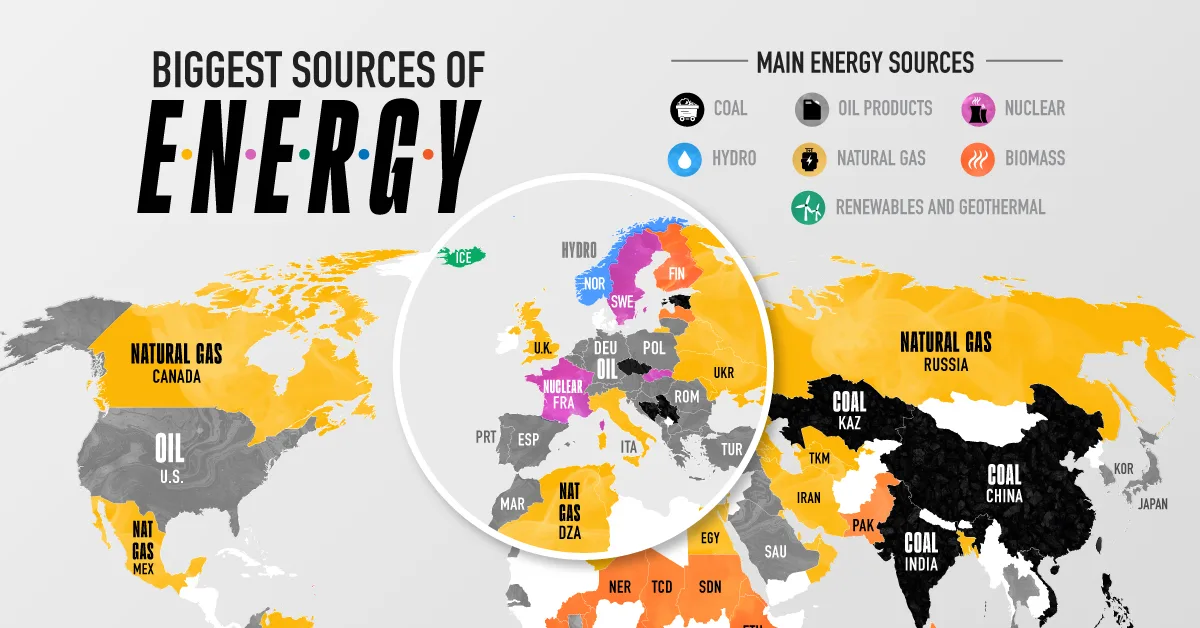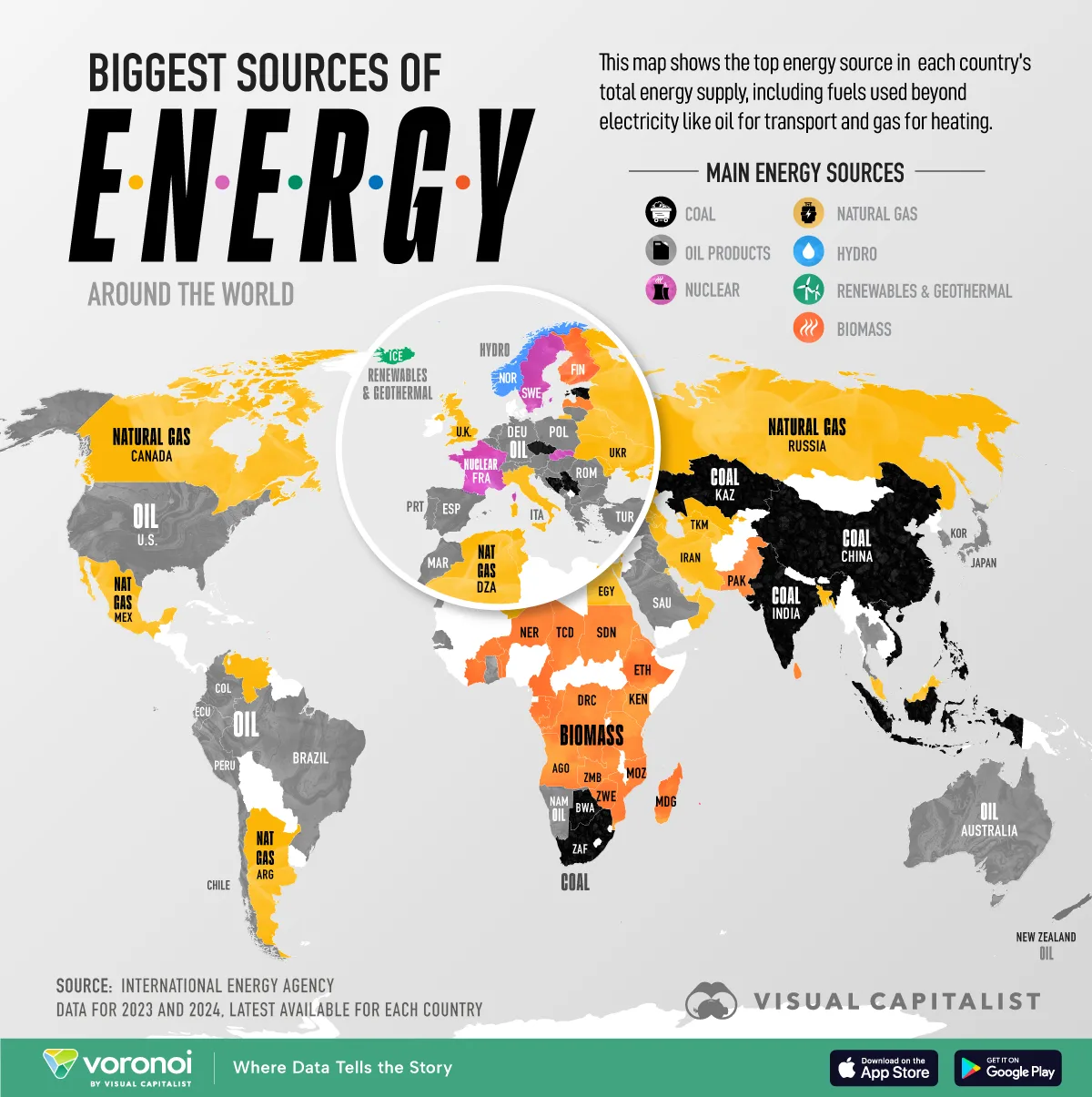
Mapped: The World’s Biggest Energy Sources by Country
See visuals like this from many other data creators on our Voronoi app. Download it for free on iOS or Android and discover incredible data-driven charts from a variety of trusted sources.
Key Takeaways
- Oil is the most common dominant energy source globally, leading in 39 of the countries covered in the dataset.
- Coal remains the primary energy source in several of Asia’s largest economies, including China, India, Indonesia, and Vietnam.
- Biomass is still the biggest energy source across much of Africa, where fuels like firewood and charcoal remain widely used for cooking and heating.
Despite rapid growth in renewables, much of the world still relies on a small group of traditional energy sources. In many countries, oil, coal, or natural gas continues to supply the largest share of energy used across transportation, industry, and electricity generation.
This map shows the largest primary energy source in 112 countries using data from the International Energy Agency (IEA). Primary energy refers to energy in its raw form before it is converted into electricity or refined fuels.
The global picture highlights how different regions depend on different fuels. Oil dominates in many economies, coal still powers several of Asia’s largest countries, and traditional biomass remains central to energy use across parts of Africa.
Oil Leads in the Largest Number of Countries
Oil is the most common primary energy source globally, with 39 of the countries in the dataset relying on it more than any other fuel. It dominates across much of Europe, the Middle East, and large parts of Asia-Pacific.
In many economies, petroleum products remain essential for transportation and heavy industry. Even countries that produce natural gas, coal, or hydropower domestically often still rely on oil for a significant share of their overall energy supply.
| Country | Largest source of energy |
|---|---|
 Albania Albania |
Oil |
 Algeria Algeria |
Natural Gas |
 Angola Angola |
Biomass |
 Argentina Argentina |
Natural Gas |
 Armenia Armenia |
Natural Gas |
 Australia Australia |
Oil |
 Austria Austria |
Oil |
 Azerbaijan Azerbaijan |
Natural Gas |
 Bangladesh Bangladesh |
Natural Gas |
 Belarus Belarus |
Natural Gas |
 Belgium Belgium |
Oil |
 Benin Benin |
Biomass |
 Bosnia and Herzegovina Bosnia and Herzegovina |
Coal |
 Botswana Botswana |
Coal |
 Brazil Brazil |
Oil |
 Bulgaria Bulgaria |
Oil |
 Burkina Faso Burkina Faso |
Biomass |
 Cameroon Cameroon |
Biomass |
 Canada Canada |
Natural Gas |
 Chad Chad |
Biomass |
 Chile Chile |
Oil |
 China China |
Coal |
 China Hong Kong SAR China Hong Kong SAR |
Natural Gas |
 Colombia Colombia |
Oil |
 Côte d’Ivoire Côte d’Ivoire |
Biomass |
 Croatia Croatia |
Oil |
 Cyprus Cyprus |
Oil |
 Czechia Czechia |
Coal |
 Democratic Republic of the Congo Democratic Republic of the Congo |
Biomass |
 Ecuador Ecuador |
Oil |
 Egypt Egypt |
Natural Gas |
 Eritrea Eritrea |
Biomass |
 Estonia Estonia |
Coal |
 Ethiopia Ethiopia |
Biomass |
 Finland Finland |
Biomass |
 France France |
Nuclear |
 Gabon Gabon |
Biomass |
 Georgia Georgia |
Natural Gas |
 Germany Germany |
Oil |
 Ghana Ghana |
Oil |
 Greece Greece |
Oil |
 Hungary Hungary |
Oil |
 Iceland Iceland |
Renewables/Geothermal |
 India India |
Coal |
 Indonesia Indonesia |
Coal |
 Iran Iran |
Natural Gas |
 Iraq Iraq |
Oil |
 Israel Israel |
Natural Gas |
 Italy Italy |
Natural Gas |
 Japan Japan |
Oil |
 Kazakhstan Kazakhstan |
Coal |
 Kenya Kenya |
Biomass |
 Kuwait Kuwait |
Natural Gas |
 Latvia Latvia |
Biomass |
 Lithuania Lithuania |
Oil |
 Luxembourg Luxembourg |
Oil |
 Madagascar Madagascar |
Biomass |
 Malaysia Malaysia |
Natural Gas |
 Malta Malta |
Natural Gas |
 Mexico Mexico |
Natural Gas |
 Moldova Moldova |
Natural Gas |
 Montenegro Montenegro |
Oil |
 Morocco Morocco |
Oil |
 Mozambique Mozambique |
Biomass |
 Namibia Namibia |
Oil |
 Netherlands Netherlands |
Oil |
 New Zealand New Zealand |
Oil |
 Niger Niger |
Biomass |
 North Macedonia North Macedonia |
Oil |
 Norway Norway |
Hydro |
 Oman Oman |
Natural Gas |
 Pakistan Pakistan |
Biomass |
 Peru Peru |
Oil |
 Philippines Philippines |
Coal |
 Poland Poland |
Oil |
 Portugal Portugal |
Oil |
 Qatar Qatar |
Natural Gas |
 Republic of the Congo Republic of the Congo |
Biomass |
 Romania Romania |
Oil |
 Russian Federation Russian Federation |
Natural Gas |
 Rwanda Rwanda |
Biomass |
 Saudi Arabia Saudi Arabia |
Oil |
 Senegal Senegal |
Oil |
 Serbia Serbia |
Coal |
 Singapore Singapore |
Oil |
 Slovakia Slovakia |
Nuclear |
 Slovenia Slovenia |
Oil |
 South Africa South Africa |
Coal |
 South Korea South Korea |
Oil |
 Spain Spain |
Oil |
 Sri Lanka Sri Lanka |
Biomass |
 Sudan Sudan |
Biomass |
 Sweden Sweden |
Nuclear |
 Switzerland Switzerland |
Oil |
 Taiwan Taiwan |
Coal |
 Tanzania Tanzania |
Biomass |
 Thailand Thailand |
Oil |
 Togo Togo |
Biomass |
 Trinidad & Tobago Trinidad & Tobago |
Natural Gas |
 Tunisia Tunisia |
Natural Gas |
 Türkiye Türkiye |
Oil |
 Turkmenistan Turkmenistan |
Natural Gas |
 Uganda Uganda |
Biomass |
 Ukraine Ukraine |
Natural Gas |
 United Arab Emirates United Arab Emirates |
Natural Gas |
 United Kingdom United Kingdom |
Natural Gas |
 United States United States |
Oil |
 Uzbekistan Uzbekistan |
Natural Gas |
 Venezuela Venezuela |
Natural Gas |
 Vietnam Vietnam |
Coal |
 Zambia Zambia |
Biomass |
 Zimbabwe Zimbabwe |
Biomass |
Major economies such as the United States, Japan, and Germany still rely primarily on oil despite growing investments in renewables and electrification.
Following oil, natural gas is the next most common primary energy source globally, with 29 countries relying on it the most.
Coal Remains Key in Major Asian Economies
Coal continues to dominate the energy mix in several of the world’s largest emerging economies. China, India, Indonesia, and Vietnam all rely on coal as their biggest primary energy source.
One reason is simple: availability. Many of these countries have large domestic coal reserves and long-established mining and power infrastructure built around the fuel.
At the same time, coal remains one of the largest contributors to global carbon emissions, making these economies central to the future trajectory of global energy transitions.
Biomass Leads in Many African Countries
Across much of Africa, biomass remains the largest primary energy source. This includes fuels such as firewood, charcoal, and agricultural waste.
In many rural areas, these fuels are still widely used for everyday needs like cooking and heating, particularly where access to electricity or modern fuels remains limited.
Outside of Africa, only three other countries in the dataset rely primarily on biomass for energy: Finland, Latvia, and Pakistan.
Learn More on the Voronoi App 
If you enjoyed today’s post, check out All of the World’s Oil Reserves by Country, in One Visualization on Voronoi.