Mapped: The World’s Countries by Political System
See visuals like this from many other data creators on our Voronoi app. Download it for free on iOS or Android and discover incredible data-driven charts from a variety of trusted sources.
Key Takeaways
- 72% of the world’s population now lives under autocratic rule, the highest share since 1978.
- Electoral autocracies—where elections exist but lack fairness—are now the most common regime type globally.
- Liberal democracies remain concentrated in Western Europe, North America, Oceania, and parts of East Asia.
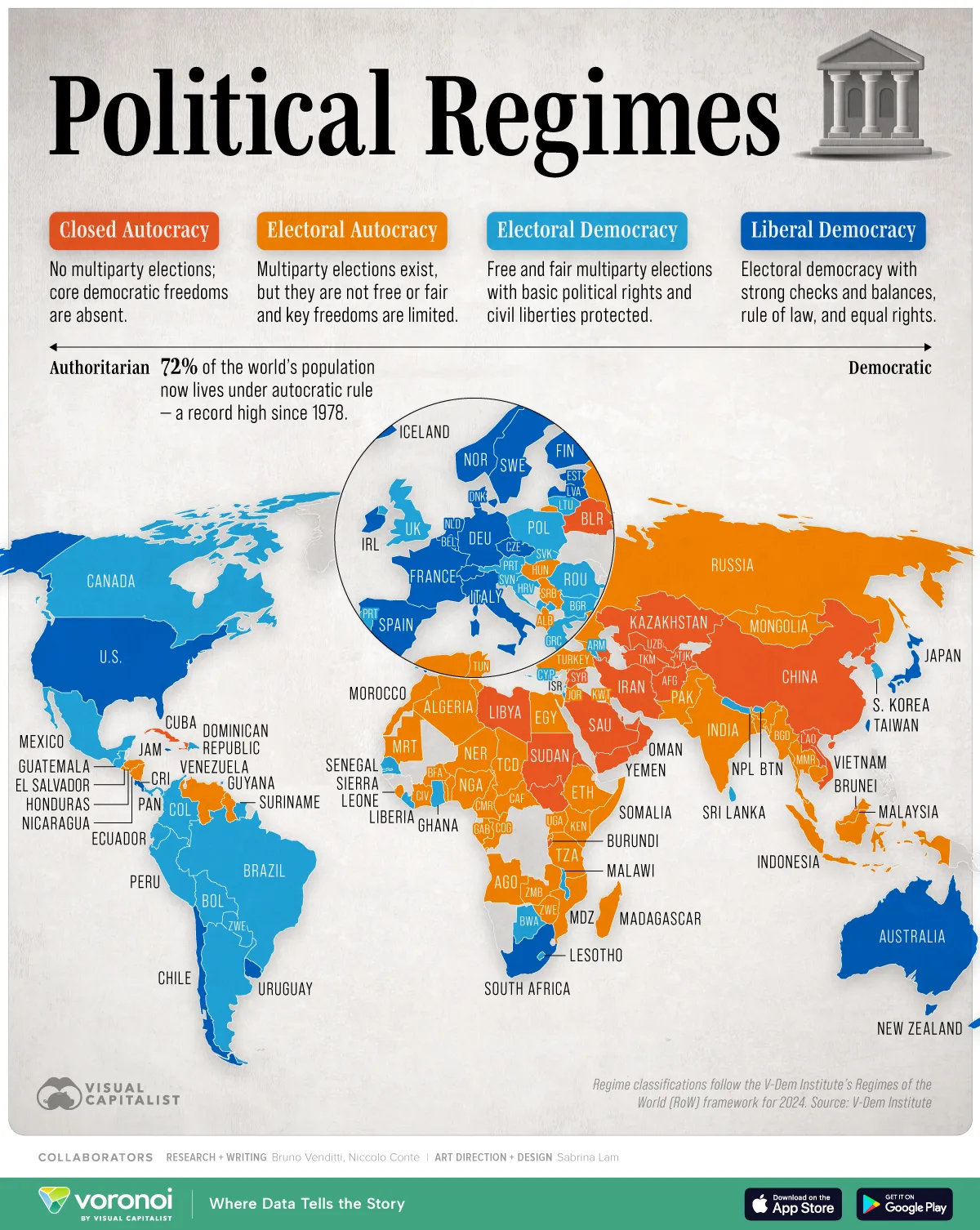
Nearly three-quarters of the world’s population now lives under autocratic rule, according to the V-Dem Institute’s 2024 Regimes of the World report. That’s the highest share since 1978.
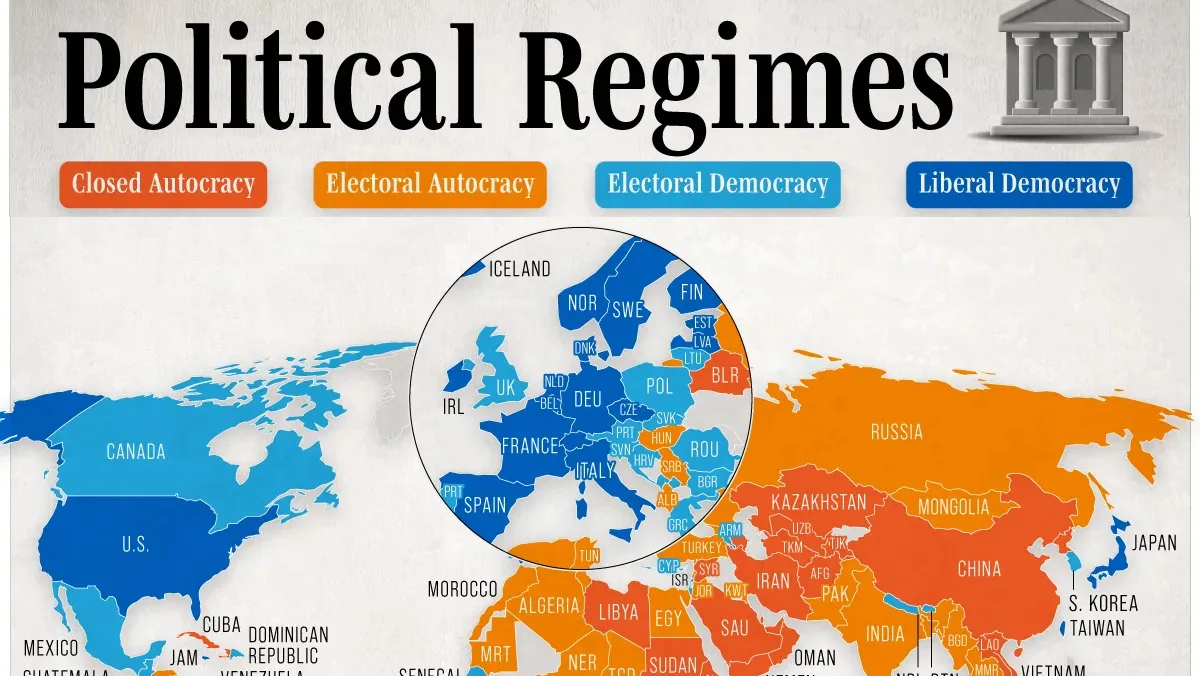
The map above classifies every country into one of four political systems: closed autocracy, electoral autocracy, electoral democracy, or liberal democracy.
The results point to a decades-long shift in global governance, with electoral autocracies now the most common regime type worldwide.
The Four Types of Political Regimes
-Dem classifies countries based on the competitiveness of elections, protection of civil liberties, and the strength of institutional checks and balances.
Here’s how the four categories differ:
- Closed autocracies have no meaningful multiparty elections and suppress core democratic freedoms. Countries like China, Saudi Arabia, and North Korea fall into this group.
- Electoral autocracies hold multiparty elections, but they are not free or fair. Media restrictions, weakened opposition, and limited civil liberties are common. This category includes countries such as Russia, India, and Turkey.
- Electoral democracies conduct free and fair elections and protect basic rights, but may lack strong institutional constraints. Examples include Argentina, Poland, and the United Kingdom.
- Liberal democracies go further, combining competitive elections with robust rule of law and checks and balances. Countries such as Germany, Japan, United States, and Uruguay are classified in this highest tier.
Scroll down to see how every country is classified.
Autocracy Is the Most Common Regime
Electoral autocracy is now the most common regime type in the world.
This category spans every continent, from Sub-Saharan Africa to South Asia and parts of Latin America. In many cases, democratic institutions still exist on paper, but their independence has eroded.
Large-population countries shifting toward electoral autocracy have an outsized effect on global trends. As a result, even if the number of democracies remains substantial, the share of people living under autocratic rule continues to grow.
| Country | Regime |
|---|---|
 Afghanistan Afghanistan |
Closed Autocracy |
 Albania Albania |
Electoral Autocracy |
 Algeria Algeria |
Electoral Autocracy |
 Angola Angola |
Electoral Autocracy |
 Argentina Argentina |
Electoral Democracy |
 Armenia Armenia |
Electoral Democracy |
 Australia Australia |
Liberal Democracy |
 Austria Austria |
Electoral Democracy |
 Azerbaijan Azerbaijan |
Closed Autocracy |
 Bangladesh Bangladesh |
Electoral Autocracy |
 Barbados Barbados |
Liberal Democracy |
 Belarus Belarus |
Closed Autocracy |
 Belgium Belgium |
Liberal Democracy |
 Benin Benin |
Electoral Autocracy |
 Bhutan Bhutan |
Electoral Democracy |
 Bolivia Bolivia |
Electoral Democracy |
 Botswana Botswana |
Electoral Democracy |
 Brazil Brazil |
Electoral Democracy |
 Brunei Brunei |
Closed Autocracy |
 Bulgaria Bulgaria |
Electoral Democracy |
 Burkina Faso Burkina Faso |
Electoral Autocracy |
 Burundi Burundi |
Closed Autocracy |
 Cambodia Cambodia |
Electoral Autocracy |
 Cameroon Cameroon |
Electoral Autocracy |
 Canada Canada |
Electoral Democracy |
 Cape Verde Cape Verde |
Electoral Democracy |
 Central African Republic Central African Republic |
Electoral Autocracy |
 Chad Chad |
Electoral Autocracy |
 Chile Chile |
Liberal Democracy |
 China China |
Closed Autocracy |
 Colombia Colombia |
Electoral Democracy |
 Comoros Comoros |
Electoral Autocracy |
 Congo (Brazzaville) Congo (Brazzaville) |
Electoral Autocracy |
 Costa Rica Costa Rica |
Liberal Democracy |
 Côte d’Ivoire Côte d’Ivoire |
Electoral Autocracy |
 Croatia Croatia |
Electoral Democracy |
 Cuba Cuba |
Closed Autocracy |
 Cyprus Cyprus |
Electoral Democracy |
 Czechia Czechia |
Liberal Democracy |
 Denmark Denmark |
Liberal Democracy |
 Dominican Republic Dominican Republic |
Electoral Democracy |
 Ecuador Ecuador |
Electoral Democracy |
 Egypt Egypt |
Electoral Autocracy |
 El Salvador El Salvador |
Electoral Autocracy |
 Eritrea Eritrea |
Closed Autocracy |
 Estonia Estonia |
Liberal Democracy |
 Eswatini Eswatini |
Electoral Autocracy |
 Ethiopia Ethiopia |
Electoral Autocracy |
 Finland Finland |
Liberal Democracy |
 France France |
Liberal Democracy |
 Gabon Gabon |
Electoral Autocracy |
 Gambia Gambia |
Electoral Democracy |
 Georgia Georgia |
Electoral Autocracy |
 Germany Germany |
Liberal Democracy |
 Ghana Ghana |
Electoral Democracy |
 Greece Greece |
Electoral Democracy |
 Guatemala Guatemala |
Electoral Democracy |
 Guyana Guyana |
Electoral Autocracy |
 Haiti Haiti |
Closed Autocracy |
 Honduras Honduras |
Electoral Autocracy |
 Hungary Hungary |
Electoral Autocracy |
 Iceland Iceland |
Liberal Democracy |
 India India |
Electoral Autocracy |
 Indonesia Indonesia |
Electoral Autocracy |
 Iran Iran |
Closed Autocracy |
 Ireland Ireland |
Liberal Democracy |
 Israel Israel |
Electoral Democracy |
 Italy Italy |
Liberal Democracy |
 Jamaica Jamaica |
Liberal Democracy |
 Japan Japan |
Liberal Democracy |
 Jordan Jordan |
Electoral Autocracy |
 Kazakhstan Kazakhstan |
Closed Autocracy |
 Kenya Kenya |
Electoral Autocracy |
 Kosovo Kosovo |
Electoral Democracy |
 Kuwait Kuwait |
Electoral Autocracy |
 Laos Laos |
Closed Autocracy |
 Latvia Latvia |
Liberal Democracy |
 Lebanon Lebanon |
Electoral Autocracy |
 Lesotho Lesotho |
Electoral Democracy |
 Liberia Liberia |
Electoral Democracy |
 Libya Libya |
Closed Autocracy |
 Lithuania Lithuania |
Electoral Democracy |
 Luxembourg Luxembourg |
Liberal Democracy |
 Madagascar Madagascar |
Electoral Autocracy |
 Malawi Malawi |
Electoral Democracy |
 Malaysia Malaysia |
Electoral Autocracy |
 Maldives Maldives |
Electoral Democracy |
 Malta Malta |
Electoral Democracy |
 Mauritania Mauritania |
Electoral Autocracy |
 Mauritius Mauritius |
Electoral Autocracy |
 Mexico Mexico |
Electoral Autocracy |
 Mongolia Mongolia |
Electoral Autocracy |
 Montenegro Montenegro |
Electoral Democracy |
 Morocco Morocco |
Electoral Autocracy |
 Mozambique Mozambique |
Electoral Autocracy |
 Myanmar Myanmar |
Electoral Autocracy |
 Nepal Nepal |
Electoral Democracy |
 Netherlands Netherlands |
Liberal Democracy |
 New Zealand New Zealand |
Liberal Democracy |
 Nicaragua Nicaragua |
Electoral Autocracy |
 Niger Niger |
Electoral Autocracy |
 Nigeria Nigeria |
Electoral Autocracy |
 North Korea North Korea |
Closed Autocracy |
 Norway Norway |
Liberal Democracy |
 Oman Oman |
Closed Autocracy |
 Pakistan Pakistan |
Electoral Autocracy |
 Panama Panama |
Electoral Democracy |
 Paraguay Paraguay |
Electoral Democracy |
 Peru Peru |
Electoral Democracy |
 Poland Poland |
Electoral Democracy |
 Portugal Portugal |
Electoral Democracy |
 Qatar Qatar |
Closed Autocracy |
 Romania Romania |
Electoral Democracy |
 Russia Russia |
Electoral Autocracy |
 Rwanda Rwanda |
Electoral Autocracy |
 Saudi Arabia Saudi Arabia |
Closed Autocracy |
 Senegal Senegal |
Electoral Democracy |
 Serbia Serbia |
Electoral Autocracy |
 Seychelles Seychelles |
Liberal Democracy |
 Sierra Leone Sierra Leone |
Electoral Autocracy |
 Singapore Singapore |
Electoral Autocracy |
 Slovakia Slovakia |
Electoral Democracy |
 Slovenia Slovenia |
Electoral Democracy |
 Solomon Islands Solomon Islands |
Electoral Democracy |
 Somalia Somalia |
Electoral Autocracy |
 South Africa South Africa |
Liberal Democracy |
 South Sudan South Sudan |
Closed Autocracy |
 Spain Spain |
Liberal Democracy |
 Sri Lanka Sri Lanka |
Electoral Democracy |
 Sudan Sudan |
Closed Autocracy |
 Suriname Suriname |
Electoral Democracy |
 Sweden Sweden |
Liberal Democracy |
 Switzerland Switzerland |
Liberal Democracy |
 Syria Syria |
Closed Autocracy |
 Taiwan Taiwan |
Liberal Democracy |
 Tajikistan Tajikistan |
Closed Autocracy |
 Tanzania Tanzania |
Electoral Autocracy |
 Thailand Thailand |
Electoral Autocracy |
 Togo Togo |
Electoral Autocracy |
 Trinidad and Tobago Trinidad and Tobago |
Electoral Democracy |
 Tunisia Tunisia |
Electoral Autocracy |
 Turkey Turkey |
Electoral Autocracy |
 Turkmenistan Turkmenistan |
Closed Autocracy |
 Uganda Uganda |
Electoral Autocracy |
 United Arab Emirates United Arab Emirates |
Closed Autocracy |
 United Kingdom United Kingdom |
Electoral Democracy |
 United States United States |
Liberal Democracy |
 Uruguay Uruguay |
Liberal Democracy |
 Uzbekistan Uzbekistan |
Closed Autocracy |
 Vanuatu Vanuatu |
Electoral Democracy |
 Venezuela Venezuela |
Electoral Autocracy |
 Vietnam Vietnam |
Closed Autocracy |
 Yemen Yemen |
Closed Autocracy |
 Zambia Zambia |
Electoral Autocracy |
 Zimbabwe Zimbabwe |
Electoral Autocracy |
Where Liberal Democracy Persists
Liberal democracies are concentrated in Western Europe, parts of East Asia, Oceania, and North America.
Nordic countries such as Sweden, Norway, and Finland remain among the strongest performers. So do nations like Australia, New Zealand, Japan, and Taiwan.
However, even among established democracies, concerns about polarization, declining trust in institutions, and pressure on judicial independence have intensified in recent years.
While democratic systems still govern many countries, the overall global trend shows autocratic systems expanding their reach in terms of population.
Methodology
The classifications are based on the V-Dem Institute’s 2024 Regimes of the World dataset, which evaluates countries across indicators including electoral integrity, civil liberties, judicial independence, and executive constraints.
Countries are then grouped into one of four regime types to provide a simplified view of the global political landscape.
Learn More on the Voronoi App 
If you enjoyed today’s post, check out The World’s 50 Largest Economies by GDP in 2026 on Voronoi, the new app from Visual Capitalist.