 Click to view this graphic in higher-resolution.
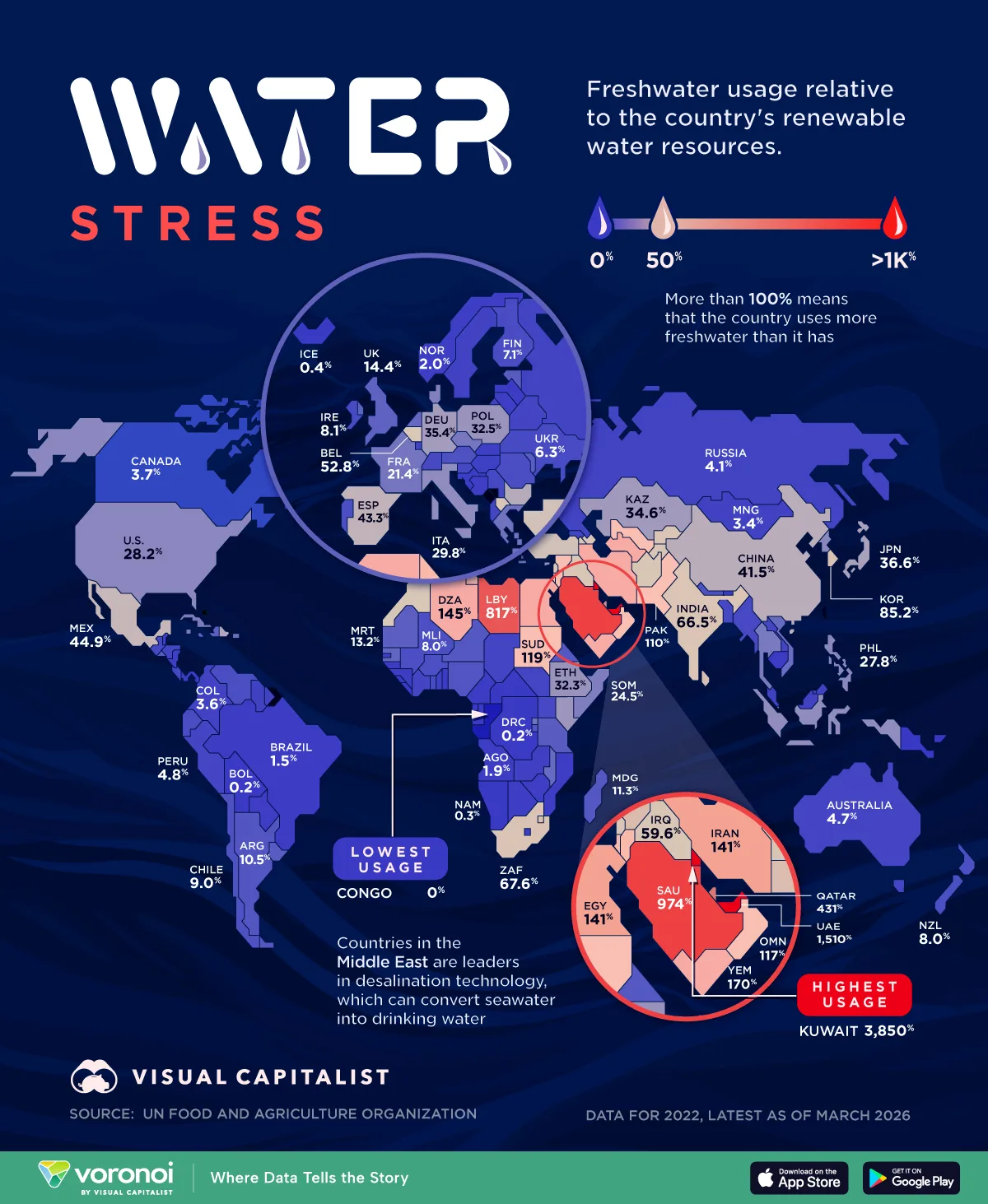
Mapped: The World’s Most Water-Stressed Countries
See visuals like this from many other data creators on our Voronoi app. Download it for free on iOS or Android and discover incredible data-driven charts from a variety of trusted sources.
Key Takeaways
- Some countries are using 10–30x more water than their natural supply can sustain.
- Kuwait has the highest water stress level in the world at 3,850%.
- The U.S. water stress level is 28.2%, making it the 58th highest water-stressed nation globally.
In some parts of the world, water use has far exceeded what nature can replenish.
This map shows water stress by country, measured as freshwater withdrawals relative to renewable water resources. Countries with scores above 100% are using more water than is naturally available each year, often relying on groundwater depletion or desalination to close the gap. Data comes from the UN Food and Agriculture Organization.
Water is essential across agriculture, manufacturing, and daily life, making these imbalances increasingly important as climate patterns shift and demand rises.
Water Stress Levels by Country
Dive into the latest data, which is from 2022, below:
| Rank | Country | Water stress (%) |
|---|---|---|
| 1 |  Kuwait Kuwait |
3,850.5 |
| 2 |  United Arab Emirates United Arab Emirates |
1,509.9 |
| 3 |  Saudi Arabia Saudi Arabia |
974.2 |
| 4 |  Libya Libya |
817.1 |
| 5 |  Qatar Qatar |
431.0 |
| 6 |  Yemen Yemen |
169.8 |
| 7 |  Algeria Algeria |
144.8 |
| 8 |  Egypt Egypt |
141.2 |
| 9 |  Turkmenistan Turkmenistan |
135.2 |
| 10 |  Bahrain Bahrain |
133.7 |
| 11 |  Israel Israel |
129.7 |
| 12 |  Syria Syria |
124.4 |
| 13 |  Uzbekistan Uzbekistan |
123.0 |
| 14 |  Sudan Sudan |
118.7 |
| 15 |  Oman Oman |
116.7 |
| 16 |  Pakistan Pakistan |
110.0 |
| 17 |  Jordan Jordan |
105.2 |
| 18 |  Tunisia Tunisia |
98.1 |
| 19 |  Sri Lanka Sri Lanka |
90.8 |
| 20 |  Barbados Barbados |
87.5 |
| 21 |  South Korea South Korea |
85.2 |
| 22 |  Iran Iran |
81.3 |
| 23 |  Eswatini Eswatini |
77.6 |
| 24 |  Malta Malta |
72.6 |
| 25 |  Tajikistan Tajikistan |
69.9 |
| 26 |  South Africa South Africa |
67.6 |
| 27 |  India India |
66.5 |
| 28 |  Armenia Armenia |
62.0 |
| 29 |  Cabo Verde Cabo Verde |
59.7 |
| 30 |  Iraq Iraq |
59.6 |
| 31 |  Lebanon Lebanon |
58.8 |
| 32 |  Azerbaijan Azerbaijan |
57.5 |
| 33 |  Afghanistan Afghanistan |
54.8 |
| 34 |  Belgium Belgium |
52.8 |
| 35 |  North Macedonia North Macedonia |
52.6 |
| 36 |  Saint Kitts and Nevis Saint Kitts and Nevis |
50.8 |
| 37 |  Morocco Morocco |
50.8 |
| 38 |  Kyrgyzstan Kyrgyzstan |
50.0 |
| 39 |  Palestine Palestine |
48.1 |
| 40 |  Türkiye Türkiye |
47.9 |
| 41 |  Zimbabwe Zimbabwe |
46.1 |
| 42 |  Mexico Mexico |
44.9 |
| 43 |  Spain Spain |
43.3 |
| 44 |  China China |
41.5 |
| 45 |  Bulgaria Bulgaria |
40.2 |
| 46 |  Dominican Republic Dominican Republic |
39.6 |
| 47 |  Japan Japan |
36.6 |
| 48 |  Germany Germany |
35.4 |
| 49 |  Kazakhstan Kazakhstan |
34.6 |
| 50 |  Singapore Singapore |
33.3 |
| 51 |  Kenya Kenya |
33.2 |
| 52 |  Poland Poland |
32.5 |
| 53 |  Ethiopia Ethiopia |
32.3 |
| 54 |  Cyprus Cyprus |
30.5 |
| 55 |  Italy Italy |
29.8 |
| 56 |  Indonesia Indonesia |
29.7 |
| 57 |  Timor-Leste Timor-Leste |
28.3 |
| 58 |  United States United States |
28.2 |
| 59 |  Philippines Philippines |
27.8 |
| 60 |  North Korea North Korea |
27.7 |
| 61 |  Denmark Denmark |
25.3 |
| 62 |  Somalia Somalia |
24.5 |
| 63 |  Cuba Cuba |
23.9 |
| 64 |  Thailand Thailand |
23.0 |
| 65 |  Mauritius Mauritius |
23.0 |
| 66 |  Czechia Czechia |
22.0 |
| 67 |  France France |
21.4 |
| 68 |  Trinidad and Tobago Trinidad and Tobago |
20.3 |
| 69 |  Greece Greece |
20.3 |
| 70 |  Rwanda Rwanda |
20.2 |
| 71 |  Puerto Rico Puerto Rico |
19.5 |
| 72 |  Vietnam Vietnam |
18.1 |
| 73 |  Malawi Malawi |
17.5 |
| 74 |  The Netherlands The Netherlands |
16.7 |
| 75 |  Senegal Senegal |
16.3 |
| 76 |  Maldives Maldives |
15.7 |
| 77 |  United Kingdom United Kingdom |
14.4 |
| 78 |  Saint Lucia Saint Lucia |
14.3 |
| 79 |  Haiti Haiti |
13.4 |
| 80 |  Mauritania Mauritania |
13.2 |
| 81 |  Estonia Estonia |
13.0 |
| 82 |  Tanzania Tanzania |
13.0 |
| 83 |  Moldova Moldova |
12.6 |
| 84 |  Jamaica Jamaica |
12.4 |
| 85 |  Portugal Portugal |
12.3 |
| 86 |  El Salvador El Salvador |
12.1 |
| 87 |  Uruguay Uruguay |
12.1 |
| 88 |  Madagascar Madagascar |
11.3 |
| 89 |  Eritrea Eritrea |
11.2 |
| 90 |  Niger Niger |
11.0 |
| 91 |  Argentina Argentina |
10.5 |
| 92 |  Burundi Burundi |
10.2 |
| 93 |  Dominica Dominica |
10.0 |
| 94 |  Nigeria Nigeria |
9.7 |
| 95 |  Chile Chile |
9.0 |
| 96 |  Austria Austria |
8.7 |
| 97 |  Antigua and Barbuda Antigua and Barbuda |
8.5 |
| 98 |  Nepal Nepal |
8.3 |
| 99 |  Hungary Hungary |
8.1 |
| 100 |  Ireland Ireland |
8.1 |
| 101 |  New Zealand New Zealand |
8.0 |
| 102 |  Mali Mali |
8.0 |
| 103 |  Saint Vincent and the Grenadines Saint Vincent and the Grenadines |
7.9 |
| 104 |  Burkina Faso Burkina Faso |
7.8 |
| 105 |  Romania Romania |
7.6 |
| 106 |  Venezuela Venezuela |
7.5 |
| 107 |  Finland Finland |
7.1 |
| 108 |  Grenada Grenada |
7.1 |
| 109 |  Ecuador Ecuador |
6.8 |
| 110 |  Switzerland Switzerland |
6.5 |
| 111 |  Djibouti Djibouti |
6.3 |
| 112 |  Ghana Ghana |
6.3 |
| 113 |  Ukraine Ukraine |
6.3 |
| 114 |  Costa Rica Costa Rica |
5.9 |
| 115 |  Uganda Uganda |
5.8 |
| 116 |  Myanmar Myanmar |
5.8 |
| 117 |  Guatemala Guatemala |
5.7 |
| 118 |  Serbia Serbia |
5.7 |
| 119 |  Bangladesh Bangladesh |
5.7 |
| 120 |  Slovenia Slovenia |
5.6 |
| 121 |  Côte d’Ivoire Côte d’Ivoire |
5.1 |
| 122 |  Peru Peru |
4.8 |
| 123 |  Laos Laos |
4.8 |
| 124 |  Albania Albania |
4.8 |
| 125 |  Australia Australia |
4.7 |
| 126 |  Belarus Belarus |
4.7 |
| 127 |  Honduras Honduras |
4.6 |
| 128 |  Chad Chad |
4.3 |
| 129 |  South Sudan South Sudan |
4.2 |
| 130 |  Georgia Georgia |
4.2 |
| 131 |  Russia Russia |
4.1 |
| 132 |  Luxembourg Luxembourg |
4.0 |
| 133 |  Suriname Suriname |
4.0 |
| 134 |  Canada Canada |
3.7 |
| 135 |  Colombia Colombia |
3.6 |
| 136 |  Sweden Sweden |
3.6 |
| 137 |  Brunei Brunei |
3.5 |
| 138 |  Malaysia Malaysia |
3.4 |
| 139 |  Mongolia Mongolia |
3.4 |
| 140 |  Togo Togo |
3.4 |
| 141 |  Guyana Guyana |
3.3 |
| 142 |  Zambia Zambia |
2.8 |
| 143 |  Lesotho Lesotho |
2.6 |
| 144 |  Slovakia Slovakia |
2.4 |
| 145 |  Botswana Botswana |
2.2 |
| 146 |  Nicaragua Nicaragua |
2.2 |
| 147 |  Gambia Gambia |
2.2 |
| 148 |  Lithuania Lithuania |
2.2 |
| 149 |  Bosnia and Herzegovina Bosnia and Herzegovina |
2.1 |
| 150 |  Norway Norway |
2.0 |
| 151 |  Sao Tome and Principe Sao Tome and Principe |
1.9 |
| 152 |  Angola Angola |
1.9 |
| 153 |  Paraguay Paraguay |
1.8 |
| 154 |  Mozambique Mozambique |
1.8 |
| 155 |  Cameroon Cameroon |
1.6 |
| 156 |  Croatia Croatia |
1.5 |
| 157 |  Brazil Brazil |
1.5 |
| 158 |  Guinea-Bissau Guinea-Bissau |
1.5 |
| 159 |  Bhutan Bhutan |
1.4 |
| 160 |  Guinea Guinea |
1.4 |
| 161 |  Belize Belize |
1.3 |
| 162 |  Cambodia Cambodia |
1.0 |
| 163 |  Latvia Latvia |
1.0 |
| 164 |  Benin Benin |
1.0 |
| 165 |  Panama Panama |
0.9 |
| 166 |  Comoros Comoros |
0.8 |
| 167 |  Gabon Gabon |
0.5 |
| 168 |  Sierra Leone Sierra Leone |
0.5 |
| 169 |  Iceland Iceland |
0.4 |
| 170 |  Central African Republic Central African Republic |
0.3 |
| 171 |  Namibia Namibia |
0.3 |
| 172 |  Fiji Fiji |
0.3 |
| 173 |  Liberia Liberia |
0.3 |
| 174 |  DRC DRC |
0.2 |
| 175 |  Bolivia Bolivia |
0.2 |
| 176 |  Equatorial Guinea Equatorial Guinea |
0.2 |
| 177 |  Papua New Guinea Papua New Guinea |
0.1 |
| 178 |  Congo Congo |
0.0 |
Some countries operate at 10–30x their natural water budget.
Kuwait leads by a wide margin, using the equivalent of 3,850% of its renewable water supply. The United Arab Emirates follows at 1,509.9%, highlighting a heavy reliance on desalination and non-renewable groundwater.
High water stress countries are clustered around the Middle East and North Africa, given they have naturally arid climates, meaning a slow supply of natural water. Some countries also have water intensive agriculture industries, which adds pressure.
Saudi Arabia is the third most water stressed country, at 974.2% its natural resources, while Libya and Qatar follow at 817.1% and 431%.
Even at a more modest level, countries are still overdrawn. Pakistan and Jordan hover above the 100% mark, at 110% and 105% respectively.
China uses 41.5% of its renewable water resources, while the U.S. is at 28.2%.
Elsewhere, Papua New Guinea, Bolivia and DRC have huge water reserves but are relatively underdeveloped economies, meaning water stress is negligible. The DRC, for example, is home to 62% of the Congo Basin, which is the world’s second-largest river system.
Congo is the only country in the dataset with zero water stress.
A Reliance on Artificial Water
Countries that cash in their full water budget rely on non-renewable sources to plug that gap.
One tactic is fossil groundwater mining, which is where water from deep underground is pumped up but for use but there isn’t enough rainwater to replenish aquifers. While this is practiced in the Middle East and North Africa, it’s also widespread across the U.S. and China.
Countries in arid regions like the Middle East are leaders in desalination technology, which converts saltwater into drinking water. This process is typically energy intensive and expensive but recent advances in technology have made it more viable, making it an interesting investment theme.
As climate patterns shift and demand continues to rise, water availability is becoming a more critical constraint on growth.
Countries operating beyond their natural water limits will likely need to expand desalination, manage demand more aggressively, or invest in more efficient infrastructure—turning water into a key economic and strategic issue in the years ahead.
Learn More on the Voronoi App
To learn more about water, check out this graphic which visualizes all the world’s water.