Mapping the Impact of Data Centers on U.S. Power Prices
Key Takeaways
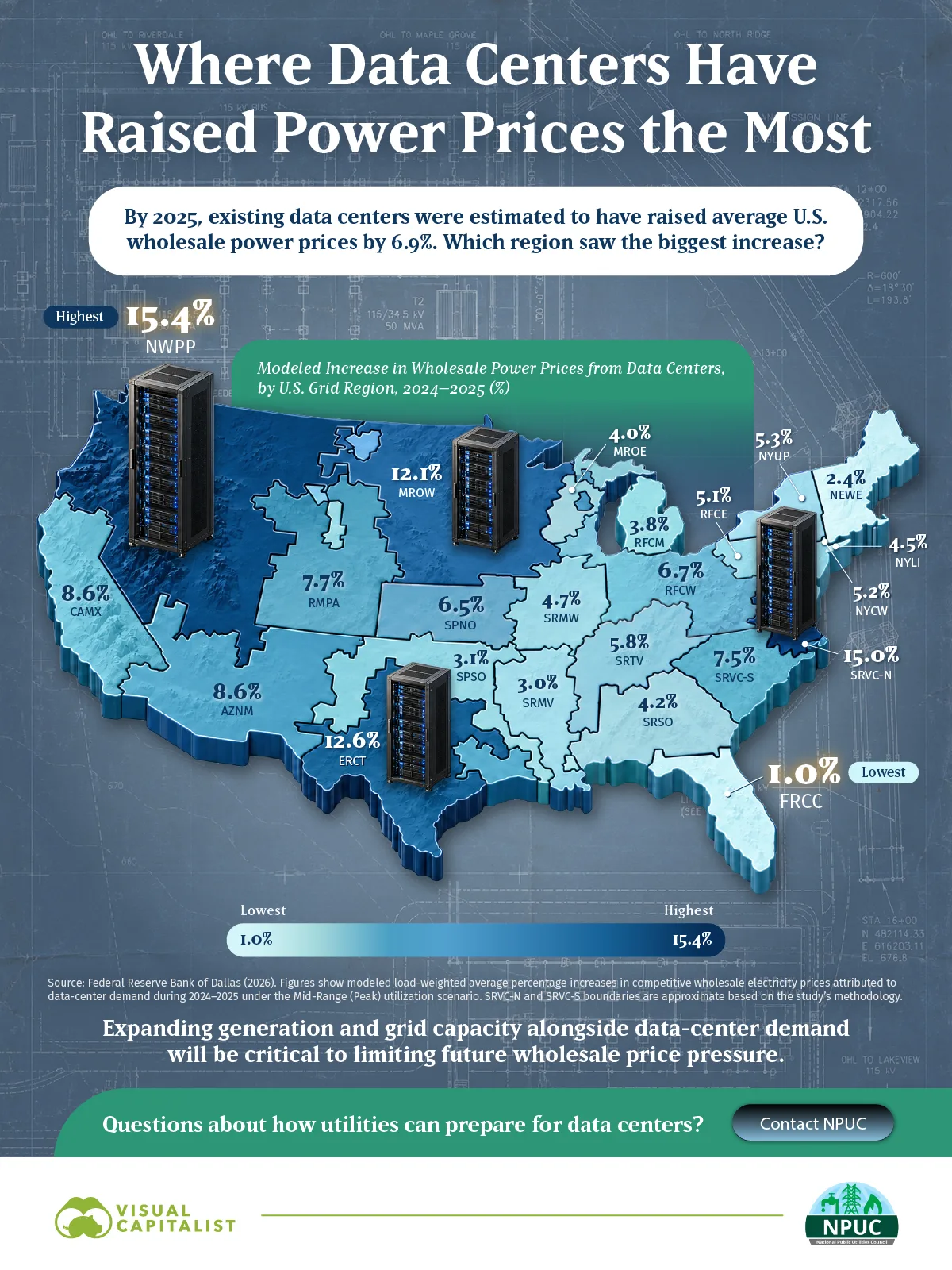
- A study published by the Federal Reserve Bank of Dallas estimates data centers raised U.S. wholesale power prices by 6.9% by 2025.
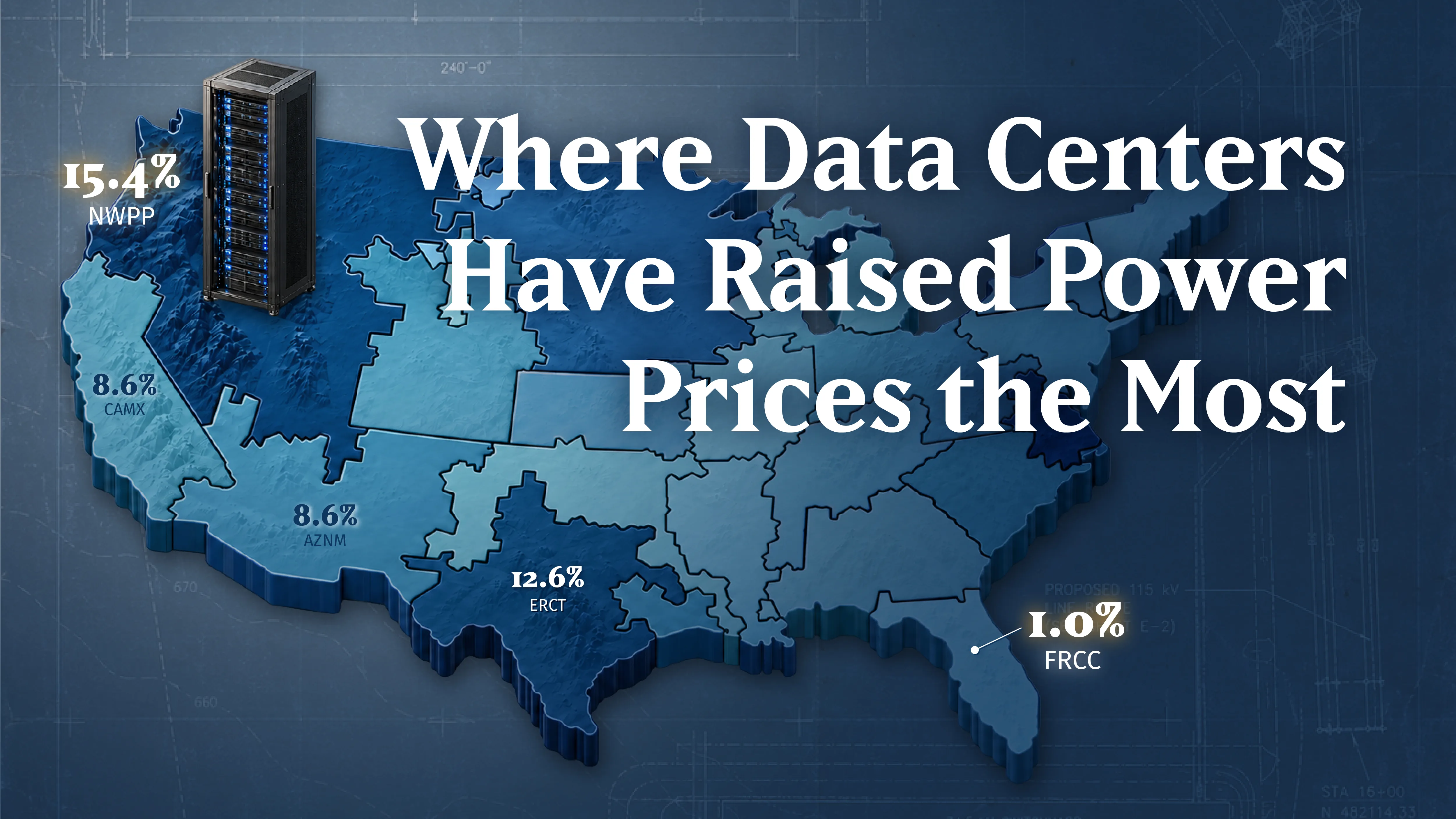
- WECC Northwest leads the 2024–2025 regional estimates at 15.4%, followed by Northern Virginia’s Dominion area at 15.0%.
- These modeled wholesale effects do not represent equivalent increases in household electricity bills.
Data centers are changing electricity demand across the U.S., with consequences that reach beyond the communities hosting them. However, their impact on wholesale power prices varies sharply across the country.
This graphic, in partnership with the National Public Utilities Council, shows data centers’ modeled wholesale-price impacts across 23 regions using data from the Federal Reserve Bank of Dallas.
Where Wholesale Prices Rose the Most
The WECC Northwest region leads with a modeled 15.4% increase during 2024–2025. Meanwhile, Northern Virginia’s Dominion area follows at 15.0%.
Here is a table that shows modeled wholesale-price impacts from data centers across 23 U.S. grid regions.
| Region code | Main states/areas covered | Modeled price increase |
|---|---|---|
| NWPP | Washington, Oregon, Idaho, Utah; parts of Montana, Nevada, Wyoming, and northern California | 15.4% |
| SRVC-N | Parts of Virginia and northeastern North Carolina, approximating Dominion’s service area | 15.0% |
| ERCT | Texas—most of the state | 12.6% |
| MROW | Iowa, Minnesota, Nebraska, North Dakota, South Dakota; parts of Wisconsin and eastern Montana | 12.1% |
| CAMX | California—most of the state | 8.6% |
| AZNM | Arizona, New Mexico; parts of Nevada, California, and far western Texas | 8.6% |
| RMPA | Colorado, eastern Wyoming; parts of western Nebraska and western South Dakota | 7.7% |
| SRVC-S | North Carolina and South Carolina—the remaining SRVC area outside SRVC-N | 7.5% |
| RFCW | Ohio, Indiana, West Virginia; parts of Illinois, Pennsylvania, Kentucky, Virginia, Maryland, and Wisconsin | 6.7% |
| SPNO | Kansas and western Missouri | 6.5% |
| SRTV | Tennessee, Kentucky; parts of Alabama, Mississippi, Georgia, Virginia, and North Carolina | 5.8% |
| NYUP | New York—upstate | 5.3% |
| NYCW | New York—New York City and the Westchester area | 5.2% |
| RFCE | New Jersey, Delaware, Maryland, eastern Pennsylvania, and Washington, D.C.; parts of Virginia | 5.1% |
| SRMW | Missouri and Illinois | 4.7% |
| NYLI | New York—Long Island | 4.5% |
| SRSO | Alabama, Georgia; parts of Mississippi and the Florida Panhandle | 4.2% |
| MROE | Parts of Wisconsin and Michigan’s Upper Peninsula | 4.0% |
| RFCM | Michigan—primarily the Lower Peninsula | 3.8% |
| SPSO | Oklahoma; parts of Texas, New Mexico, Arkansas, and Louisiana | 3.1% |
| SRMV | Louisiana, Arkansas; parts of Mississippi, Missouri, and eastern Texas | 3.0% |
| NEWE | Connecticut, Maine, Massachusetts, New Hampshire, Rhode Island, and Vermont | 2.4% |
| FRCC | Florida—most of the state | 1.0% |
Methodology
ERCOT, covering most of Texas, ranks third at 12.6%, followed by MRO West at 12.1%. By contrast, Florida’s grid region records the smallest increase, at 1.0%.
Nationally, the study estimates that data centers raised wholesale power prices by 6.9% by 2025. The national figure therefore masks wide differences in regional price pressure.
How Price Pressure Crosses Regions
In addition, the effects do not stop at regional boundaries. Electricity trade can transmit price pressure to areas with limited local data-center growth.
WECC California, for example, shows an 8.6% increase. The broader takeaway: a region’s exposure extends beyond the data centers within its own borders.
What This Means for Utilities
These estimates use the Mid-Range (Peak) scenario and weight regional averages by electricity demand. However, they describe wholesale markets, not equivalent increases in household electricity bills.
The model compares electricity prices with data-center demand against prices without it. These estimates do not track price growth between 2024 and 2025.
Consequently, utilities need generation and grid capacity to keep pace as data center markets evolve. Planning must consider both local projects and demand across connected regions.
-
 Energy4 weeks ago
Magic Radar 2026: How Do U.S. Utilities Compare on Decarbonization?
How U.S. utilities compare on emissions intensity, net-zero target timing, and Scope 1, 2, and 3 reporting.
-
 Energy2 months ago
The Rising Cost of Electricity in the United States
Washington, DC had the largest increase in electricity prices from 2020 to 2025, while North Dakota saw the biggest decline.
-
 Technology3 months ago
U.S. Battery Capacity Growth Forecast: 2026–2031
See how U.S. carbon offsets break down by project type in 2026, from forestry to methane, refrigerants, and wind.
-
 Energy4 months ago
Ranked: Countries Building the Most Small Modular Nuclear Reactors
Small Modular Nuclear Reactors are moving from concept to siting, with the U.S. leading at 28 announcements as power demand surges.
-
 Energy1 year ago
Ranked: The Top 10 Cleanest Operating Utilities In The U.S.
Just four U.S. utilities operate with over 80% carbon-free generation. This graphic ranks the top 10 cleanest utilities by their fuel mix.