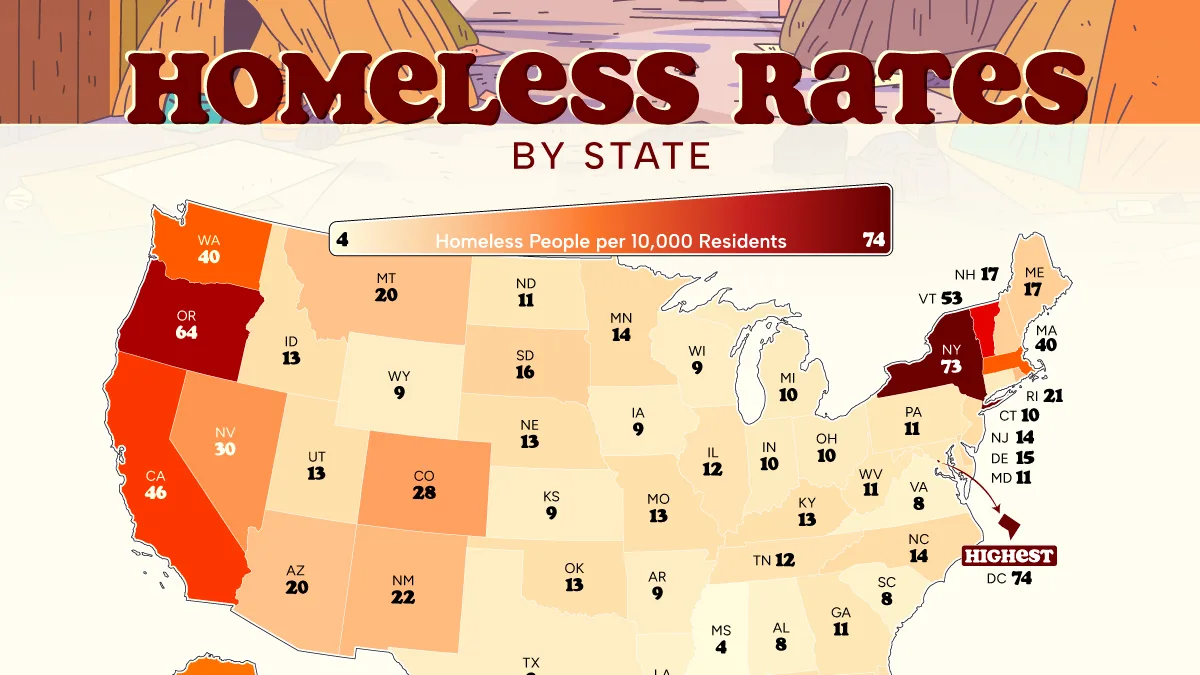
Mapped: Where Homelessness Rates Are Highest in the U.S.
Key Takeaways:
- Nearly 746,000 people experienced homelessness in the U.S. in January 2025, equivalent to roughly 22 people per 10,000 residents.
- Washington, D.C. had the highest rate at 74 per 10,000 residents, followed by New York (73) and Oregon (64).
- The national homeless population fell 3.3% in 2025 after increasing 12.1% in 2023 and 18.1% in 2024.
Homelessness rates vary widely across the United States, shaped in part by differences in housing costs, incomes, shelter availability, and local conditions.
This visualization maps homelessness rates using 2025 point-in-time estimates from the U.S. Department of Housing and Urban Development (HUD) and Census Bureau population estimates.
Where Homelessness Rates Are Highest
The table below shows the number of people experiencing homelessness per 10,000 residents in each state and Washington, D.C.
| Rank | State or District | Homeless per 10,000 Residents |
|---|---|---|
| 1 | District of Columbia | 74 |
| 2 | New York | 73 |
| 3 | Oregon | 64 |
| 4 | Vermont | 53 |
| 5 | Hawaii | 48 |
| 6 | California | 46 |
| 7 | Washington | 40 |
| 8 | Massachusetts | 40 |
| 9 | Alaska | 36 |
| 10 | Nevada | 30 |
| 11 | Colorado | 28 |
| 12 | New Mexico | 22 |
| 13 | Rhode Island | 21 |
| 14 | Arizona | 20 |
| 15 | Montana | 20 |
| 16 | Maine | 17 |
| 17 | New Hampshire | 17 |
| 18 | South Dakota | 16 |
| 19 | Delaware | 15 |
| 20 | Minnesota | 14 |
| 21 | New Jersey | 14 |
| 22 | North Carolina | 14 |
| 23 | Missouri | 13 |
| 24 | Idaho | 13 |
| 25 | Nebraska | 13 |
| 26 | Utah | 13 |
| 27 | Kentucky | 13 |
| 28 | Oklahoma | 13 |
| 29 | Tennessee | 12 |
| 30 | Florida | 12 |
| 31 | Illinois | 12 |
| 32 | Maryland | 11 |
| 33 | Pennsylvania | 11 |
| 34 | West Virginia | 11 |
| 35 | Georgia | 11 |
| 36 | North Dakota | 11 |
| 37 | Ohio | 10 |
| 38 | Connecticut | 10 |
| 39 | Michigan | 10 |
| 40 | Indiana | 10 |
| 41 | Wyoming | 9 |
| 42 | Kansas | 9 |
| 43 | Texas | 9 |
| 44 | Wisconsin | 9 |
| 45 | Arkansas | 9 |
| 46 | Iowa | 9 |
| 47 | Virginia | 8 |
| 48 | Louisiana | 8 |
| 49 | Alabama | 8 |
| 50 | South Carolina | 8 |
| 51 | Mississippi | 4 |
The gap between the highest and lowest rates is substantial. Washington, D.C. records 74 people experiencing homelessness per 10,000 residents, compared with just four in Mississippi. Among states, New York ranks highest at 73, followed by Oregon at 64.
High poverty rates do not necessarily correspond with high homelessness rates. Mississippi, Louisiana, and Alabama are among the poorer U.S. states, yet each records eight or fewer people experiencing homelessness per 10,000 residents. Housing affordability is an important part of the equation, especially as the cost of securing a home varies significantly across the country.
What Counts as Homelessness?
HUD’s point-in-time count measures people experiencing both sheltered and unsheltered homelessness on a single night in January. Sheltered homelessness includes people in emergency or transitional shelters, while unsheltered homelessness includes people sleeping in cars, encampments, abandoned buildings, or other places not intended for habitation.
However, the count does not capture everyone experiencing housing instability. People temporarily staying with friends or relatives, for example, can be missed, as can people in locations unknown to survey teams.
Homelessness Fell in 2025, But Remains Elevated
The 745,652 people counted in January 2025 represented a 3.3% decline from 2024. However, this followed sharp increases of 12.1% in 2023 and 18.1% in 2024, leaving homelessness well above levels seen during much of the previous decade.
Housing affordability remains a central factor. The National Alliance to End Homelessness highlights shortages of affordable housing, low incomes, limited rental assistance, and weakened safety nets as major drivers. These pressures can be particularly acute for households already living near the poverty line.
Veteran homelessness provides one example of long-term progress. The number of veterans experiencing homelessness fell from 73,367 in 2009 to 32,495 in 2025, a decline of roughly 56%. Researchers and service organizations also point to affordable housing, rental assistance, and healthcare as important tools for reducing homelessness.
Learn More on the Voronoi App
To explore the geographic divide further, see Which States Have the Highest Homelessness Rates? on the Voronoi app.