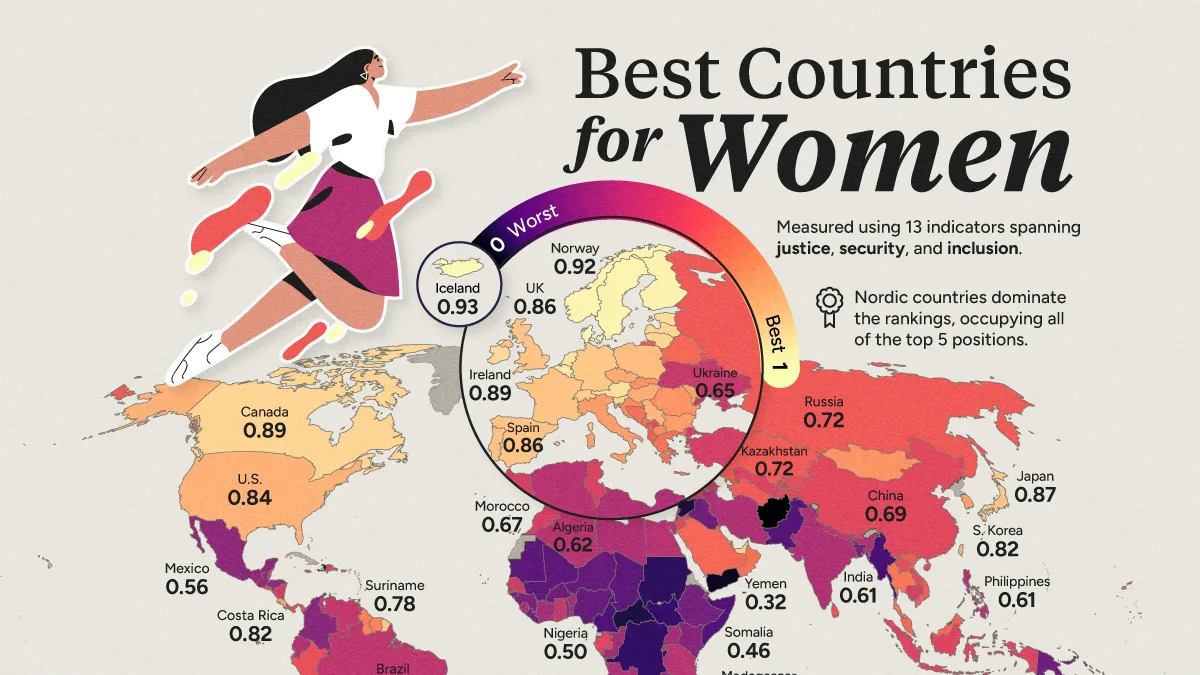
Mapped: Which Countries Are Best for Women?
Key Takeaways:
- Denmark ranks as the world’s best country for women, while Nordic nations occupy all five of the top positions.
- Afghanistan remains the lowest-ranked country, with Denmark’s score more than three times higher.
- Costa Rica and Uruguay enter the top global quintile for the first time, marking notable progress in Latin America.
Where is the best place in the world to be a woman? According to the latest Women, Peace and Security (WPS) Index, the answer remains Northern Europe, where Nordic countries occupy all five of the top positions.
Published by the Georgetown Institute for Women, Peace and Security, the 2025/26 WPS Index ranks 181 countries using 13 indicators spanning women’s inclusion, justice, and security. The results form the basis for this 2026 ranking.
The World’s Best and Worst Countries for Women
The following table ranks countries based on the Women, Peace and Security Index.
| Rank | Country | WPS Index Score |
|---|---|---|
| 1 |  Denmark Denmark |
0.939 |
| 2 |  Iceland Iceland |
0.932 |
| 3 |  Norway Norway |
0.924 |
| 3 |  Sweden Sweden |
0.924 |
| 5 |  Finland Finland |
0.921 |
| 6 |  Luxembourg Luxembourg |
0.918 |
| 7 |  Belgium Belgium |
0.912 |
| 8 |  Netherlands Netherlands |
0.905 |
| 9 |  Austria Austria |
0.898 |
| 9 |  New Zealand New Zealand |
0.898 |
| 11 |  Australia Australia |
0.896 |
| 11 |  Estonia Estonia |
0.896 |
| 13 |  Ireland Ireland |
0.891 |
| 14 |  Slovenia Slovenia |
0.889 |
| 15 |  Lithuania Lithuania |
0.887 |
| 16 |  Canada Canada |
0.885 |
| 17 |  Latvia Latvia |
0.884 |
| 17 |  Singapore Singapore |
0.884 |
| 19 |  Switzerland Switzerland |
0.877 |
| 20 |  United Arab Emirates United Arab Emirates |
0.872 |
| 21 |  Germany Germany |
0.869 |
| 22 |  Japan Japan |
0.866 |
| 23 |  France France |
0.864 |
| 23 |  United Kingdom United Kingdom |
0.864 |
| 25 |  Spain Spain |
0.862 |
| 26 |  Portugal Portugal |
0.861 |
| 27 |  Poland Poland |
0.854 |
| 27 |  Taiwan Taiwan |
0.854 |
| 29 |  Serbia Serbia |
0.844 |
| 30 |  Malta Malta |
0.841 |
| 31 |  United States United States |
0.840 |
| 32 |  Czechia Czechia |
0.832 |
| 32 |  Hungary Hungary |
0.832 |
| 34 |  Costa Rica Costa Rica |
0.824 |
| 35 |  Uruguay Uruguay |
0.822 |
| 36 |  Moldova Moldova |
0.821 |
| 37 |  South Korea South Korea |
0.815 |
| 38 |  Bulgaria Bulgaria |
0.814 |
| 39 |  Italy Italy |
0.811 |
| 40 |  Seychelles Seychelles |
0.810 |
| 41 |  Hong Kong Hong Kong |
0.809 |
| 42 |  Barbados Barbados |
0.807 |
| 43 |  Romania Romania |
0.801 |
| 44 |  Mongolia Mongolia |
0.799 |
| 45 |  Georgia Georgia |
0.798 |
| 46 |  Slovakia Slovakia |
0.797 |
| 47 |  Argentina Argentina |
0.791 |
| 48 |  Croatia Croatia |
0.788 |
| 49 |  Grenada Grenada |
0.787 |
| 49 |  North Macedonia North Macedonia |
0.787 |
| 51 |  Suriname Suriname |
0.779 |
| 52 |  Cyprus Cyprus |
0.770 |
| 52 |  Guyana Guyana |
0.770 |
| 54 |  Paraguay Paraguay |
0.768 |
| 55 |  Bahrain Bahrain |
0.765 |
| 56 |  Armenia Armenia |
0.762 |
| 57 |  Thailand Thailand |
0.761 |
| 58 |  Oman Oman |
0.755 |
| 59 |  Bosnia and Herzegovina Bosnia and Herzegovina |
0.753 |
| 60 |  Greece Greece |
0.752 |
| 61 |  Montenegro Montenegro |
0.743 |
| 62 |  Cabo Verde Cabo Verde |
0.741 |
| 63 |  Belarus Belarus |
0.739 |
| 63 |  Chile Chile |
0.739 |
| 63 |  Palau Palau |
0.739 |
| 63 |  Saudi Arabia Saudi Arabia |
0.739 |
| 67 |  Malaysia Malaysia |
0.738 |
| 68 |  Albania Albania |
0.731 |
| 68 |  Fiji Fiji |
0.731 |
| 70 |  Kuwait Kuwait |
0.723 |
| 70 |  Qatar Qatar |
0.723 |
| 72 |  Kazakhstan Kazakhstan |
0.722 |
| 73 |  Viet Nam Viet Nam |
0.721 |
| 74 |  Turkmenistan Turkmenistan |
0.720 |
| 75 |  Russian Federation Russian Federation |
0.718 |
| 76 |  Puerto Rico Puerto Rico |
0.707 |
| 77 |  Sri Lanka Sri Lanka |
0.706 |
| 78 |  Maldives Maldives |
0.704 |
| 79 |  Jamaica Jamaica |
0.703 |
| 80 |  Bolivia Bolivia |
0.701 |
| 80 |  Peru Peru |
0.701 |
| 82 |  Kosovo Kosovo |
0.700 |
| 83 |  Lao PDR Lao PDR |
0.698 |
| 84 |  Israel Israel |
0.697 |
| 84 |  Kyrgyzstan Kyrgyzstan |
0.697 |
| 86 |  Panama Panama |
0.696 |
| 87 |  El Salvador El Salvador |
0.691 |
| 88 |  Jordan Jordan |
0.686 |
| 89 |  China China |
0.685 |
| 89 |  Samoa Samoa |
0.685 |
| 89 |  Tajikistan Tajikistan |
0.685 |
| 89 |  Tonga Tonga |
0.685 |
| 89 |  Trinidad and Tobago Trinidad and Tobago |
0.685 |
| 94 |  Gabon Gabon |
0.679 |
| 94 |  Mauritius Mauritius |
0.679 |
| 96 |  Indonesia Indonesia |
0.678 |
| 97 |  Dominican Republic Dominican Republic |
0.675 |
| 98 |  Uzbekistan Uzbekistan |
0.674 |
| 99 |  Bhutan Bhutan |
0.673 |
| 100 |  Tunisia Tunisia |
0.671 |
| 101 |  Marshall Islands Marshall Islands |
0.670 |
| 102 |  Morocco Morocco |
0.668 |
| 102 |  Timor-Leste Timor-Leste |
0.668 |
| 104 |  Belize Belize |
0.667 |
| 104 |  Cambodia Cambodia |
0.667 |
| 106 |  Türkiye Türkiye |
0.664 |
| 107 |  Nicaragua Nicaragua |
0.659 |
| 108 |  Botswana Botswana |
0.658 |
| 108 |  Solomon Islands Solomon Islands |
0.658 |
| 110 |  Senegal Senegal |
0.657 |
| 111 |  Azerbaijan Azerbaijan |
0.653 |
| 112 |  Kiribati Kiribati |
0.652 |
| 113 |  Federated States of Micronesia Federated States of Micronesia |
0.648 |
| 113 |  South Africa South Africa |
0.648 |
| 115 |  Vanuatu Vanuatu |
0.646 |
| 116 |  Ukraine Ukraine |
0.645 |
| 117 |  Ghana Ghana |
0.639 |
| 118 |  Venezuela Venezuela |
0.638 |
| 119 |  Brazil Brazil |
0.632 |
| 120 |  Nepal Nepal |
0.631 |
| 121 |  Rwanda Rwanda |
0.624 |
| 121 |  Tanzania Tanzania |
0.624 |
| 123 |  Algeria Algeria |
0.621 |
| 124 |  São Tomé and Príncipe São Tomé and Príncipe |
0.620 |
| 125 |  Egypt Egypt |
0.617 |
| 126 |  Lesotho Lesotho |
0.614 |
| 127 |  Ecuador Ecuador |
0.612 |
| 128 |  Iran Iran |
0.608 |
| 128 |  Libya Libya |
0.608 |
| 128 |  Namibia Namibia |
0.608 |
| 131 |  India India |
0.607 |
| 131 |  Philippines Philippines |
0.607 |
| 133 |  Angola Angola |
0.601 |
| 133 |  Sierra Leone Sierra Leone |
0.601 |
| 135 |  Comoros Comoros |
0.590 |
| 135 |  Zimbabwe Zimbabwe |
0.590 |
| 137 |  Côte d’Ivoire Côte d’Ivoire |
0.589 |
| 138 |  Benin Benin |
0.587 |
| 138 |  Uganda Uganda |
0.587 |
| 140 |  Congo Congo |
0.583 |
| 141 |  Lebanon Lebanon |
0.575 |
| 142 |  Zambia Zambia |
0.566 |
| 143 |  Togo Togo |
0.562 |
| 144 |  Guatemala Guatemala |
0.561 |
| 144 |  Honduras Honduras |
0.561 |
| 146 |  Djibouti Djibouti |
0.560 |
| 147 |  Mexico Mexico |
0.558 |
| 148 |  Eswatini Eswatini |
0.556 |
| 149 |  Colombia Colombia |
0.551 |
| 150 |  Malawi Malawi |
0.549 |
| 151 |  Mozambique Mozambique |
0.548 |
| 152 |  Kenya Kenya |
0.542 |
| 153 |  Gambia Gambia |
0.528 |
| 154 |  Guinea Guinea |
0.527 |
| 155 |  Bangladesh Bangladesh |
0.526 |
| 156 |  Ethiopia Ethiopia |
0.516 |
| 157 |  Liberia Liberia |
0.512 |
| 158 |  Iraq Iraq |
0.510 |
| 159 |  Guinea-Bissau Guinea-Bissau |
0.508 |
| 160 |  Burkina Faso Burkina Faso |
0.507 |
| 160 |  Papua New Guinea Papua New Guinea |
0.507 |
| 162 |  Nigeria Nigeria |
0.495 |
| 163 |  Niger Niger |
0.492 |
| 164 |  Mali Mali |
0.478 |
| 165 |  Chad Chad |
0.476 |
| 166 |  Mauritania Mauritania |
0.475 |
| 167 |  Palestine Palestine |
0.469 |
| 168 |  Madagascar Madagascar |
0.466 |
| 169 |  Pakistan Pakistan |
0.462 |
| 170 |  Somalia Somalia |
0.455 |
| 171 |  Cameroon Cameroon |
0.451 |
| 172 |  Myanmar Myanmar |
0.442 |
| 173 |  South Sudan South Sudan |
0.411 |
| 174 |  Burundi Burundi |
0.407 |
| 175 |  Democratic Republic of the Congo Democratic Republic of the Congo |
0.405 |
| 176 |  Haiti Haiti |
0.399 |
| 177 |  Sudan Sudan |
0.397 |
| 178 |  Syrian Arab Republic Syrian Arab Republic |
0.364 |
| 179 |  Central African Republic Central African Republic |
0.362 |
| 180 |  Yemen Yemen |
0.323 |
| 181 |  Afghanistan Afghanistan |
0.279 |
The rankings reveal a sharp geographic divide. Northern Europe continues to set the global benchmark for women’s wellbeing, while countries affected by conflict and political instability cluster at the bottom.
Denmark ranks first with a score of 0.939, followed by Iceland, Norway, Sweden, and Finland. Luxembourg, Belgium, the Netherlands, Austria, and New Zealand round out the global top 10. Afghanistan ranks last, with a score less than one-third of Denmark’s.
Why Nordic Countries Continue to Lead
Nordic countries occupy all five of the top positions thanks to consistently strong performance across the index’s three dimensions: inclusion, justice, and security.
Women in these countries generally benefit from high levels of education, workforce participation, legal protection, financial inclusion, and political representation, alongside relatively low rates of violence. Strong public institutions and broad social safety nets also help support gender equality throughout life.
While no country scores a perfect 1.0, the Nordic region remains the global benchmark for women’s wellbeing.
Outside Northern Europe, Australia and New Zealand continue to perform strongly. Costa Rica and Uruguay also enter the top global quintile for the first time, reflecting sustained gains in women’s rights and wellbeing and making them notable standouts in Latin America.
Conflict Remains the Biggest Divider
At the opposite end of the rankings are Afghanistan, Yemen, the Central African Republic, Syria, Sudan, Haiti, the Democratic Republic of the Congo, Burundi, South Sudan, and Myanmar. Many of these countries have experienced years of armed conflict, political instability, or humanitarian crises that disproportionately affect women.
More than 70% of women living in the 12 lowest-ranked countries reside within 50 kilometers of armed conflict, exposing them to higher risks of displacement and gender-based violence. Countries with greater exposure to conflict also tend to score worse on access to justice and maternal health.
This aligns with broader research showing that violence against women rises during periods of instability, while fragile institutions often struggle to provide legal protections and support services. According to the World Health Organization, violence against women remains one of the world’s most widespread human rights violations.
Women’s Wellbeing Reflects Broader Society
The WPS Index measures more than gender equality alone. By combining indicators across security, economic inclusion, healthcare, legal rights, and political participation, it provides a broader snapshot of how supportive countries are for women to live, work, and thrive.
Countries that rank highly typically combine economic opportunity, strong legal protections, accessible healthcare, and low levels of violence. Nations facing prolonged instability, by contrast, often struggle across several dimensions at once.
The rankings therefore offer a broader view of social resilience and institutional strength, not just women’s outcomes in isolation.
Learn More on the Voronoi App 
To explore more global demographic and workforce trends, check out This Map Shows Where Women Work on the Voronoi app.