

We are delighted to introduce the next contribution to our New Principal Investigators collection.
Read the paper
Jiaoyan Zhao, Bradley A. Tavana, Seongje Park, Max Jacobsen, Nicholas Woodlief, Erin Locke, Rebecca M. Gracia, Cedric Schaack, Minjung Son
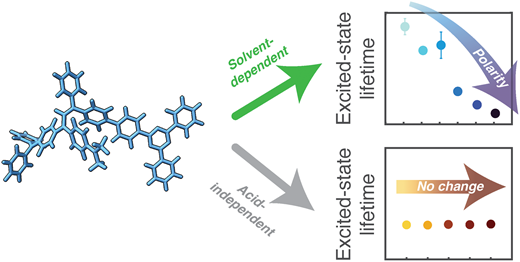
Designing molecules whose optical properties can be controlled by their surroundings is an important goal in developing next-generation light-responsive materials. In this work, we investigated a class of molecules called tetraarylallenes, which undergo a dramatic change in their light absorption upon activation with acids. Using ultrafast laser spectroscopy, we found that the surrounding solvent strongly influences both their absorption properties and how quickly they relax after absorbing light. Surprisingly, these properties remain largely unchanged regardless of the acid used for activation. Our findings reveal how the molecular environment controls the behavior of these light-responsive molecules, offering new insights for designing optical materials with tunable properties.
Meet the Principal Investigator
 Dr. Minjung Son is the David R. Dalton Career Development Assistant Professor of Chemistry at Boston University. She received her B.S. and M.S. in Chemistry from Yonsei University and earned her Ph.D. at MIT as a Robert T. Haslam Presidential Fellow, developing ultrabroadband two-dimensional electronic spectroscopy to uncover light-harvesting mechanisms in plants. As a postdoctoral researcher at the University of Wisconsin–Madison, she explored energy-flow pathways in exciton-polaritonic systems. Since founding her group in 2023, she has combined ultrafast spectroscopy, microscopy, materials science, photonics, and biophysics to investigate spatiotemporal photophysics in complex molecular and polaritonic systems.
You recently started your own group, what are the big research question/s your group will be focusing on?
My research group is broadly interested in understanding how molecules interact with light and how we can use these interactions to control the behavior of molecules and materials. One of our central research questions is whether we can manipulate how energy moves through molecular systems by coupling them strongly to confined light, creating hybrid states known as polaritons. We use ultrafast laser spectroscopy to observe how these processes unfold on incredibly short timescales, down to quadrillionths of a second. Ultimately, we hope to uncover fundamental principles that will enable the design of new materials with tailored optical and electronic properties.
What inspired you to get into science?
What initially drew me to science was the idea that we could use light to capture snapshots of molecular events that happen far too quickly for the human eye to see. I was fascinated by the fact that fundamental concepts I had learned about in the classroom, such as molecular vibrations and energy transfer, could actually be observed experimentally in real time using ultrafast laser spectroscopy. What makes this even more exciting is that these seemingly abstract molecular processes underpin many phenomena and technologies we encounter in everyday life. Being able to directly observe how molecules behave, and connect these fundamental insights to real-world applications, is what continues to inspire me as a scientist.
What advice would you give to those who are seeking their first group leader position?
My advice would be to be patient and stay focused on what genuinely excites you about science. The path to becoming an independent researcher is rarely linear, and there will inevitably be setbacks, uncertainties, and periods when progress seems slow. It’s important not to let these challenges overshadow your passion for research. I would also encourage aspiring group leaders to remember that running a research group involves much more than doing science yourself. It means mentoring students, building a team, and creating an environment where others can thrive. Thinking about the kind of scientist and mentor you want to become is just as important as developing your research vision. Above all, try to enjoy the journey and focus on the opportunities and discoveries that keep you motivated.


