
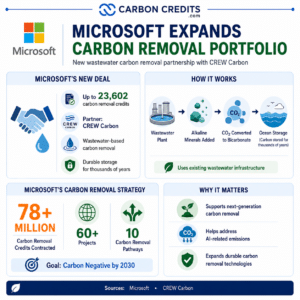
Microsoft is adding another technology to its growing carbon removal portfolio. The company has agreed to purchase up to 23,602 carbon dioxide removal (CDR) credits from U.S.-based startup CREW Carbon. The credits will come from projects that remove carbon while treating wastewater, opening a new pathway for durable carbon removal.
The agreement is small compared with some of Microsoft’s million-ton carbon removal purchases, but it highlights something bigger. The tech giant is continuing to diversify the technologies it supports.
Instead of relying only on direct air capture, biochar, or bioenergy with carbon capture and storage (BECCS), it is backing newer solutions that could scale faster and lower costs. The deal also shows that wastewater treatment may become an unexpected source of permanent carbon removal.
Phillip Goodman, Carbon Removal Portfolio Director at Microsoft, stated:
“Microsoft’s offtake agreement with CREW supports the advancement of a novel, wastewater-based approach that is highly durable and measurable. CREW has shown that carbon removal in the wastewater sector is implementable and scalable with high Monitoring, Reporting and Verification (MRV) certainty.”
Turning Wastewater Into a Carbon Sink: How It Can Lock Away Carbon for Millennia
Wastewater plants are built to treat wastewater, not to remove carbon. CREW Carbon wants to change that.
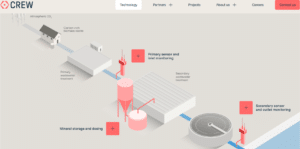
The company has developed a process that adds alkaline minerals to wastewater. These minerals react with dissolved carbon dioxide and convert it into stable bicarbonate ions that eventually flow into the ocean. There, the carbon can remain stored for thousands of years as part of the natural carbon cycle.
Unlike many engineered carbon removal systems, the process uses existing wastewater infrastructure. Utilities do not need to build entirely new plants. Instead, they can add CREW’s technology to facilities already treating municipal wastewater.
The company says the process offers another benefit. It can improve wastewater treatment performance while helping utilities lower operating costs. This year, CREW Carbon raised $25 million in Series A funding. The money will help expand its projects to more wastewater treatment plants in North America.
This makes wastewater one of several emerging carbon removal pathways now moving from pilot projects toward commercial deployment.
The agreement builds on CREW’s existing long-term carbon removal deals with major corporate buyers, including JPMorgan, Google, Autodesk, and Stripe through Frontier. Together, these commitments bring CREW’s total contracted carbon removal portfolio to more than $40 million.
Microsoft Keeps Building the World’s Largest Carbon Removal Portfolio
The latest agreement fits Microsoft’s long-term climate strategy. The company has pledged to become carbon-negative by 2030 and remove all the carbon it has emitted since its founding in 1975 by 2050. Those goals require far more than cutting emissions.
The tech giant also needs permanent carbon removal.
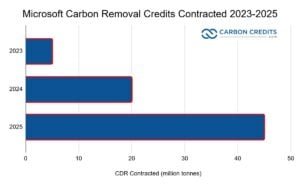
Microsoft’s latest carbon removal update shows it has signed contracts for over 78 million metric tons of carbon removal. This includes more than 60 projects and 10 different carbon removal pathways.
In fiscal 2025, it signed contracts for projects to remove over 45 million metric tons of carbon dioxide. These projects cover 29 initiatives across five continents and various carbon removal methods. These methods include direct air capture, biochar, reforestation, enhanced rock weathering, and BECCs.
The company states that these commitments are just a small part of the 7–9 billion metric tons of CO₂ the world needs to remove each year, which is essential to keep global warming near 1.5°C.
The tech giant has become the world’s largest corporate buyer of durable carbon removal. In 2026 alone, it signed agreements covering:
- 1 million biochar credits,
- 626,000 BECCS credits,
- nearly 37,000 enhanced rock weathering credits, and
- several direct air capture and mineralization projects.
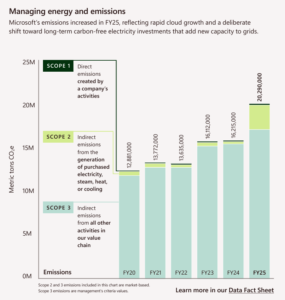
Carbon Removal Helps Microsoft Address Rising AI Emissions
Corporate Demand Is Fueling the Carbon Removal Boom
Microsoft’s latest deal reflects a much bigger trend. Companies are buying more durable carbon removal as they work toward net-zero goals.
According to CDR.fyi, buyers contracted more than 8 million metric tons of durable carbon removal in 2025, setting another annual record. Technology companies remain the biggest buyers because they face growing emissions from AI, cloud computing, and expanding digital infrastructure.
The market still has a long way to go. The Intergovernmental Panel on Climate Change (IPCC) states that the world must remove billions of tons of CO₂ each year this century. This is needed to balance emissions that are hard to cut. The International Energy Agency (IEA) also says carbon removal will play an important role in reaching global net-zero emissions by 2050.
Investment is rising as well. McKinsey & Company estimates the carbon removal market could grow into a $1.2 trillion industry by 2050 if countries stay on track to meet climate goals.
Could Wastewater Become Carbon Removal’s Next Big Market?
Most carbon removal projects today focus on forests, biochar, direct air capture, or enhanced rock weathering. Wastewater offers another opportunity.
According to the International Energy Agency, the global wastewater sector produces about 2% of energy-related methane emissions. Methane is a strong greenhouse gas. It warms the Earth about 80 times more than carbon dioxide over 20 years, says the United Nations Environment Programme (UNEP).
Using wastewater plants to remove carbon while improving water treatment could create two climate benefits at the same time. Because thousands of wastewater treatment plants already operate worldwide, the technology may also scale faster than solutions that require entirely new facilities.
A New Frontier for Net Zero Climate Finance
Microsoft’s latest purchase is modest compared with its larger carbon removal agreements. But it highlights an important shift in the market.
The company is no longer investing only in proven technologies. It is also helping early-stage carbon removal companies move from pilot projects to commercial deployment. That strategy could speed up innovation while expanding future supplies of durable carbon removal.
For Microsoft, wastewater carbon removal adds another tool to help reach its goal of becoming carbon negative by 2030 and removing its historical emissions by 2050.
For the broader carbon market, the agreement shows that the next generation of carbon removal may come from unexpected places. Alongside forests, biochar, and direct air capture, wastewater could become another important part of the world’s effort to remove carbon permanently and achieve net zero.
The post Microsoft Bets on Wastewater to Power the Next Wave of Carbon Removal appeared first on Carbon Credits.


