
A new maritime decarbonization pilot is showing how companies could reduce supply chain emissions without waiting for low-carbon fuels to become available on every shipping route.
Danish shipping company NORDEN has delivered the first verified maritime emissions reductions through the Roundtable on Sustainable Biomaterials (RSB) Book & Claim registry. The pilot, completed with Microsoft and RSB, marks the first time a maritime carrier has issued and delivered verified emissions reductions through the RSB system.
The development could give companies a more practical way to tackle shipping-related Scope 3 emissions, particularly when sustainable fuels remain limited in availability.
Anne Jensen, COO at NORDEN, commented:
“For many companies, some of the most difficult emissions to address are those embedded deep within global supply chains, where they often have little visibility or direct influence over how goods are transported.
This transaction demonstrates how Book & Claim can help bridge that gap. By enabling companies to invest in verified emissions reductions from maritime transport, regardless of where the fuel is used or where they sit in the value chain, we can help accelerate decarbonisation across industries.”
Shipping Remains a Major Emissions Challenge
The maritime sector carries most of the world’s international trade, but it also produces a significant carbon footprint.
The latest figures cited by the United Nations Conference on Trade and Development (UNCTAD) show that shipping greenhouse gas emissions increased by 5% in 2024. Longer voyages, including those caused by geopolitical disruptions and rerouting, contributed to the increase. At the same time, only about 8% of the world’s fleet by tonnage was equipped to use alternative fuels.
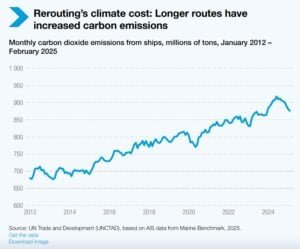
- The International Maritime Organization (IMO) estimates that global shipping produced 1.056 billion tonnes of CO2 in 2018, about 2.89% of global anthropogenic CO2 emissions at the time.
The sector therefore faces a difficult transition. Ships have long operating lives, alternative fuels are still developing, and supply is not evenly distributed across global ports.
That creates a problem for companies trying to reduce emissions linked to their transported goods.
A business may want to use a lower-emission fuel for its cargo, but the required fuel may not be available at the port where its particular vessel operates.
NORDEN’s Book & Claim model is designed to address that gap.
How NORDEN’s Maritime Book & Claim Model Works
Under a Book & Claim system, the physical movement of a low-emission fuel does not have to match the customer’s specific cargo movement.
Instead, NORDEN can use lower-emission fuel where it makes the most operational sense within its fleet. The resulting emissions reductions are then documented and allocated to a customer.
This separates the physical use of the fuel from the customer’s shipping activity.
For companies, that means they do not necessarily have to change their logistics routes or wait for sustainable fuel to become available at every port.
Scaling Biofuel Through Book & Claim
NORDEN says its biofuel solutions can be used either as blends or as B100, with emissions reductions of up to 80%–90%, depending on the fuel and application. The company also says customers can select the level of emissions reduction based on their ambitions and budget.
The important distinction is that the model is built around documented and verified emissions reductions rather than simply purchasing a conventional carbon offset.
NORDEN first had to obtain RSB Book & Claim trader certification before it could issue and sell verified reductions through the registry. RSB developed the certification by adapting its existing Book & Claim framework, previously used in aviation, for maritime transport and carriers.
Why Microsoft Is Testing the Model
Microsoft is the first company globally to use the RSB registry’s Book & Claim system for shipping emissions. The move fits into a much larger challenge for the technology giant: reducing emissions across its value chain.
Microsoft’s latest sustainability report highlights the growing emissions challenge from its expanding AI and data center infrastructure.
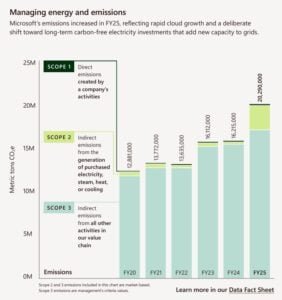
In FY2025, Microsoft reported 20.29 million metric tons of CO₂e across Scopes 1, 2 and 3. That was 25% higher than the 16.21 million metric tons reported a year earlier. Microsoft linked the increase mainly to data center growth and changes in its use of renewable energy certificates.
- Scope 3 remained the largest source, accounting for 85.82% of total emissions, down from 97.29% in FY2024. Scope 2 made up 13.34%, while Scope 1 accounted for 0.84%.
- Precisely, Scope 3 emissions were 17.41 million metric tons. Capital goods made up the largest share at 44.57%, followed by purchased goods and services at 25.28%. Together, they accounted for nearly 70% of Scope 3 emissions. Transportation also contributed to the footprint. Upstream transportation and distribution accounted for 3.66% of Scope 3 emissions, while downstream transportation and distribution made up 0.42%.
Turns to Shipping to Cut Scope 3 Emissions
These figures show why cleaner shipping can play a role in Microsoft’s climate strategy. Maritime transport is only a small part of its overall Scope 3 footprint, but it gives the company a direct way to reduce emissions linked to its global supply chain.
More importantly, its Scope 3 emissions remained a growing problem as they were 26% higher in FY2024 than its 2020 baseline. This makes maritime freight an important area for intervention.
Microsoft has already been working with suppliers and other partners to address emissions embedded in its wider supply chain. In 2024, the company contracted 19 GW of new renewable energy across 16 countries and continued investing in technologies and partnerships designed to tackle hard-to-abate Scope 3 emissions.
The NORDEN pilot adds another tool to that strategy.
Bella Horstmann, Senior Manager, Market Development, Microsoft, said:
“Decarbonising supply chains requires solutions that are both credible and scalable. This collaboration with NORDEN and RSB shows how Book & Claim can help accelerate progress in sectors where change is otherwise complex and demonstrates that companies don’t need to wait to start reducing their shipping emissions in a verified and meaningful way.”
The Pilot Could Help Scale Maritime Decarbonization
NORDEN and Microsoft had already announced their collaboration in 2025. At the time, the companies said the pilot could reduce Microsoft’s maritime Scope 3 emissions by nearly 10,000 tonnes of CO2e over three years.
The latest transaction takes that collaboration a step further by putting the reductions through the RSB registry.
That verification component could prove critical as more companies look for credible ways to account for supply chain emissions.
Book & Claim does not eliminate the need to increase the physical supply of sustainable marine fuels. Instead, it can create demand while the industry works through fuel availability, infrastructure, and cost challenges.
RSB now plans to update its Book and Claim Chain of Custody procedure to support broader adoption across maritime transport. NORDEN also plans to work with customers and partners to expand the model.
The timing is significant. Shipping emissions are rising again, while the availability of alternative-fuel-capable vessels remains limited.
For companies such as Microsoft, the challenge is therefore not simply finding cleaner ships. It is finding a system that can connect real emissions reductions with complex global supply chains.
NORDEN’s pilot suggests Book & Claim could become one part of that solution.
However, strong verification and transparent accounting remain essential. If the model scales, companies can use it to cut maritime Scope 3 emissions today. Meanwhile, the shipping industry can continue building the cleaner fuel infrastructure needed for the long term.
The post Microsoft Uses NORDEN’s Book & Claim Pilot to Tackle Scope 3 Emissions appeared first on Carbon Credits.


