
The benefits of composting, as a soil amendment, may be well understood, but in today’s world of being greener and reducing waste, composting has also become an essential way to reduce trips to the landfill, ensure less nutrient runoff and support agriculture. Some operations compost produce and other organics that can’t be sold. Other businesses are focused on providing the tools farmers need to manage their on-farm waste while creating compost they (and others) can use in the process.
Regardless of whether compost is used hyper-locally or distributed throughout the community, the benefits are significant.
Going green before it was cool
In 1996, Nate Andre and his brother Paul could have been said to have turned over a new leaf as they started composting leaves and grass. Local regulations of the day had banned leaves and grass clippings from the landfill.
“In ‘96 we were taking leaf waste from towns and just composting leaf waste. And if we got manure that was good,” says Andre. “And that’s what a lot of compost is made from, just leaf waste and wood chips, which has a lot of carbon.”
Their idea to take that change in green waste disposal rules as a sign to bring more organic matter to their land has grown into a constant-motion (constant composting) solution that adds nutrients to their more than 1,600 acres of corn, soybeans and rye, while providing a valuable soil amendment to a few locals and keeping organic matter out of the landfill. With their farm on the beach ridges of Lake Erie, the sand content in the soil is high. It led them to a no-till approach in the 70s, cover-cropping and then the addition of composting to enrich the soil.
“Most of our nutrients for the farm come from the compost. We are working with four major food manufacturers, taking their waste products,” says Andre of the composting done at Andre Farms in Wauseon, OH. “And waste products from grain elevators, manure from horse farms and we’re also doing small livestock facilities. We’ve created a place where they can take it.”
With a new compost start every second week, the Andres have 26 batches of a year at a size that would be staggering to the typical home and garden composter. The composting process starts at the concrete slab for blending then takes about six months for completion.
“Everything comes in at the south end of the compost site,” he says. “We’re rotating with a large excavator. Everything moves north about 30 feet every time we rotate. We rotate every two weeks.”
The Andres have a food de-packager that can manage cans, bread in bags, mouldy cheese and more for inclusion in the latest batch.
“If we get a little too many baked beans today, we’re probably okay,” he says.
Making the best of the basics
As an EPA-regulated site, the Andres have their composting dialled in, but there are no fancy digesters here. This is the kind of composting any farm could do, if they wanted to. Each composting batch runs at about 200 feet long with windrows about 15 feet high.
“That slows our process down quite a bit, because we’re so tall,” says Andre. “We’re running about 160 to 170 degrees [Fahrenheit] temperatures most of the time.”
With the amount of science required to understand how the inputs work together at any given time, he says there is a need to “fly by the seat of our pants” to keep nitrogen and moisture ratios in check.
“Over the years, we’ve learned what kind of pile we need to have to get the right blend of carbon and nitrogen ratios,” he says.
There is no deadstock processed at Andre Farms due to the stigma of incorporating it. Andre says they are licensed to include it, but don’t. Instead, they need to screen everything that comes in for different reasons.
“We get the teddy bears and footballs and the Lego toys,” he says. “People sweep out the back of the pickup and they forget there are things at the bottom. And at the dairy, their tire sidewalls, they get thrown in. We pick those out too. You find just about anything.”
Providing the tools needed
Not every farm has the ability to run a dozen massive composting piles at a time and do so well, like Andre Farms does. But, many farms want to make the most of on-farm waste like deadstock and that’s where Advanced Composting Technologies (ACT) in Candler, North Carolina comes in.
Chander Cummins, president of ACT, says the company has helped roll out about 550 composting facilities throughout North America as a result of the ideas of his partner, Keith Warren, who saw the potential of a product out of the composting industry. What began as composting dairy waste and tailings from a pallet mill led to the USDA contacting the company about ways to help with disposal of animal mortalities.
The company invents, manufactures, designs and installs innovative composting systems. According to Cummins, they reduce the footprint of composting and process more material with 40 percent less labor than traditional windrows. The systems incorporate a variety of materials, which can make for some interesting requests.
“We’re working with a lot of different mediums,” he says. “From livestock mortalities to tobacco processing waste and everything in between. You get some pretty strange calls sometimes.”
He feels the work they are doing to supply farms with composting equipment is only managing about three to five percent of the US deadstock volume.
“There’s still a lot going to rendering,” he says. “There’s a lot going to the landfill, there’s a lot that gets buried around the US and incinerated around the US.”
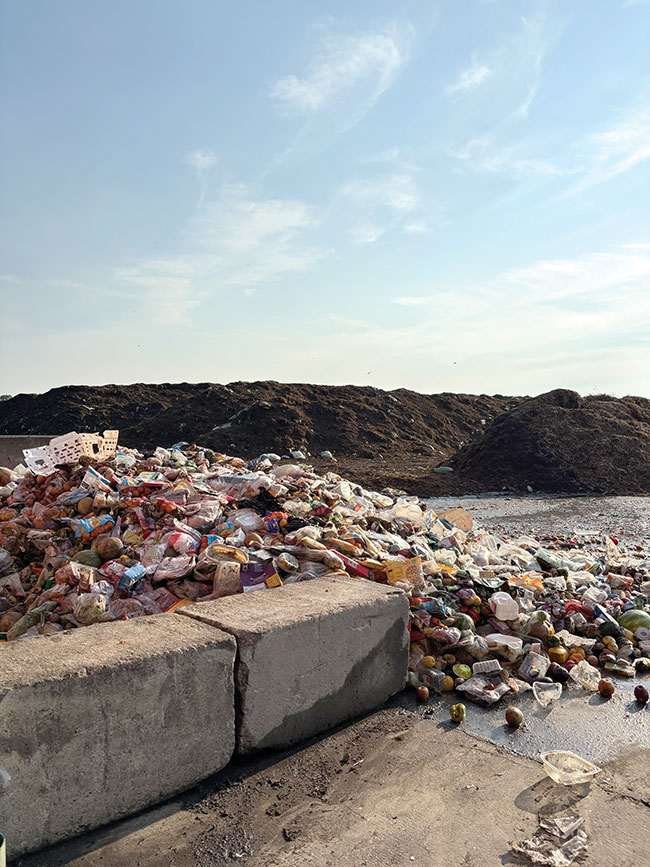
Andre Farms incorporates local food waste into its composting practices.
photo: Bree Rody
The right balance
Cummins says ACT is always trying to make the process easier, faster and more exact for their customers. That means helping to adjust the ratio of elements in the mix that lead to a better outcome.
“We don’t believe in pathogen reduction, we believe in pathogen kill,” he says. “That way we’re really making a difference.”
ACT’s livestock work began with poultry in 2001, then swine in 2003 and dairy about 10 years ago. Though chickens, turkeys and hogs remain the primary part of the industry.
“Now we’re looking at helping some of the cattlemen across the US with their beef stock,” he says.
He says the micro and macro nutrients that come out of the ACT composters make for a beautiful soil amendment. Like at Andre Farms, most of the farms use it on their own land, but some have enough to bag it and sell it, and others have enough to sell their compost in bulk volumes. This high-end amendment comes from people who understand why they are doing and why.
“We believe that training is just as important as the actual equipment,” says Cummins. “Some of our facilities will come back and retrain when they have new employees.”
He says they help farms understand the right recipe to achieve optimal results.
Mamma Mia! That’s a lot of tomatoes!
Finding the right balance and making changes based on the inputs is something Andre works with regularly. During his chat with Manure Manager, he received truck loads of tomatoes and carrots. Andre Farms takes the things that aren’t good as cow feed but work well in composting, with some adjustment. Both Nate and Paul and sons Ross and David know the ins and outs as well, as they prepare to take the farm forward for another generation.
“We never know what might be showing up,” he says. “Our compost starts out very wet because the food waste is very wet. Over the years we’ve learned what kind of pile we need to have to get the right blend of carbon and nitrogen ratios.”
They make use of silage, straw, leaves, horse manure and other carbon to help balance out the food waste. Sometimes they still do wood grinding to get coarser material.
“You need the stuff that’s more coarse to get the air space,” says Andre. You need air, that’s what creates the compost is the air.”
Ongoing learning
ACT is always ready to share new learnings according to Cummins.
“I’m staying in touch,” he says. “If they do run into issues, if they want to try something new. They found a new product and want to see if it will work. We’re always training to whatever they want to try. As long as they’ll stay at the proper levels of carbon, the nitrogen and proper water, we can give it the air, and the particle size and we can get that composting to where it needs to be.”
He says that when different elements are thrown into the mix, it can reduce the temperatures. Like when a truckload of lemons shows up. The citric acid in the peel works as an antibacterial to protect the sugars on the inside.
“This would slow a day’s worth of composting unless you break it open and change the diet to give a lot of quick energy to fight through the peel’s natural defences,” he says. “We get calls all the time and can get the process back inline within about 24 hours through understanding the elements at play.”
Obviously, with composting deadstock, time, temperature and testing are primary elements for any of the farms using an ACT system. With automated recorders, the time and temperature data is available at a moment’s notice. The temperatures are achieved by creating the proper mix within the compost, the testing of the compost proves the elimination of any pathogens. Some regions require random testing, while others are once a year.
All the states ACT works with allow for composting of deadstock and the company even assists with applying for permits and other necessary documentation. Most of the farms are small scale, but ACT has worked with some facilities at industrial composter levels.
Farms often work together to achieve economies of scale with ACT equipment and as they grow in their compost production, they can add on to the system. But there is always one element they need to look for, carbon. Andre has built long-term relationships that ensure a steady flow, but others may have to keep an eye out for opportunities.
“It’s the one piece that everyone tries to cheat [with] a bit,” says Cummins. “So we always preach to them there’s free carbon out there.” •


