
In a perfect world, manure equipment would be inexpensive, easy to find and always fit for purpose. In reality, costs are rising and sometimes equipment needs to be modified to make it more suitable for the task at hand.
This is why some farmers and commercial applicators have put on their engineering hats in order to think through a challenge, find practical solutions, and make modifications to their equipment.
“Farmers are always looking for better ways to transport, apply, or utilize the manure from their animals,” says Glen Arnold, field specialist, manure nutrient management systems and professor at Ohio State University Extension. “Modifying existing equipment that a farmer currently owns is a way to save on purchasing new equipment.”
Arnold notes that most farmers are handy with equipment such as welders and cutting torches, and they can do much of the work themselves.
“If a farmer sees a piece of equipment that is working for another farmer, they can decide if they want to buy a similar piece of equipment that is new or used,” he says, “Or they can look at the equipment they currently have and decide if it could be modified to accomplish the same task.”
Spare parts for these modifications aren’t necessarily difficult to find. “Farmers rarely throw away items they feel they might have a use for at some time in the future,” says Arnold. “There is also a substantial amount of used equipment available on social media sites such as the Facebook page Manure Kings. Local equipment dealerships also often have used equipment or used parts for sale.”
Since prices for new equipment have risen rapidly over the past few years, “Any new or used equipment purchase on the farm is going to be a significant cost,” says Arnold. That’s why it makes sense to repurpose parts from other sources.
“Farmers looking to add a drag hose system to their farm, for example, can often find used hoses from a drag hose operator who has replaced their main line hoses or drag hoses a few times,” says Arnold. “And used manure tankers become available as their owners look for newer or larger tankers. The key is to start with a mixture of new and used manure equipment and work towards upgrading equipment as the business progresses.”
When it comes to bang for the buck, some modifications offer a better return on investment than others. “For liquid manure, modifications that allow the farmer to take advantage of the nitrogen in the liquid manure might be their best return,” says Arnold. “For example, the nitrogen value in swine manure is worth more than the phosphorus and potassium values combined. If the equipment modification efforts work, this allows the farmer to capture this nitrogen so they can save money on purchased nitrogen expenses and opens additional days of the year to manure application.”
Necessity: The mother of invention
Bill Tenhove is the owner of Ten Hove’s Custom Farming, which specializes in forage harvesting, liquid manure and large square baling. Tenhove started modifying his own manure application equipment more than 30 years ago.
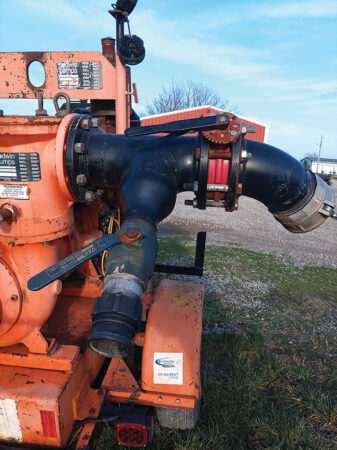
Multiple fittings were added to six-inch pumps now have more options.
“We cut our manure boom in half and spread it out because we were getting overlap,” he says. “We had to move our nozzles further apart, and we made the modification not for financial reasons, but in order to do the job right.”
Since then, Tenhove and his crew have tackled other projects. “I built a dribble bar to prevent the manure from being blown about by the wind,” he says, “We built our own manure boat, and we’re always building high-pressure manure pumps. We put Smart Turner pumps on the back of diesel engines. We use them ourselves, and we sell them to other people.”
The old adage, “Necessity is the mother of invention,” certainly applies to Tenhove’s situation. Chopping the boom in half and building a dribble bar were necessities at the time, simply because there were no solutions available for him to purchase. On the other hand, the high-pressure pumps that were commercially available were too expensive, so Tenhove decided it would be cheaper to build one himself.
“As for the manure boat,” he says, “there was one available commercially, but it was too big, too clumsy and too expensive. We actually went to [the manufacturer] to ask them to build us the kind of boat we needed, but they wouldn’t hear it, so we built one ourselves.”
Tenhove credits his employees with helping him find the solutions that made sense and made a difference. “We sat around the table, usually with a few beers, and we talked about what we should do,” he says. “Needs, wants and costs are a good way of looking at it.”
He recommends keeping things simple. “We made the boat so simple, that it’s easy to work on,” he says. “Since we’re the end-user, when we have to fix it, we’re the ones who have to get dirty. So the easier you can make it to fix, the better.”
Many of the parts that were needed for the modifications were available off-the-shelf, explains Tenhove, but many had to be custom-made. “We put a plasma table in our shop, and we also have a milling machine and a lathe,” he says. “So, we made a lot of our parts ourselves.”
The process didn’t always go as smoothly as expected, and it sometimes took a while to complete. “Things worked out as planned about 90 percent of the time,” Tenhove says, “And then we had to make some tweaks. Our manure boat took us five years to perfect, since we had some bearing problems and some pump problems. Now, we have no problems. On the other hand, the dribble bar worked as planned, right off the bat.”
New business opportunities
For some entrepreneurial individuals, like Tenhove, who not only builds high-pressure manure pumps for his own needs but also sells them to others, modified equipment can translate into new business opportunities.

The added hitch on W.D. Farms‘ honeywagon allows the machine to pull its nine-shank chisel plow.
“Some people are mechanically inclined,” says Kevin Erb, program manager, conservation professional training program, UW-Madison Division of Extension Natural Resources Institute. “They look at something sitting brand new at the dealership and say, ‘Why did they do it that way?’ and modify it before it ever hits the dirt to begin with. For other folks, the equipment that’s out there doesn’t do the job. A lot of [Wisconsin equipment companies] started out as manure applicators or farmers who knew that what they wanted, couldn’t find it on the open market, ended up creating their own, and turned it into a business.”
Erb explains that sometimes manufacturers are inspired by modifications made by famers or commercial applicators. “Thinking back to when manure agitation boats were coming out” he says, “we had two companies come out to an event with boats, along with three or four manure applicators who brought their own homemade boats to go head-to-head with the competition. Three of those four no longer build their own. They bought what industry has to offer. So, a lot of times, industry looks at these innovations, they improve on what the manure applicators and farmers have done, and then bring that to market.”
Many of the modifications and upgrades to equipment that Erb has seen over the decades have led to improved efficiencies and better crop yield. “When I first started in this industry some 30 years ago, guys were very happy to get 600 gallons a minute through a six-inch hose,” he says. “And if they did 400,000 gallons a day, they were happy. Today, I’ve got guys who constantly hit two million gallons, and others that are not happy unless they move three million gallons of manure a day.”
Besides employing larger hoses, Erb explains, these innovators have had to wrap their minds around concepts like friction loss and the need to properly space booster pumps. “The benefits are improved efficiencies and economics,” he says. “They know that every day they delay planting corn in the spring, they’re losing a bushel per acre. So if they can shave a week off their manure application, they’re saving money, and improving their yield.”
Constant improvement
Eric Dresbach, president of W.D. Farms LLC has been in the manure business since 1987. His children, Megan and David Dresbach are VPs of W.D. Farms and work alongside their father in the business.

The chisel, pulled via the honeywagon hitch, is 22.5 feet wide and on 30-inch centers.
Eric started modifying equipment in 1987. “I modified my honeywagon to be able to suck off semis,” he explains. In the many years since then, he modified the ladder on his tractor to “stair style,” started using double conical stainless steel tankers instead of straight round or ovals to reduce carry back, added a flange to a lagoon pump to make gearbox removal easier, built a pull-type chisel plow with a hitch pin versus hanging on wagon, built a three-point caddy for a drag hose spray bar, and much more.
Some of his creations made it back to the factory and were incorporated in future designs by manufacturers. “That’s life,” he says. “I could have patented my ideas, but all they would have to do is change a couple of bolts and the patent would no longer apply.”
“I think it’s a compliment,” says Negan. “The factory saw this as a good idea, and they used it.”
Good ideas seem to come to the Dresbachs on a regular basis, and they’re always working on ways to improved equipment and boost efficiencies. “We are fortunate to have more than just a farm shop,” says Eric. “We have a lot of tools and machines to do our own manufacturing. My cousin had made several modifications on his own farm, so he was a great sounding board and advice giver. Today, my son runs the shop and constantly has ideas on how to make things better, bigger, faster and safer.”
“The industry is still growing,” says Eric, “You don’t have to reinvent the wheel. Just find a wheel and then modify it to suit your situation.” •


