
Canada’s agri-food system is a mixed bag of successes and vulnerabilities when it comes to social, economic, and environmental sustainability, according to an updated assessment released by the Centre for Agri-Food Benchmarking.
The National Index on Agri-Food Performance 2025 Update, created by the centre, is meant to support the credibility and competitiveness of Canadian agriculture amidst scrutiny in business and politics worldwide.
Why it matters: Rising expectations of consumers and retailers make respected data important for the agriculture sector to support its claims.
The index is comprised of a wide range of indicators and metrics, developed with input from some 165 partners across the agri-food industry. It’s organized into four sustainability blocks: environment, food integrity, economic, and societal well-being. Key take-aways from the 2025 update are:
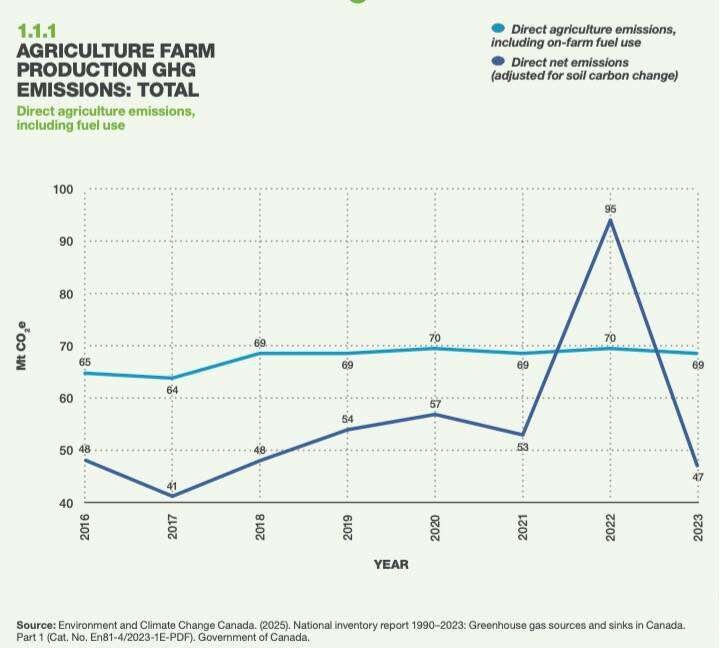
• Environment indicators: Greenhouse gas emissions have plateaued, soil health continues to improve and water quality remains strong. However, methane emissions are increasing, and rising water use signals potential future stress.
• Food integrity indicators: Food security is worsening, with one in four Canadians experiencing food insecurity in 2023, underscoring affordability as a critical social and policy issue.
• Economic indicators: The agri-food sector’s economic contributions remain steady, but face challenges. GDP output is up, yet the sector’s share of the economy has slightly declined. Rising farm debt ratios and declining research and development investment raise concerns about long-term competitiveness and innovation capacity.
• Societal well-being Indicators: Social indicators are mixed. Fatality rates are falling and wages are increasing, but mental health stress, inclusion gaps and temporary foreign worker non-compliance highlight ongoing vulnerabilities in the sector.
Amanda Richardson, executive director for the centre, says the 2025 update is also useful in identifying what sustainability areas are still missing in current assessment efforts. The absence of robust metrics for measuring pest control and biodiversity, for example, make it impossible to accurately determine if progress is being made in those areas.
“That’s a risk all on its own,” Richardson says.
“In terms of what we need to do going forward…that’s exactly the purpose of the Index is identifying what these gaps are, and to identify which ones we need to prioritize the most. Where can we put our efforts towards collecting better data”
The scale and diversity of Canadian agriculture also remains a perennial challenge in developing accurate whole-sector assessments. Richardson describes data under environmental indicators, for example, as “all over the place,” and reiterates the presence of regional differences.
Indeed, some conclusions appear to conflict with those of other regional sustainability reports.
According to the 2025 benchmarking update, for example, methane remains the dominant greenhouse gas from agriculture, increasing by 13.4 per cent year-over-year. Nitrous oxide emissions, conversely, declined by 12.3 per cent.
Informed by data from Environment and Climate Change Canada, these numbers differ from the 2025 “Report on Progress to Reduce Greenhouse Gas Emissions” from the Office of the Auditor General of Ontario. The latter states that, in Ontario, greenhouse gasses from the province’s cattle herd – the animal most often associated with agricultural methane – have dropped as the provincial herd fell by 500,000 between 2005 and 2023.
However, emissions from crop production doubled over the same period, in part driven by the conversion of land from livestock production to crop production. This increase “more than offset the emissions reductions from animal production,” and is “the main cause” of the net increase in emissions from Ontario’s agriculture sector.
Another challenge, Richardson says, is the lag time between data collection and analysis, and events occurring in real time. Things happening now or in the recent past, that is, are hard to account for in such analysis, particularly as the impacts of those events – tariffs, weather events, etc. – are often not immediately clear.
Other findings highlight longer term trends.
“Food security – I still find it to be quite a shocking statistic,” Richardson says, referring to the finding of one in four Canadians experiencing food insecurity as of 2023.
“We’re not hearing that for the first time. That’s a big number we all need to pay attention to.”
The post National benchmarking shows agri-food greenhouse gas emissions hit plateau appeared first on Farmtario.


