

Nepal’s Foreign Minister has claimed that the tragic recent events have been caused by the environmental irresponsibility of other nations and has called for compensation to be paid by the major emitters.
In an interview on Kantipur TV the minister, Shisir Khanal, said: ‘Nepal’s greenhouse gas emissions are virtually negligible. Yet, we are paying the ultimate price for a global crisis we did not create. The rapid melting of glaciers and these catastrophic mountain tsunamis are direct consequences of global climate change.
‘We are shifting our diplomatic framework from “aid” to “justice and compensation”. This is not a matter of charity; it is a matter of legal and moral liability. The major industrial emitters – such as China, which is the world’s top emitter, the United States at number two, and India at number three – have a historical responsibility to compensate vulnerable nations like Nepal.
‘To this end, the Ministry of Finance has officially dispatched a formal climate compensation claim letter to our international partners. We will be raising this issue with absolute firmness and clarity at every upcoming international forum. This is a matter of civilisational survival.
‘If our Himalayan glaciers disappear, the water security of over two billion people in South Asia – dependent on rivers like the Ganges and the Trishuli – will be permanently compromised. We are advocating not just for Nepal, but for the survival of South Asian civilisation.’
The catastrophe that was visited upon Nepal last week might itself be the cause of future disasters.
University of Michigan geoscientist Marin Clark explains that what are known as ‘cascading natural hazards’ occur when one event triggers a chain of further hazards that can threaten communities for weeks or even years. In Nepal, a new lake is forming where the initial glacial collapse occurred, creating the potential for another flood if the water is suddenly released.
Meanwhile, sediment deposited by the first flood has altered the river’s shape and reduced its capacity to carry water, increasing the risk of further flooding during future monsoons.
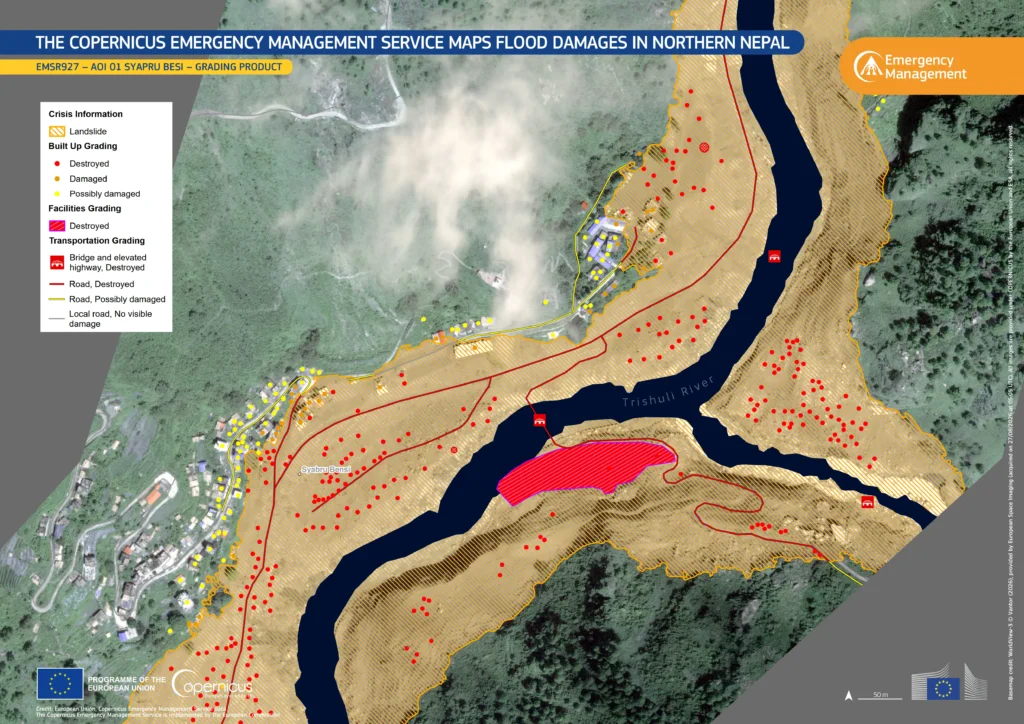
Image: European Union, Copernicus Emergency Management Service data


