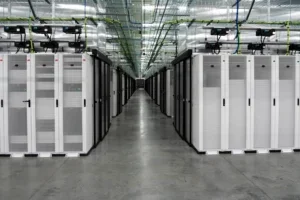
Proposed reliability standards that would require qualifying data centers, artificial intelligence facilities, and cryptocurrency operations to provide grid data, coordinate protection settings, and respond to grid operators’ instructions have passed their final stakeholder ballot, the North American Electric Reliability Corporation (NERC) announced Oct. 15.
The standards and associated implementation plans will next go before NERC’s Board of Trustees for adoption, followed by submission to the Federal Energy Regulatory Commission (FERC) for U.S. regulatory approval.
The Project 2026-02 package comprises three new reliability standards governing interconnection studies and modeling, operational data and communications, and protection coordination and disturbance monitoring. It also includes targeted revisions to two existing facility-interconnection standards intended to prevent overlapping compliance requirements.
The action advances FERC’s July 16 directive, which requires NERC to file initial computational-load reliability standards and proposed registration criteria by Dec. 31, 2026. The commission issued the order following NERC investigations documenting large data centers and cryptocurrency facilities abruptly reducing electricity consumption during grid disturbances, raising concerns about voltage stability, frequency response, and the adequacy of existing planning models.
In one widely cited incident, successive transmission faults in the Eastern Interconnection in July 2024 triggered the near-simultaneous loss of roughly 1,500 MW of data center load—not because of utility-directed disconnections, but owing to customer-side protection and controls. System frequency rose to 60.053 Hz before returning to 60.0 Hz within four minutes. “This incident demonstrates how large-scale load tripping can meaningfully affect BPS frequency,” NERC concluded in its July 2025 assessment. A separate January 2026 NERC incident review examined 26 events involving cryptocurrency mining loads in the Electric Reliability Council of Texas (ERCOT) region between January 2023 and September 2025. Each involved load reductions exceeding 100 MW, with affected facilities losing between 17% and 95% of their pre-disturbance consumption following normally cleared transmission faults.
In response to these emerging risks, NERC issued a Level 3 Essential Action Alert on May 4, calling on existing registered entities to address computational-load modeling, interconnection studies, commissioning, protection and control, disturbance monitoring, and operational coordination. The alert identified seven essential actions to improve the industry’s ability to anticipate and manage large-load behavior during grid disturbances. Although registered entities were required to acknowledge the alert and report on their responses, the actions themselves were not mandatory reliability standards.
The proposed standards form the first phase of NERC’s broader Large Loads Action Plan, which seeks to address gaps in how computational loads are studied, monitored, and coordinated with the bulk-power system (BPS). NERC has emphasized that the initial requirements establish essential reliability processes, while more technically complex performance standards remain under development.
Data Centers Subject to the New Standards
The proposed standards would apply to computational-load sites with at least 50 MW of total connected load supplied through electrical equipment connected to the BPS at 100 kV or above, including sites served from multiple points of connection.
The criteria account for different data center configurations. According to NERC’s Project 2026-02 FAQ, the 100-kV threshold generally refers to the high-side voltage of the electrical equipment supplying the site—though not necessarily the point of connection specified in an interconnection agreement. Multiple buildings can constitute a single computational-load site, which may also receive electricity from separate substations or electrical connections. The threshold represents a change from NERC’s initial registration proposal, which contemplated 20 MW and 60 kV. Following stakeholder comments, NERC raised those criteria to 50 MW and 100 kV.
A separate but closely related registration effort advanced on Oct. 8, when NERC’s board approved proposed revisions to its Rules of Procedure establishing two new functional entity categories: Computational Load Owner (CLO) and Computational Load Operator (CLOP). The board also authorized expedited development of a data request to support registration of those entities, pending FERC approval of the proposed criteria.
The new categories would allow NERC to register organizations responsible for owning and operating qualifying computational-load sites and assign the reliability requirements applicable to their respective functions. According to NERC’s Project 2026-02 FAQ, a single site could have multiple registered owners or operators, depending on who owns the equipment and who is responsible for its operation. At multitenant facilities, a centralized or shared operating function could serve as the accountable operator. Individual registration determinations would be made through NERC and its Regional Entities based on each site’s circumstances.
The registration criteria and proposed reliability standards are being developed through separate, coordinated processes. Both will require applicable FERC approval before they become enforceable.
Proposed Standards Target Modeling, Operations, and Protection
NERC’s initial package addresses three interconnected areas: planning and modeling, operational coordination, and protection and disturbance monitoring. The requirements draw on existing reliability practices for transmission and generation facilities but account for the operating characteristics of large computational loads.
Interconnection studies and modeling. The first standard, CLO-001-1, would require coordinated interconnection studies, commissioning procedures, and planning-model data for qualifying computational-load sites. Transmission planners and planning coordinators would study new interconnections and changes to existing sites meeting a planning coordinator’s definition of a “qualified change.”
The proposed modeling requirements address reliability concerns about whether existing load models adequately capture the rapid response of data center equipment and controls during grid disturbances. Computational-load owners would have to provide modeling data covering equipment tripping, ride-through capabilities, and recovery following disturbances, along with information about the amount and expected use of computing infrastructure. They would also have to verify that configurable, site-specific model parameters reflect installed equipment and provide updated verification documentation within 180 days of changes to hardware, software, firmware, or settings that alter dynamic response.
The requirements are intended to improve the accuracy of planning studies and help planners assess how computational loads could affect grid performance during disturbances, NERC explained.
Operational data and communications. The second standard, CLO-002-1, would establish operational data and communications requirements between computational-load facilities and the grid entities responsible for maintaining reliability. Transmission operators, balancing authorities, and reliability coordinators would specify the information needed for operational planning, real-time monitoring, and reliability assessments. Computational-load owners and operators receiving those specifications would be required to satisfy them.
Among its most significant provisions is Requirement R8, which would require computational-load operators to comply with operating instructions from their transmission operator, balancing authority, or reliability coordinator unless the action cannot be physically implemented or would violate safety, equipment, regulatory, or statutory requirements. Under R9, operators unable to comply would have to notify the entity issuing the instruction. The standard would also require communications capabilities between computational-load operators and their transmission operators and balancing authorities, along with procedures for communications failures and personnel training on oral operating instructions.
The requirements could affect how data centers coordinate with grid operators during emergencies and other stressed operating conditions. However, NERC has emphasized that the proposed obligations would not automatically convert firm electricity service into interruptible or non-firm service. “The foundational CLO-002-1 standard establishes essential interpersonal communications and operational response processes for Computational Load Sites,” NERC explained. “These interpersonal communication requirements are comparable to (and follow the same NERC requirement framework for) all other operators of equipment that can meaningfully impact BPS reliability. The requirements explicitly denote that responding to Operating Instructions is not required when such action cannot be physically implemented or it would violate safety, equipment, regulatory, or statutory requirements. Furthermore, nothing in the Project 2026- 02 standards changes the service priority agreed upon for Computational Load Sites.”
The operating-instruction requirements may also raise questions for multitenant data centers, where facility operators may lack direct control over tenants’ computing equipment. Although CLO-002-1 provides exceptions for instructions that cannot be physically implemented or would violate safety, equipment, regulatory, or statutory requirements, it does not expressly identify contractual limitations on an operator’s authority over tenant equipment as grounds for noncompliance.
Protection coordination and disturbance monitoring. The third standard, CLO-003-1, would establish requirements for coordinating protection-system settings and recording electrical disturbances at qualifying computational-load sites.
Computational-load owners would be required to establish and follow a process for developing protection settings so protective systems operate in the intended sequence during faults. The process would include coordinating settings across equipment owned by different entities and resolving identified coordination issues before implementing those settings.
The standard would also require sequence-of-events recording of specified circuit-breaker positions, fault recordings, and continuous dynamic disturbance data. According to NERC’s Project 2026-02 FAQ, ordinary operational telemetry may not adequately capture the rapid load responses and protection-control interactions associated with computational loads.
Higher-resolution recordings would support event analysis, model validation, and assessments of how facilities respond during grid disturbances. Responsibility for the recordings would depend on equipment ownership. Computational-load owners would be responsible for sequence-of-events data from specified circuit breakers associated with equipment they own. The entity owning the main power transformer supplying the site—whether the computational-load owner, transmission owner, distribution provider, or generator owner—would be responsible for the applicable fault and dynamic disturbance recordings.
Proposed Timeline and Future Steps
The final-ballot package also includes proposed revisions to two existing reliability standards: FAC-001-5, governing facility interconnection requirements, and FAC-002-5, governing facility interconnection studies. The revisions generally seek to clarify the applicability of the existing standards to avoid duplicative interconnection requirements for computational-load sites covered by CLO-001-1.
The proposed standards would not become enforceable until applicable regulatory approval and the relevant implementation deadlines. NERC has proposed three implementation plans establishing effective dates and phased compliance periods: one covering CLO-001-1, FAC-001-5, and FAC-002-5, one for CLO-002-1, and one for CLO-003-1.
The schedules account for dependencies between requirements, NERC explained in an August webinar. Under the CLO-001-1 implementation plan, planning coordinators would have three months after the standard’s effective date to establish qualified-change definitions, while planning coordinators and transmission planners would have the same period to develop modeling-data specifications. Applicable transmission owners, distribution providers, and generator owners would have six months to establish interconnection requirements, followed by nine months for the remaining interconnection-study, commissioning, and computational-load owner obligations. Under the CLO-002-1 implementation plan, transmission operators, balancing authorities, and reliability coordinators would have six months to establish and distribute operational-data specifications, while computational-load owners and operators would generally have 12 months to meet the corresponding data, communications, operating-instruction, and training requirements.
Disturbance monitoring would have the longest proposed transition period. Under the CLO-003-1 implementation plan, sites already operating when the standard takes effect would have 36 months to meet applicable recording requirements. Sites entering service afterward would have until 15 months after the standard’s effective date or their in-service date, whichever is later. NERC said the longer transition accounts for equipment procurement, installation, and necessary outages. Entities with sites in service within 12 months of the standard’s effective date could request extensions if circumstances beyond their control prevent installation of monitoring equipment. Protection-coordination requirements would begin after nine months.
The initial standards also leave a significant technical issue unresolved: minimum voltage and frequency ride-through performance requirements for computational loads. Ride-through refers to a facility’s ability to remain connected and operating during temporary voltage or frequency disturbances, instead of disconnecting when electrical conditions deviate from normal. For large data centers, widespread disconnections triggered by protective equipment could abruptly remove hundreds of megawatts of demand, creating additional frequency and voltage stability risks.
While CLO-001-1 would require modeling data on ride-through capabilities, interconnection requirements could incorporate ride-through criteria based on grid performance needs identified through planning studies. The package does not, however, establish industry-wide minimum voltage and frequency ride-through requirements specifying the disturbances through which computational-load facilities must remain connected, NERC explains in its project FAQ.
That work is advancing separately. According to NERC’s third-quarter Large Loads Action Plan update, its Large Loads Working Group has developed three additional Standard Authorization Requests addressing computational-load disturbance performance, the study of load losses in planning and near-term reliability assessments, and event reporting and model validation. These initiatives have been progressing through stakeholder review.
Under FERC’s July order, NERC must submit a work plan for additional computational-load reliability standards by March 1, 2027. NERC’s standards-development roadmap identifies further potential requirements covering disturbance performance, load oscillations, protection coordination, model validation, event reporting, co-located generation, and cybersecurity, with proposed standards-development activities extending into 2027 and beyond.
—Sonal Patel is senior editor at POWER magazine (@sonalcpatel, @POWERmagazine).
Editor’s note (10/16/2026): This story has been substantially expanded to include details of the proposed reliability standards, registration criteria, implementation timelines, and additional standards development underway at NERC.