
Nestlé, the Swiss food and drink giant, has committed to two major restoration projects in Brazil to generate carbon credits. The company is working with re.green, a Brazilian restoration company, and chocolatier Barry Callebaut on these projects.
They aim to cut down Nestlé’s carbon footprint. At the same time, they aim to restore degraded lands, plant native trees, and support more sustainable supply chains for cocoa and coffee.
Planting Millions: Nestlé’s Brazil Projects
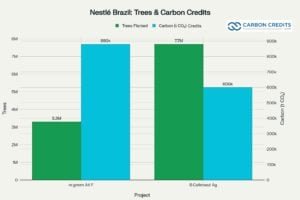
Nestlé’s deal with re.green focuses on restoring roughly 2,000 hectares in Bahia’s Atlantic Forest. Over a 30-year period, the project plans to plant around 3.3 million native trees.
Re.green estimates this will create around 880,000 tonnes of CO₂-equivalent in carbon credits. This is based on a strong ARR (Afforestation, Reforestation, and Revegetation) method.
In a second initiative, Nestlé and Barry Callebaut will work on 6,000 hectares across Bahia and Pará. This project will turn degraded land into a mixed agroforestry system—mainly cocoa trees plus native species.
The plan calls for planting 7.7 million seedlings over many years. This agroforestry system is expected to generate around 600,000 tonnes of carbon credits.
Altogether, Nestlé’s efforts in Brazil cover about 8,000 hectares and aim to plant roughly 11 million trees.
Why This Deal Matters for Climate and Business
This deal is strategically important for Nestlé on several fronts. First, it supports its climate goals. These project credits reduce carbon in the atmosphere. This helps Nestlé aim for net-zero emissions in the long run.
Second, the projects improve Nestlé’s supply chain resilience. Restoring landscapes where the company sources cocoa and coffee helps to keep these regions healthy.
Third, these are not just tree-planting projects. Restoration boosts biodiversity, enhances soil quality, safeguards water resources, and helps local communities. Using native species in the Atlantic Forest helps preserve one of Brazil’s most threatened biomes.
Finally, the deal is a signal of long-term commitment. Nestlé is more than just buying credits. It’s creating nature-based solutions that match its business and environmental goals.
Nestlé’s Roadmap to Net-Zero
- Nestlé has set bold climate targets. The company aims to plant 200 million trees by 2030 and achieve net-zero greenhouse gas emissions by 2050.
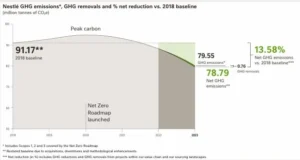
In its 2024 Non-Financial Statement, Nestlé clarifies that it will not use carbon credits outside its value chain to achieve its main net-zero goals. Instead, it invests in nature-based solutions tied directly to its sourcing regions.
Nestlé uses rigorous approaches to estimate greenhouse gas removals. It accounts for tree growth, species types, soil differences, and uses field data and science-based models. It also meets global standards, like those from the Intergovernmental Panel on Climate Change (IPCC) and the GHG Protocol. This helps ensure transparency and accuracy.
In addition to reforestation, Nestlé partners on regenerative agriculture. For instance, it has a global agroforestry initiative with OFI (Olam Food Ingredients). This program will help 25,000 farmers in Brazil, Côte d’Ivoire, and Nigeria change their farms.
- The plan includes planting 2.8 million trees and transforming more than 72,000 hectares into agroforestry systems over time.
These combined efforts show how Nestlé links carbon removal, biodiversity restoration, and sustainable farming to its broader climate strategy.
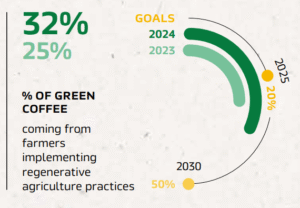
Nestlé’s Nescafé hit its 2025 target early by sourcing 32% of its coffee through regenerative agriculture in 2024. This gives it a strong lead toward the 2030 goal of 50%.
The company has invested over $1 billion. This supports more than 200,000 farmers on 400,000 hectares. They train these farmers in methods like shade trees, natural composting, and cover crops.
These practices help restore soil health and lower the need for chemicals. They have also cut greenhouse gas emissions by 20-40% per kilogram of green coffee. They also help Nestlé reach its goal of halving production-related emissions by 2030 and achieving net-zero by 2050.
Backing the Green: Funding and Market Momentum
These reforestation deals come amid strong momentum in Brazil’s nature-based carbon sector. The Brazilian Development Bank (BNDES) approved an $85 million loan for ARR projects. These projects should create about 2.47 million carbon credits.
Meanwhile, re.green itself has won fresh financing. It secured 80 million reais (approx. US$14 million) from BNDES, with Bradesco as a financial partner. The deal helps re.green scale up restoration in key biomes.
Credits from ARR projects in Brazil, especially those using high-quality methods, should trade for around $55 per tonne of CO₂ equivalent. This carbon price can vary based on deal structures.
This shows that both public and private resources are flowing into nature-based carbon solutions. For Nestlé, joining this trend offers both environmental benefits and strategic value.
Impact for Business and Nature
These contracted projects by Nestlé have a significant impact on business and nature:
- Credible Carbon Removal:
Nestlé is funding long-term restoration projects linked to its supply chain. This helps create high-integrity carbon credits instead of just buying generic ones. - Sustainable Sourcing:
Restoring tree cover in cocoa and coffee regions strengthens the ecological base of Nestlé’s ingredient supply. - Corporate Climate Leadership:
This move positions Nestlé as a leader in tying net-zero goals to meaningful, nature-based actions. - Market Signal:
Big corporate deals like this could drive more investment in restoration. This would boost Brazil’s carbon credit market and increase the supply of high-quality nature credits.
What Could Go Wrong? Nestlé’s Bold Step in Carbon Leadership
While this initiative is ambitious, its success depends on several factors. Tree survival over decades is crucial: saplings must grow, persist, and avoid being lost to fires or land-use changes. Long-term monitoring is needed to make sure the credits represent real removal.
Also, the permanence and additionality of the credits matter. Observers will watch how re.green, Nestlé, and their auditors ensure that the forest does not revert and that the project would not have happened without this financing.
Finally, the social dimension is important. Local communities must benefit, and land rights and governance issues should be handled transparently. Without community support, restoration projects often struggle.
Nestlé’s carbon credit deal with re.green and Barry Callebaut marks a significant and strategic step in its climate journey. Its net-zero strategy focuses on nature-based solutions, backed by careful accounting and long-term commitments. Public and private investors in Brazil’s carbon market are also backing this shift.
If the projects succeed, they could show big companies how to scale regenerative landscapes. This approach can help not only to offset emissions but also to build stronger business foundations.
The post Nestlé to Plant 11 Million Trees in Brazil to Generate Carbon Credits and Boost Sustainability appeared first on Carbon Credits.


