

Imagine it’s a typical weekday morning in Delhi. You leave for work and your children head to school. The house is nearly empty, yet your rooftop solar panels continue generating electricity throughout the day under the bright Delhi sun. Now here’s the question most of us must thought :
“If nobody is using electricity during the day, what happens to all the extra power generated by my solar panels?“
Does it get wasted? Do you lose it? Or does the electricity company pay you for it? The answer lies in something called Net metering.
For many homeowners, terms like net meter, DISCOM approval, grid synchronization, export units, and energy credits can sound technical and overwhelming. However, understanding net metering is essential because it directly impacts how much value you get from your rooftop solar system.
In this guide, we’ll explain the latest net metering rules in Delhi, who is eligible, how the approval process works, how it connects with PM Surya Ghar Yojana, and how homeowners can maximize long-term solar savings.
Net Metering Rules in Delhi 2026: What Homeowners Need to Know
Let’s understand this with a simple example. Imagine your solar system generates 20 units of electricity today, but your home only consumes 12 units. Instead of letting the remaining 8 units go unused, they are automatically sent to the electricity grid. Through net metering, those extra units help reduce the electricity you draw from the grid later.
This ensures that the electricity generated by your rooftop solar system continues creating value even when it is not being used instantly.
For installing rooftop solar under the PM Surya Ghar Yojana, net metering is an important part of the overall solar ecosystem, enabling better utilization of solar energy and improved savings.
Who Is Eligible for Net Metering in Delhi?
Net metering in Delhi is generally available to residential consumers who install a rooftop solar system and have a valid electricity connection in their name. Since solar regulations and eligibility requirements may evolve over time, homeowners should always review the latest residential rooftop solar policies applicable in Delhi before proceeding with installation. To be eligible, homeowners generally need:
- A valid electricity connection
- Adequate shadow-free rooftop space
- Property ownership or authorization documents
- A rooftop solar system that complies with utility requirements
Which DISCOM Handles Your Application?
The DISCOM responsible for processing your net metering application in Delhi depends on the location of your property.
| DISCOM | Full Name | Areas Generally Covered |
| BRPL | BSES Rajdhani Power Limited | South Delhi and West Delhi |
| BYPL | BSES Yamuna Power Limited | East Delhi and Central Delhi |
| TPDDL | Tata Power Delhi Distribution Limited | North Delhi and North-West Delhi |
| NDMC | New Delhi Municipal Council | NDMC service areas and parts of Central Delhi |
Tip: If you’re unsure which DISCOM serves your area, check your electricity bill. The utility name is usually displayed at the top.
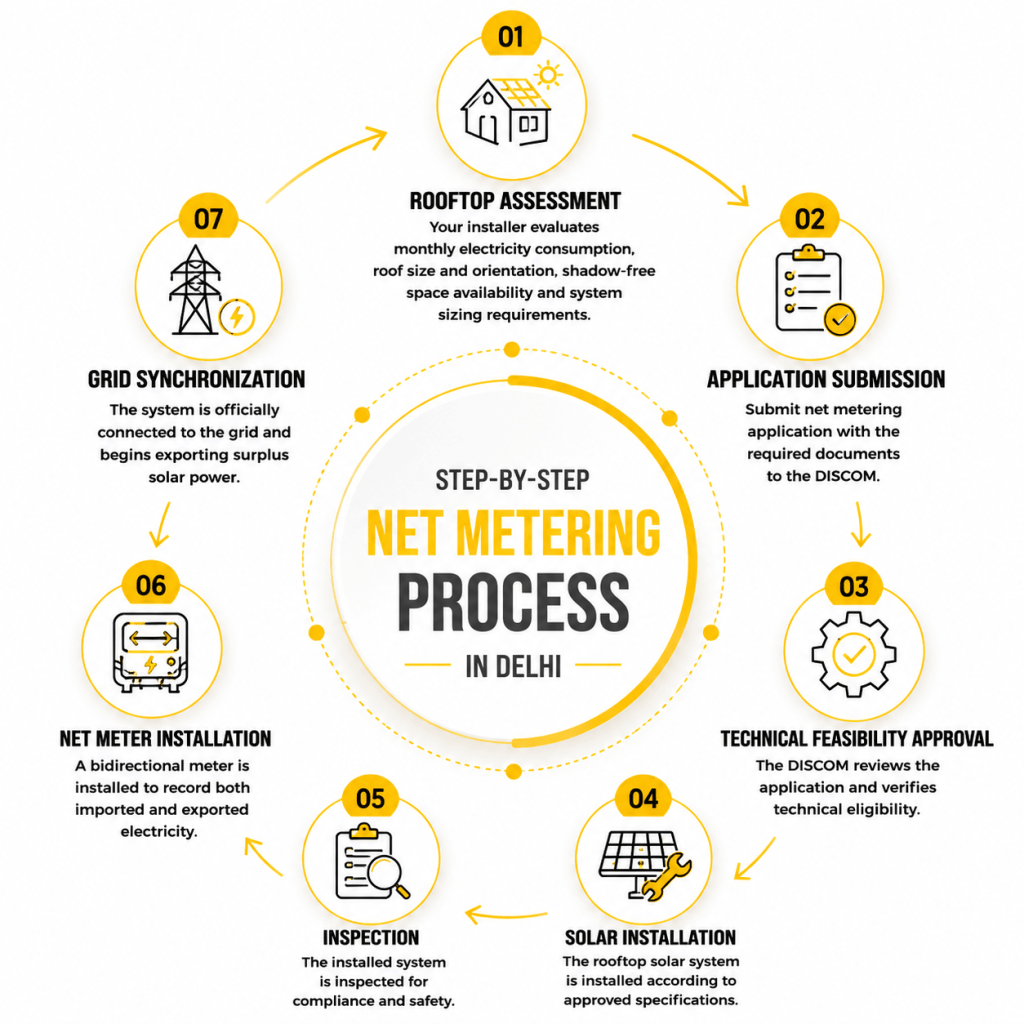
Step-by-Step Net Metering Process in Delhi
Step 1: Rooftop Assessment
Your installer evaluates:
- Monthly electricity consumption
- Roof size and orientation
- Shadow-free space availability
- System sizing requirements
Step 2: Application Submission
Homeowners who want a more detailed breakdown of inspections, approvals, and meter installation stages can also explore MYSUN’s complete guide to the net metering process.
Pro Tip: Ensure that the mobile number linked to your electricity connection is active and updated. Most application-related OTPs and approvals are sent to this registered number.
Step 3: Technical Feasibility Approval
The DISCOM reviews the application and verifies technical eligibility.
Step 4: Solar Installation
The rooftop solar system is installed according to approved specifications.
Step 5: Inspection
The installed system is inspected for compliance and safety.
Step 6: Net Meter Installation
A bidirectional meter is installed to record both imported and exported electricity.
Step 7: Grid Synchronization
The system is officially connected to the electricity grid and begins exporting surplus solar power.
Before You Apply, Keep These Documents Ready
Most residential applicants typically need:
- Latest electricity bill
- Identity proof
- Address proof
- Property ownership documents
- Solar system specifications
- Application forms and declarations
Keeping these documents ready can help avoid unnecessary delays during the approval process.
How Long Does the Entire Process Usually Take?
While timelines may vary depending on the DISCOM and application completeness, most residential net metering applications are generally completed within 30–45 days.
Delays are often caused by:
- Incomplete documentation
- Mobile number mismatches
- Pending inspections
- Technical clarifications
Working with an experienced solar partner can help streamline the process.
How PM Surya Ghar Yojana Works with Net Metering
One of the most common misconceptions is that subsidy and net metering are two separate benefits. In reality, they complement each other. While the PM Surya Ghar Yojana helps reduce the upfront cost of installing solar, net metering helps you maximize savings after the system is installed. PM Surya Ghar Yojana Helps You:
- Reduce upfront installation costs
- Access government subsidy benefits
- Improve project affordability
Net Metering Helps You:
- Earn value from surplus solar generation
- Reduce electricity bills
- Improve long-term returns from your solar investment
Together, these benefits make rooftop solar significantly more attractive for residential consumers.
Real-World Impact: Do These Savings Actually Work?
Many of us still assume solar only works if someone is home during the day. However, net metering allows you to benefit from solar generation even when your house is empty.
Consider two typical Delhi households. One installed a 3kW rooftop solar system and previously paid around ₹6,000 per month in electricity bills. Another opted for a 5kW system and was spending more than ₹8,000 per month, primarily due to higher air-conditioning usage.
On average, their solar systems generated approximately 350–450 units and 600–750 units of electricity per month, respectively. Since both families were away during working hours, a large portion of the solar power generated during the day was exported to the grid through net metering.
The exported units were then adjusted against the electricity consumed during the evening and night, when the families returned home. As a result, their dependence on grid electricity reduced significantly, leading to lower monthly electricity bills and better overall returns from their solar investment.
Things Homeowners Often Get Wrong About Net Metering
| Myth | Reality |
| Solar will completely eliminate my electricity bill. | Savings depend on system size, consumption patterns, and applicable charges. |
| Extra solar power gets wasted. | Surplus electricity is exported to the grid and adjusted through net metering. |
| Solar only works if someone is home all day. | Working families benefit significantly because the daytime generation earns credits. |
| Net metering is complicated. | With the right solar partner, approvals and documentation are generally straightforward. |
Typical Solar Generation in Delhi
The amount of electricity generated depends on roof orientation, shading, weather conditions, and system performance. However, homeowners can use the following estimates as a reference:
| System Size | Estimated Monthly Generation | Estimated Annual Generation |
| 3kW | 350–450 Units | 4,500–5,400 Units |
| 5kW | 600–750 Units | 7,200–9,000 Units |
| 10kW | 1,200–1,500 Units | 14,000–18,000 Units |
These figures can help homeowners estimate the potential value of rooftop solar before making an investment decision.
Can Apartment Owners Benefit from Net Metering?
Yes, depending on the applicable regulations and project structure.Apartment residents and housing societies may be able to benefit through:
Group Net Metering: Allows a consumer with multiple electricity connections (e.g., an independent building owner with multiple floors/meters) to generate solar energy on one roof and distribute the solar net metering credits across separate electricity connections.
Virtual Net Metering: Designed for residential societies and apartments. Solar panels are installed on a communal rooftop or shared area, and the net metering benefits are split proportionally among the electricity bills of participating residents
These mechanisms help extend the benefits of rooftop solar beyond individual independent homes and encourage broader adoption across residential communities.
Why More Delhi Homeowners Are Choosing Solar in 2026
A few years ago, most homeowners viewed solar as something only environmentally conscious people installed. Today, the conversation has changed. Rising electricity bills, longer AC usage during Delhi summers, and government-backed schemes such as PM Surya Ghar have made solar a practical financial decision for many families. More homeowners are now looking at rooftop solar not just as a way to generate clean energy, but as a way to gain greater control over future electricity expenses.
When combined with net metering, rooftop solar becomes more than just an energy solution—it becomes a long-term financial investment that helps homeowners gain greater control over their electricity costs.
Final Thoughts
If you’ve been considering rooftop solar but felt unsure about how net metering works, you’re not alone. It’s one of the most common questions homeowners ask before making the switch. The good news is that once you understand how surplus electricity is credited and adjusted, the concept becomes surprisingly straightforward. More importantly, it helps ensure that every unit generated on your roof continues working for you. For Delhi homeowners exploring solar in 2026, understanding net metering today can help you make a smarter investment tomorrow.
Don’t let upfront costs keep your household locked into paying high electricity bills. So whether you’re exploring subsidy eligibility, net metering approvals, or system sizing, MYSUN can help simplify the entire process. Let our regional NCR experts design a zero-stress financial path to total energy independence.
 Contact our solar advisors today: 8448380218
 Email: hello@itsmysun.com
 Try the MYSUN Solar Calculator to check your savings now.
The post Net Metering in Delhi 2026: Rules, Process, Savings & PM Surya Ghar Benefits Explained appeared first on Rediscover the Sun with MYSUN – Solar Power Company in India.


