
Idaho National Laboratory (INL) has partnered with NVIDIA to launch a major project that uses artificial intelligence (AI) to speed up nuclear reactor development. The initiative aims to cut reactor build times by up to 50% and reduce operating costs by a similar margin.
ezstandalone.cmd.push(function () { ezstandalone.showAds(119); });
The project, called Prometheus, focuses on using AI across the full nuclear lifecycle. This includes reactor design, licensing, construction, and daily operations. The goal is to deploy reactors in years instead of decades.
Today, building a nuclear plant can take 15 to 20 years from planning to operation. This long timeline has slowed the growth of nuclear energy, even as demand for clean and reliable power increases.
ezstandalone.cmd.push(function () { ezstandalone.showAds(127); });
The Prometheus project aims to remove these delays by combining advanced computing with human oversight. Engineers will still guide decisions, but AI will handle complex modeling, data analysis, and repetitive tasks.
DOE’s Genesis Mission Drives AI Adoption
The Prometheus project is part of a broader federal program led by the U.S. Department of Energy (DOE). Known as the Genesis Mission, the program aims to double the impact of U.S. science and engineering within a decade.
ezstandalone.cmd.push(function () { ezstandalone.showAds(128); });
Launched in November 2024, the initiative promotes the use of AI across all 17 national laboratories. It focuses on solving major challenges in energy, manufacturing, and national security.
The DOE has committed $293 million in funding through a competitive program. This funding supports more than 20 national challenges, including nuclear energy, advanced materials, and grid systems.
ezstandalone.cmd.push(function () { ezstandalone.showAds(129); });
The agency has also signed agreements with 24 organizations, including Amazon Web Services, Google, Microsoft, OpenAI, and NVIDIA. These partnerships give national labs access to advanced AI tools and cloud computing systems.
By combining public research with private sector technology, the DOE aims to speed up innovation and reduce development costs.
ezstandalone.cmd.push(function () { ezstandalone.showAds(130); });
AI Energy Demand Creates Urgency for Nuclear Power
The partnership also responds to a growing energy challenge. AI systems require large amounts of electricity, especially in data centers.
According to the International Energy Agency, global data centers used about 415 terawatt-hours (TWh) of electricity in 2024. This is close to the total annual power consumption of a country like Japan.
Demand is expected to rise sharply as AI adoption expands. This creates pressure on power grids and increases the need for stable, low-carbon electricity.
ezstandalone.cmd.push(function () { ezstandalone.showAds(131); });
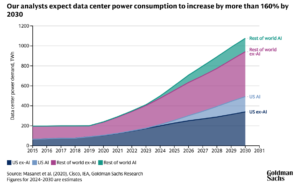
Nuclear energy offers a solution. Unlike solar and wind, it provides constant baseload power. This makes it well-suited for energy-intensive AI systems that must run 24 hours a day.
The partnership creates what researchers describe as a “virtuous cycle.” AI helps speed up nuclear deployment, while nuclear energy supplies the power needed for AI growth.
How NVIDIA’s GPUs Are Rewiring Nuclear Engineering
NVIDIA brings key technology to the project. Its graphics processing units (GPUs) are widely used for AI and high-performance computing.
ezstandalone.cmd.push(function () { ezstandalone.showAds(132); });
These systems can speed up complex simulations used in nuclear engineering. Tasks that once took weeks can now be completed in days or even hours.
The project will improve several major nuclear codes, including MOOSE, BISON, Griffin, and Pronghorn. These tools model reactor physics, heat transfer, and fuel performance.
NVIDIA also provides tools for real-time operations. Its systems can help balance workloads and improve energy efficiency in data centers. The company reports that some of its solutions can reduce peak power demand and improve system performance.
ezstandalone.cmd.push(function () { ezstandalone.showAds(133); });
Another key platform is NVIDIA’s Omniverse. This system creates digital twins, or virtual models of real-world systems. In nuclear energy, digital twins can simulate plant operations, test safety scenarios, and improve maintenance planning.
These tools allow engineers to test designs and operations before building physical systems. This reduces risk and lowers costs.
Real-World Testing at U.S. Nuclear Facilities
The Prometheus project will use existing facilities at INL to test its AI systems.
ezstandalone.cmd.push(function () { ezstandalone.showAds(134); });
One key site is the Neutron Radiography Reactor (NRAD). This research reactor supports testing of nuclear fuel and materials. It provides a controlled environment to validate AI models without affecting commercial operations.
Another facility is MARVEL, a small microreactor under development. It is expected to produce about 85 kilowatts of electricity and connect to a nuclear microgrid by 2027 or 2028.
MARVEL will serve as a test platform for AI-driven reactor control. This includes automated load management and predictive maintenance. Its smaller size and advanced safety features make it suitable for early-stage testing.
ezstandalone.cmd.push(function () { ezstandalone.showAds(135); });
The project will use a mix of computing systems. Large supercomputers will handle training and complex simulations. Local AI systems will manage real-time operations inside nuclear facilities. This hybrid approach balances performance, security, and reliability.
Can AI Finally Fix Nuclear’s Cost Problem?
The partnership could have a major economic impact. Nuclear projects often face delays and cost overruns.
For example, the Vogtle Units 3 and 4 project in the United States experienced more than 100% cost increases and delays of over seven years. These challenges have made investors cautious about new nuclear builds.
ezstandalone.cmd.push(function () { ezstandalone.showAds(136); });
AI tools could reduce these risks. By identifying problems early, they can prevent costly changes during construction.
The DOE expects the project to expand beyond INL and NVIDIA. Future partners may include reactor developers, utilities, and investors. This open model could help build a full ecosystem for AI-driven nuclear deployment.
Market demand is also growing. Analysts at Goldman Sachs estimate that 85 to 90 gigawatts (GW) of new nuclear capacity may be needed by 2030 to support global data center growth. This creates strong demand for faster and more efficient reactor development.
ezstandalone.cmd.push(function () { ezstandalone.showAds(137); });
Why Faster Nuclear Could Be a Climate Game-Changer
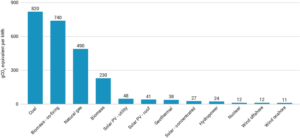
Nuclear energy plays an important role in reducing emissions. According to the Intergovernmental Panel on Climate Change, nuclear power produces about 12 grams of CO₂ per kilowatt-hour over its lifecycle.
This is much lower than fossil fuels. Coal produces around 820 grams, while natural gas produces about 490 grams per kilowatt-hour.
As electricity demand rises, low-carbon power sources become more important. AI-driven growth in data centers could increase emissions if powered by fossil fuels.
ezstandalone.cmd.push(function () { ezstandalone.showAds(138); });
By enabling faster nuclear deployment, the Prometheus project supports climate goals. It helps provide reliable, low-emission electricity at scale.
The project also aligns with broader ESG priorities. These include improving energy efficiency, reducing system costs, and strengthening energy security.
AI Could Slash Nuclear Red Tape
One of the most ambitious goals of the project is to speed up nuclear licensing. Today, the approval process can take 5 to 10 years. This adds uncertainty and increases project costs.
ezstandalone.cmd.push(function () { ezstandalone.showAds(139); });
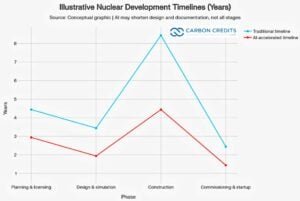
AI systems could help by generating safety reports, environmental studies, and regulatory documents. These tools can also identify issues early in the design phase.
By improving consistency and speed, AI could make nuclear projects more attractive to investors. Faster approvals would also support the deployment of standardized reactor designs, including small modular reactors.
The INL–NVIDIA partnership marks a major step in combining AI and nuclear energy. By targeting 50% faster deployment and lower costs, the Prometheus project aims to solve long-standing challenges in the nuclear sector.
ezstandalone.cmd.push(function () { ezstandalone.showAds(140); });
The initiative also addresses a growing need for reliable, low-carbon power. As AI systems expand, energy demand will continue to rise.
If successful, the project could reshape how nuclear reactors are designed, built, and operated. It may also create a model for using AI to solve other complex energy challenges.
For policymakers, investors, and industry leaders, Prometheus represents a key test of how advanced technology can accelerate the global energy transition.
ezstandalone.cmd.push(function () { ezstandalone.showAds(141); });
The post NVIDIA and Idaho National Laboratory Launch AI Project to Cut Nuclear Build Time in Half appeared first on Carbon Credits.


